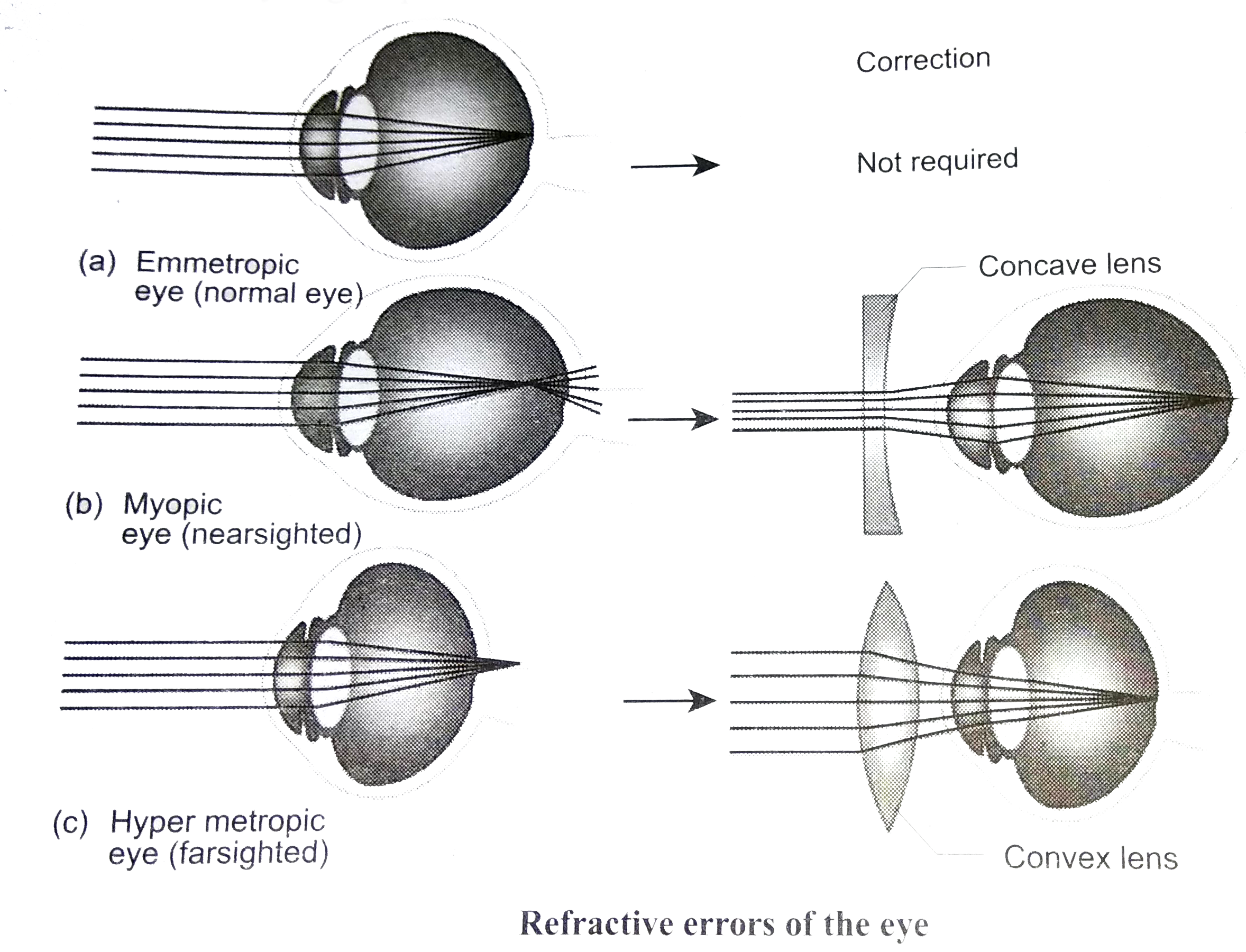
Refractive errors of eye:
Myopia (near sightedness): The affected person can see the nearby objects but not the distant objects. This condition may result due to an elongated eyeball or thickened lens, so that the image of distant object is formed in front of the yellow spot. This error can be corrected using concave lens that diverge the entering light rays and focuses it on the retina.
Hypermetropia (long sightedness): the affected person can see only the distant objects clearly but not the objects nearby. This condition results due to a shortened eyeball and thin lens, so the image of closest object is converged behind the retina. This defect can be overcome by using convex lens that converge the entering light rays on the retina.
Preshyopia : Due to aging, the lens loses elasticity and the power of accommodation. Convex lenses are used to correct this defect.
Astigmatism is due to the rough (irregular) curvature of cornea or lens. Cylindrical glasses are used to correct this error.
Cataract : Due to the changes in nature of protein, the lens becomes opaque. It can be corrected by surgical procedures.