Home
Class 11
PHYSICS
A particle is projected from the top of ...

A particle is projected from the top of a tower of height H. Initial velocity of projection is u at an angle ` theta` above the horizontal . Particle hits the ground at a distance R from the bottom of tower. What should be the angle of projection `theta` so that R is maximum ? What is the maximum value of R?

Text Solution

Verified by Experts
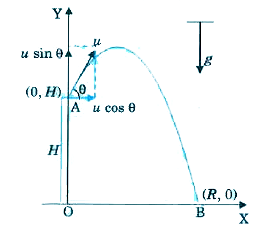
Refer to below given figure .

We have selected botton of the tower O as the origin . Horizontal direction is X-axis and vertically upward direction is selected as Y-axis A is the point of projection and B is the point where particle hits the ground . Coordinqates of the initial point a are (0. H) and for the final point (R, 0). components of displacement along X-axis and Y-axis can be written as followings:
`S_(x)=R-0=R,`
`S_(y)=0-H=-H`
Acceleration due to gravity is vertically downwards , hence components can be written as follows :
`a_(x)=0,`
`a_(y)=-g`,
Components of initial velocity are as follows :
`u_(x)=u cos theta`,
`u_(y)=u sin theta`,
X-axis: `S_(x)=u_(x)t+(1)/(2)a_(x)t^(2)`
`rArr =(u cos theta) t rArr t =(R)/(u cos theta)`
Y-axis: `S_(y)=u_(y)t+(1)/(2)a_(y)t^(2)`
`rArr-H=(u sin theta) t+(1)/(2)(-g)t^(2)`
Substituting t from equation (i) , we get the following :
`rArr -H=( u sin theta) ((R)/(u cos theta))-(g)/(2)((R)/(u cos theta))^(2)`
`rArr -H=R tan theta-(gR^(2))/(2u^(2))(1+tan^(2) theta)`
`rArr -2u^(2)H=2u^(2)Rtan theta-gR^(2)(1+tan^(2) theta)`
`rArr -2u^(2)H=2u^(2)R tan theta-gR^(2)-gR^(2)-gR^(2)tan^(2) theta`
`rArr gR^(2) tan^(2) theta-2u^(2) R tan theta+(gR^(2)-2u^(2)H)=0`
Discriminate of above equation must be greater than zero for real value of tan `theta` .
`Delta ge 0`
`rArr 4u^(4)R^(2)-4gR^(2)(gR^(2)-2u^(2)H) ge 0`
`rArr u^(4)-g(gR^(2)-2u^(2)H) ge0`
`rArr u^(4)-g^(2)R^(2)+2gu^(2)H ge 0`
`rArr g^(2)R^(2) le u^(4)+2 "gu"^(2)H`
`rArr R le (u)/(g)sqrt(u^(2)+2gH)`
Hence maximum range can be written as followings:
`rArr R_("max")=(u)/(g)sqrt(u^(2)+2gH)`
If discriminant of a quadratic equation `ax^(2)+bx+c=0` is zero , then equal roots can be written as `x=-b//2a` . If we assume R equal to `R_("max")` described by equation (ii), then we can understand that discriminant of the equation (ii) will be zero , hence `tan theta` for the equation can be written as follows:
`tan theta =(2Ru^(2))/(2gR^(2))=(u^(2))/(gR)`
Substituting value of R from equation (iii) , we get the following :
`tan theta=(u^(2))/(g(u)/(g)sqrt(u^(2)+2gH)`
`rArr tan theta=(u)/(sqrt(u^(2)+2gH)`
`rArr theta=tan^(-1)((u)/(sqrtu^(2)+2gH))`
Promotional Banner

Topper's Solved these Questions

  • MOTION IN A PLANE

    MODERN PUBLICATION|Exercise NCERT FILE (Solved) NCERT (Textbook Exercises)|25 Videos
  • MOTION IN A PLANE

    MODERN PUBLICATION|Exercise NCERT FILE (Solved) (NCERT (Additional Exercises))|7 Videos
  • MOTION IN A PLANE

    MODERN PUBLICATION|Exercise Conceptual Questions|23 Videos
  • MECHANICAL PROPERTIES OF FLUIDS

    MODERN PUBLICATION|Exercise Chapter Practise Test|16 Videos
  • MOTION IN A STRAIGHT LINE

    MODERN PUBLICATION|Exercise CHAPTER PRACTICE TEST|16 Videos

Similar Questions

Explore conceptually related problems

A ball is projected horizontal from the top of a tower with a velocity v_(0) . It will be moving at an angle of 60^(@) with the horizontal after time.

A particle is thrown horizontally from a tower of height 20m . If the speed of projection is 20m/s then the distance of point from the tower,where the particle hit the ground is:-

A particle is projected in air with an initial velocity u directed at an angle theta above horizontal. After time t_(0) the velocity of the particle is directed at angle phi above horizontal.

A particle is projected from the top of a tower of height h with a speed u at an angle theta above the horizontal . T_(1) =Time taken by the projectile to reach the height of tower again . T_(2) =Time taken by the projectile to move at right angle to initial direction of motion . V_(1) =Speed of the projectile when it moves at an angle theta//2 with the horizontal . V_(2) =Speed with projectile strikes the ground . .

A stone is projected at an angle alpha to the horizontal from the top of a tower of height 3h. If the stone reaches a maximum height 'h', above the tower, show that it reaches the ground at a distance 6h cot alpha from the foot of the lower.

A particle is projected from ground with some initial velocity making an angle of 45^(@) with the horizontal. It reaches a height of 7.5 m above the ground while it travels a horizontal distance of 10 m from the point of projection. The initial speed of the projection is

A particle of mass m is projected with an initial velocity U at an angle theta to the horizontal. The torque of gravity on projectile at maximum height about the point of projection is

A particle is projected horizontal with a speed u from the top of plane inclined at an angle theta with the horizontal. How far from the point of projection will the particle strike the plane?

A particle is projected from the ground with an initial speed of v at an angle theta with horizontal. The average velocity of the particle between its point of projection and highest point of trajectroy is :

