Home
Class 11
PHYSICS
A ball is projected with initial speed u...

A ball is projected with initial speed u at an angle `theta` above the horizontal . Calculate the time after which ball will be moving at right angle to its initial velocity.

Text Solution

Verified by Experts
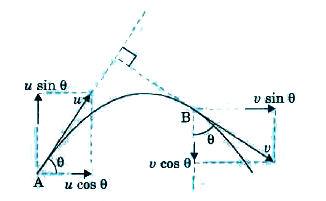
Let particle be projected from the point A and its velocity become perpendicular to its initial velocity at point B as shown in the figure . Let velocity of the ball at point B be v . Refer to the figure to understand that velocity at point B will make an angle ` theta` with the vertical.

Components of velocities are shown in figure . We know that horizontal component of velocity remains constant, hence we can write the following:
`v sin theta =u cos theta`
`rArr v=(u cos theta)/(sin theta)`
Let us asume upward direction as positive direction and apply equation of kinematics .
`v_(y)=u_(y)+a_(y)t`
`rArr (-v cos theta)=(u sin theta)+ (-g) t`
Substituting value of v from equation (i), we get the following:
`"gt"=u sin theta+(u cos theta)/( sin theta) cos theta`
`t=(u)/(g) cosec theta`
Promotional Banner

Topper's Solved these Questions

  • MOTION IN A PLANE

    MODERN PUBLICATION|Exercise NCERT FILE (Solved) NCERT (Textbook Exercises)|25 Videos
  • MOTION IN A PLANE

    MODERN PUBLICATION|Exercise NCERT FILE (Solved) (NCERT (Additional Exercises))|7 Videos
  • MOTION IN A PLANE

    MODERN PUBLICATION|Exercise Conceptual Questions|23 Videos
  • MECHANICAL PROPERTIES OF FLUIDS

    MODERN PUBLICATION|Exercise Chapter Practise Test|16 Videos
  • MOTION IN A STRAIGHT LINE

    MODERN PUBLICATION|Exercise CHAPTER PRACTICE TEST|16 Videos

Similar Questions

Explore conceptually related problems

A body of mass m is projected with intial speed u at an angle theta with the horizontal. The change in momentum of body after time t is :-

A body is projected with speed u at an angle theta to the horizontal to have maximum range. Its velocity at the highest point will be ___.

A particle is projected with initial speed u at an angle theta above the horizontal . Let A be the point of projection , B the point where velocity makes an angle theta //2 above the horizontal and C the highest point of the trajectory . Radius of curvature of the trajectory at point A is

A particle is projected with initial speed u at an angle theta above the horizontal . Let A be the point of projection , B the point where velocity makes an angle theta //2 above the horizontal and C the highest point of the trajectory . Radius of curvature of the trajectory at point C is

A particle is projected with initial speed u at an angle theta above the horizontal . Let A be the point of projection , B the point where velocity makes an angle theta //2 above the horizontal and C the highest point of the trajectory . Radius of curvature of the trajectory at point B is

A particle is projected from a point P with a velocity v at an angle theta with horizontal. At a certain point Q it moves at right angles to its initial direction. Then

A particle is project d from point A with velocity u at an angle alpha with horizontal. In its parabolic path, at point P the particle is moving at right angles to its initial direction of projection. Its velocity at P is:

A particle is projected with speed 10 m//s at angle 60^(@) with the horizontal. Then the time after which its speed becomes half of initial.

A particle is projected from a point O with a velocity u at an angle alpha (upwards) to the horizontal. At a certain point P it moves at right angles to its initial direction. It follows that:

Knowledge Check

  • A body of mass m is projected with intial speed u at an angle theta with the horizontal. The change in momentum of body after time t is :-

    A
    m u `sin theta`
    B
    2 m u `sin theta`
    C
    m g t
    D
    zero
  • A particle is projected with initial velocity u making an angle alpha with the horizontal, its time of flight will be given by

    A
    `(2usinalpha)/(g)`
    B
    `(2u^(2)sinalpha)/(g)`
    C
    `(usinalpha)/(g)`
    D
    `(u^(2)sinalpha)/(g)`
  • A particle is projected with initial speed u at an angle theta above the horizontal . Let A be the point of projection , B the point where velocity makes an angle theta //2 above the horizontal and C the highest point of the trajectory . Radius of curvature of the trajectory at point A is

    A
    `(u^(2))/(g cos theta)`
    B
    `(2u^(2))/(g cos theta)`
    C
    `(u^(2))/(2 g cos theta)`
    D
    `(u^(2) cos theta)/(g)`

