Home
Class 12
PHYSICS
A uniform electric field and a uniform m...

A uniform electric field and a uniform magnetic field are acting along the same direction in a certain region. If an electron is projected along the direction of the fields with a certain velocity then

Text Solution

Verified by Experts
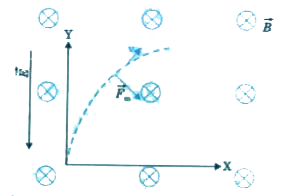
Refer to the figure to understand the described situation. We have shown the X-Y plane on paper. Electric field is applied along negative Y-axis, hence it will drive the electron along Y-axis att0. Just after t = 0, the magnetic force starts acting on the particle along X-axis because the magnetic field is directed along negative Z-axis, or inwards in the figure. This way the electron is moved on the X-Y plane. The magnetic force always remains perpendicular to velocity as well as magnetic field and hence electron remains restricted to X-Y plane only and moves along the path as shown in the figure.

Displacement of electron along Y-axis first increases and then when the velocity of electron becomes perpendicular to Y-axis (or electric field) its Y-coordinate starts decreasing. The meaning of velocity being perpendicular to Y-axis is that the Y-component of velocity becomes zero for that instant. But firstly, we can understand that the velocity of electron in general is having only two components, which are along X and Y-axes only.
So the velocity of electron at any instant of time can be written as follows:
`vecv = v_(x) hati + v_(y) hatj`
Now, the Lorentz force on electron can be written as follows:
`vecF = - e vecE - evecv xx vecB`
`rArr" " vecF = - e (- E hatj) - e (v_(x) hati + v_(y) hatj) xx (-B hatk)`
`rArr " " vecF = eEhatj + e (v_(x)B hati + v_(y) B hatj) xx (hatk) `
`rArr" " vecF = eE hatj - eBv_(x) hatj + eBv_(y) hati`
` rArr" " vecF = eBv_(y) hati + (eE - eBv_(x))hatj`
Hence, we have got the X and Y-components of instantaneous force acting on the electron. Hence we can write the following equations:
`m (dv)/(dt) = eBv_(y) rArr (dv)/(dt) = (eB)/m v_(y) ` ...(i)
` m (dv)/(dt) = eE - eBv_(x) rArr (dv_(y))/(dt) = (eE)/m - (eB)/m v_(x)` ...(ii)
Let us differentiate equation (ii) to get the following:
`(d^(2)v_(y))/(dt^(2)) = - (eB)/m (dv)/(dt) ` .....(iii)
Now substituting `(dv_(x))/(dt)` from equation (i) in equation (iii) we get the following :
`(d^(2)v_(y))/(dt^(2)) = - (eB)/m ((eB)/mv_(y))`
` rArr" " (d^(2)v_(y))/(dt^(2)) = -( (eB)/m)^(2) v_(y)`
` rArr " " (d^(2) v_(y))/(dt^(2)) = - omega^(2) v_(y)` ...(iv)
Here, `omega = (eB)/m`
We can see that equation (iv) is same as the equation of SHM. Thus, we can write `v_(y)` , as follows:
`v_(y) = A sin (omegat + delta) ` ......(v)
We have two conditions to be used for equation (v).
At ` t = 0 , v_(y) = 0 " and at " t = 0 , a_(y) = dv_(y)//dt = eE//m`.
On substituting these two conditions in equation (v) we get the following:
`delta = 0 " and " A = e E//m omega = E//B`. Hence, the Y-component of velocity can finally be written as follows:
` v_(y) = E/B sin omega t ` .....(vi)
We have to find maximum displacement along Y-axis, which is the instant when
` v_(y) = 0 `
From equation (vi) we get
`sin omega t = 0 rArr omega t = pi rArr t = pi//omega = pi m//e B` Further , we can write equation (vi) as follows :
`(dy)/(dt) = E/B sin omegat rArr dy = E/B sin omega t dt `
`rArr " " underset(0)overset(y) int dy = E/B underset(0)overset(t=pi m//eB) int sin omegat dt `
` rArr " " y = E/B [ - (cos omegat)/omega]_(0)^(pim//eB) `
` rArr" " y = E/(B omega) [- cos omega t]_(0)^(pi m//eB) `
` rArr" " y = E/(B(eB)/m) [1 - cos ((eB)/m (pi m)/(eB))] = (2 m E)/(eB^(2))`
Promotional Banner

Topper's Solved these Questions

  • MOVING CHARGES AND MAGNETISM

    MODERN PUBLICATION|Exercise NCERT FILE (NCERT Textbook Exercises)|13 Videos
  • MOVING CHARGES AND MAGNETISM

    MODERN PUBLICATION|Exercise NCERT FILE (NCERT Additional Exercises)|15 Videos
  • MOVING CHARGES AND MAGNETISM

    MODERN PUBLICATION|Exercise Conceptual Questions|29 Videos
  • MAGNETISM AND MATTER

    MODERN PUBLICATION|Exercise CHAPTER PRACTICE TEST FOR BOARD EXAMINATION|16 Videos
  • NUCLEI

    MODERN PUBLICATION|Exercise CHAPTER PRACTICE TEST FOR BOARD EXAMINATION|15 Videos

Similar Questions

Explore conceptually related problems

A uniform electric field and a uniform magnetic field are acting along the same direction in a certain region. If an electron is projected in the same direction then the electron

A uniform electric field and a uniform magneitc field exist in a region in the same direction An electron is projected with velocity pointed in the same direction the electron will

A uniform electric field and a uniform magnetic field are produced, pointed in the same direction. An electron is projected with its velocity pointing in the same direction. Then,

A uniform magnetic field and a uniform electric field are produced, pointing in the same direction. An electron is projected with its velocity pointed in the same direction. What will be the effect on electron?

A homogenous electric field E and a uniform magnetic field vecB are pointing in the same direction. A proton is projected with its velocity parallel to vecE . It will

Uniform electric and magnetic fields are applied along the same direction and a negatively charged particle is given an initial velocity at an acute angle with the direction of the fields. What kind of a path will the particle follow?

