Home
Class 12
PHYSICS
For a circular coil of radius R and N tu...

For a circular coil of radius R and N turns carrying current I, the magnitude of the magnetic field at a point on its axis at a distance x from its centre is given by `B=(mu_0IR^2N)/(2(x^2+R^2)^(3//2))`
(a) Show that this reduces to the familiar result for field at the centre of the coil.
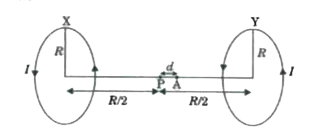
(b) Consider two parallel coaxial circular coils of equal radius R, and number of turns N, carrying equal currents in the same direction, and separated by a distance R. Show that the field on the axis around the mid-point between the coils is uniform over a distance that is small as compared to R and is given by `B=0*72(mu_0NI)/(R)` approximately.
[Such as arrangement to produce a nearly uniform magnetic field over a small region is known as Helmholtz coils.]

Text Solution

Verified by Experts
(a) If we substitute `x = 0 ` in this relation then we can get magnetic field at the centre of the coil.
` B = (mu_(0)IR^(2)N)/(2R^(3)) = (mu_(0)NI)/(2R)`
Hence, it has reduced to the relation for magnetic field at the centre of the coil.
(b)

Let the midpoint of the line joining the centres of two coils be at P. Let A be the point around P. Let `PA = d` such that `d lt lt R`. Let distance of the point A is `R//2 + d` from X then it must be `R//2 - d` from the coil Y.
For coil X :
` x = R//2 + d `
Magnetic field at A due to coil X
` B_(X) = mu_(0)/(4 pi) (2 pi IR^(2)N)/((R^(2) + x^(2))^(3//2))`
` = mu_(0)/(4 pi) xx (2 pi INR^(2))/([R^(2)+ (R/2 +d)^(2)]^(3//2))`
` = mu_(0)/(4 pi) xx (2 pi INR^(2))/([R^(2) + R^(2)/4 + d^(2) + Rd]^(3//2))`
Since `d lt lt R , d^(2)` can be removed from the above exprcsion.
`rArr B_(X) = (mu_(0)INR^(2))/(2(5/4 R^(2) + Rd)^(3/2))`
` = (mu_(0)INR^(2))/(2(5/4 R^(2))^(3/2)[1 + (4d)/(5R)]^(3/2))`
` = (mu_(0)INR^(2))/(2(5/4 R^(2))^(3/2))[1 + (4d)/(5R)]^(-3/2)`
The direction of magnetic field `B_(X)` is along PA towards the centre of coil Y.
For coil Y:
`x = R//2 - d`
Magnetic field at A due to to coil Y:
`B_(Y) = (mu_(0))/(4 pi) (2pi IR^(2)N)/((R^(2)+x^(2))^(3//2)) `
` = (mu_(0))/(4 pi) xx (2 pi INR^(2))/([R^(2) + (R/2 - d)^(2)]^(3//2)) `
` = mu_(0)/(4 pi) xx (2 pi INR^(2))/([R^(2) + R^(2)/4 + d^(2) - Rd]^(3//2)) `
Since ` d lt lt R, d^(2)` can be removed from the above expression.
`rArr B_(Y) = (mu_(0)INR^(2))/(2(5/4 R^(2) - Rd)^(3/2))`
` = (mu_(0)INR^(2))/(2(5/4 R^(2))^(3/2)[1 - (4d)/(5R)]^(3/2))`
` = (mu_(0)INR^(2))/(2(5/4 R^(2))^(3/2) )[1 - (4d)/(5R)]^(-3/2)`
The direction of magnetic field `B_(Y)` is along PA, towards the centre of coil Y. So, the resultant magnetic field at point A due to coils X and Y will be:
`B = B_(X) + B_(Y)`
` = (mu_(0)INR^(2))/(2(5/4R^(2))^(3/2)) [1 + (4d)/(5R)]^(-3/2)+(mu_(0)INR^(2))/(2(5/4 R^(2))^(3/2)) [1 - (4d)/(5R)]^(-3/2)`
`= (mu_(0)INR^(2))/(2(5/4R^(2))^(3/2))[(1+ (4d)/(5R))^(-3/2)+(1 - (4d)/(5R))^(-3/2)]`
Expanding the above expression by binomial theorem and neglecting higher powers as `d lt lt R`, we get ,
`= (mu_(0)INR^(2))/(2(5/4 R^(2))^(3/2)) [(1 - 3/2 xx (4d)/(5R)) + (1 + 3/2 xx (4d)/(5R))]`
` = (mu_(0)IN)/(2R) (4/5)^(3/2) xx 2`
` = 0.72 (mu_(0)NI)/R`
` :. ` Total magnetic field due to two magnetic fields
` = 0.72 (mu_(0)NI)/R ` T at A due to coils X and Y . So, we can say that around P, the value of magnetic field remains almost constant because d is not appearing in the result.
Promotional Banner

Topper's Solved these Questions

  • MOVING CHARGES AND MAGNETISM

    MODERN PUBLICATION|Exercise NCERT (Exemplar Problems ) Objective Questions (MCQ Type - I)|6 Videos
  • MOVING CHARGES AND MAGNETISM

    MODERN PUBLICATION|Exercise NCERT (Exemplar Problems ) Objective Questions (MCQ Type - II)|5 Videos
  • MOVING CHARGES AND MAGNETISM

    MODERN PUBLICATION|Exercise NCERT FILE (NCERT Textbook Exercises)|13 Videos
  • MAGNETISM AND MATTER

    MODERN PUBLICATION|Exercise CHAPTER PRACTICE TEST FOR BOARD EXAMINATION|16 Videos
  • NUCLEI

    MODERN PUBLICATION|Exercise CHAPTER PRACTICE TEST FOR BOARD EXAMINATION|15 Videos

Similar Questions

Explore conceptually related problems

Two parallel coaxial circular coils of equal radius R and equal number of turns N carry equal currents I in the same direction and are separated by a distance 2R . Find the magnitude and direction of the net magnetic field produced at the mid-point of the line joining their centres.

A circular coil of radius 10 cm having 100 turns carries a current of 3.2 A. The magnetic field at the center of the coil is

A circular coil of n turns and radius r carries a current I. The magnetic field at the center is

The magnetic moment of a current I carrying circular coil of radius r and number of turns N varies as

A circular coil having 50 turns each of radius 0.05 m carries a current of 1 A. The magnitude of magnetic induction at a point 0.2 m from its centre on its axis is

A circular coil of radius r carries a current I. The magnetic field at its centre is B. At what distance from the centre, on the axis of the coil the magneitc field will be B/27 ?

