Home
Class 12
PHYSICS
An equiconvex lens of refractive index m...

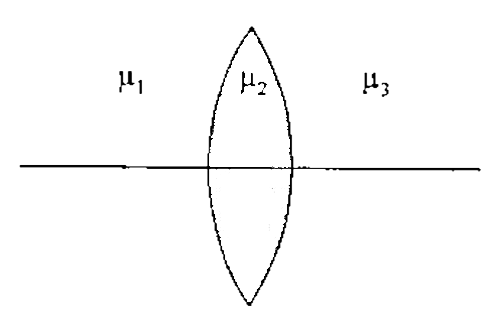
An equiconvex lens of refractive index `mu_(2)` is placed such that the refractive index of the surrounding media is as shown :

Text Solution

Verified by Experts
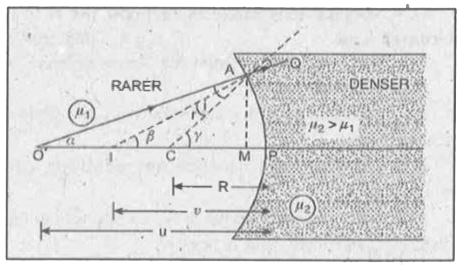
Let a point object O be situated on the principal axis of the concave spherical refracting surface. Let P be pole and C be centre of curvature and PC = R be radius of curvature. Let `mu_(1)` and `mu_(2)` be refractive indices of rarer and denser medium respectively as shown in the figure.
Let incident ray OA refracts at A and bends towards the normal along AQ and when produced in backward direction, it meets at point I. So I will be the virtual image of point O.

From Snell.s law for small i and r,
`(sin i)/(sin r)=(i)/(r)=(mu_(2))/(mu_(1))`
or `mu_(1)i=mu_(2)r` ...(i)
`"In " DeltaAOC," " "In" Delta IC,`
`gamma = i + alpha " " gamma= r+beta`
or `i = gamma - alpha" or " r= gamma - beta`
Putting the values of i and r in Eq. (1), we get
`mu_(1)(gamma-alpha)=mu_(2)(gamma-beta)`
or `mu_(1)gamma-mu_(1)alpha=mu_(2)gamma-mu_(2)beta`
or `-mu_(1)alpha+mu_(2)beta=(mu_(2)-mu_(1))gamma`
Since `alpha, beta` and `gamma` are small, so they can be replaced by their tangents.
`-mu_(1) tan alpha+mu_(2)tan beta=(mu_(2)-mu_(1))tan gamma`
or `-mu_(1)(AM)/(MO)+mu_(2)(AM)/(MI)=(mu_(2)-mu_(1))(AN)/(MC)`
or `-(mu_(1))/(MO)+(mu_(2))/(MI)=(mu_(2)-mu_(1))/(MC)`
Since M is very close to P, so
`MO ~= PO, MI ~= PI` and `MC ~= PC`
`:. -(mu_(1))/(PO)+(mu_(2))/(PI)=(mu_(2)-mu_(1))/(PC)`
Using sign conventions,
PO = - u, PI = - v, PC = R, we get
`-(mu_(1))/(-u)+(mu_(2))/(v)=(mu_(2)-mu_(1))/(R)`
or `-(mu_(1))/(u)+(mu_(2))/(v)=(mu_(2)-mu_(1))/(R)`
or `(mu_(2))/(v)-(mu_(1))/(u)=(mu_(2)-mu_(1))/(R)`
Promotional Banner

Topper's Solved these Questions

  • OPTICS

    MBD -HARYANA BOARD|Exercise OBJECTIVE TYPE QUESTIONS|26 Videos
  • OPTICS

    MBD -HARYANA BOARD|Exercise SHORT ANSWER TYPE QUESTIONS|46 Videos
  • MODEL TEST PAPER - 2

    MBD -HARYANA BOARD|Exercise SET - D ( LONG ANSWER TYPE QUESTIONS)|4 Videos
  • PRINCIPLES OF COMMUNICATION

    MBD -HARYANA BOARD|Exercise Objective Type Questions|19 Videos

Similar Questions

Explore conceptually related problems

An equiconvex lens of refractive index n_(2) is placed such that the refractive index of the surrouding media is as shown. The lens :

A convex lens of refractive index mu_g is held in a reansparent medium of refractive index mu_m If course of rays is as shown in Fig., how are mu_g and mu_m related ? .

An equiconvex lens of refractive index 1.6 has power 4D in air. Its power in water is:

If a convex lens of refractive index mu _l is placed in a medium of refractive index mu_m Such that mu_l > mu_m > mu_(air) then

A double convex lens of refractive index m_(1) is immersed in a liquid of refractive index m_(2) . This lens will act as:

A glass lens of refractive index 1.5 is placed in a trough of liquid. What must be the refractive index of the liquid in order to make the lens disappear ?

A glass lens of refractive index 1.5 is placed in a trough of liquid. What must be the refractive index of the liquid in order to mark the lens disappear?

MBD -HARYANA BOARD-OPTICS-LONG ANSWER TYPE QUESTIONS
  1. The refractive index of a medium 'x' with respect to a medium 'y' is 2...

    Text Solution

    |

  2. Prove that (-mu1)/(u)+(mu2)/(v) = (mu2 - mu1)/( R) when refraction occ...

    Text Solution

    |

  3. An equiconvex lens of refractive index mu(2) is placed such that the r...

    Text Solution

    |

  4. An equiconvex lens of refractive index mu(2) is placed such that the r...

    Text Solution

    |

  5. Derive lens maker's formula for a thin biconvex lens.

    Text Solution

    |

  6. Draw a ray diagram to show the formation of the image of an object pla...

    Text Solution

    |

  7. State and prove prism formula.

    Text Solution

    |

  8. Discuss the phenomenon of refraction through a prism. Prove that delta...

    Text Solution

    |

  9. Draw the ray diagram for simple microscope. Write expression for its ...

    Text Solution

    |

  10. Draw a labelled diagram of compound microscope. Derive expression for...

    Text Solution

    |

  11. The magnifying power of a compound microscope is

    Text Solution

    |

  12. Draw a labelled ray diagram showing the image formation in an astrono...

    Text Solution

    |

  13. Draw ray diagram for an astronomical telescope. Define magnification ...

    Text Solution

    |

  14. Derive formula for fringe width using Young's double slit method for ...

    Text Solution

    |

  15. Define fringe width in interference and derive its expression.

    Text Solution

    |

  16. The fringe width in Young’s double slit experiment increases when

    Text Solution

    |

  17. Explain two methods of Polarisation.

    Text Solution

    |

  18. MALUS LAW

    Text Solution

    |

