Home
Class 12
PHYSICS
State and prove prism formula....

State and prove prism formula.

Text Solution

Verified by Experts
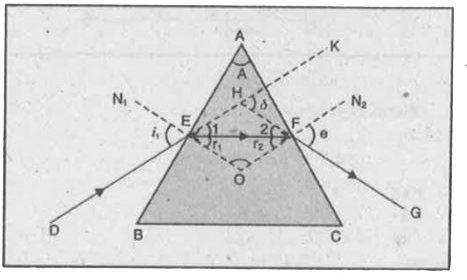
Refraction. The phenomenon of change in path of a ray of light as it passes from one medium into another is called refraction.
Let a ray DE strikes the face AB of the prism at an angle of incidence i and emerges out at an angle e. Let `r_(1)` and `r_(2)` be the angles of refraction and `delta` be exterior angle of deviation.
`delta` is exterior angle of triangle HEF
`:. delta=1+2=(i-r_(1))+(e-r_(2))`
or `delta=i+e-(r_(1)+r_(2))` ...(1)
In quadrilateral AEOF, we have
`/_ AEO + A +/_AFO +/_O=360^(@)`
or `90^(@)+A+90^(@)+ /_O=360^(@)`
or `A+ /_O=180^(@)`

Also, in triangle FEO,
`r_(1)+r_(2)+ /_O=180^(@)`
`A+ /_O=r_(1)+r_(2)+ /_O`
or `A=r_(1)+r_(2)` ...(ii)
Substituting in equation (i), we have
`delta=i+e-A`
or `A+delta=i+e`
For small angled prism,
At face AB,
`(sin i)/(sin r_(1))=(i)/(r_(1))=(mu)`
or `i=mu r_(1)`
Similarly, at face AC,
`e=mu r_(2)`
Putting the value of i and e in equation (iii), we get
`delta=mu r_(1)+ mu r_(2)-A=mu(r_(1)+r_(2))-A`
Using equation (ii), we get
`delta=(mu-1)A` ...(iv)
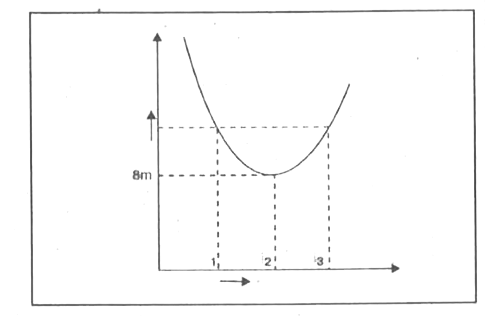
If we repeat the experiment with different angles of incidence, then we get a graph as shown in the figure when i is increased, `delta` decreases first, reaches a minimum and starts increasing again. For a particular value of `delta`, there are two angles of incidence `i_(1)` and `i_(2)`, At minimum deviation,

`delta=delta_(m)` and `i_(1)=i_(2)=i`
Hence `r_(1)=r_(2)=r`
`:. r+r=2A` or `r=(A)/(2)`
And `delta_(m)=i+i-A`
or `2i=A+delta_(m)`
or `i=(A+delta_(m))/(2)`
Now `mu=(sin i)/(sin r)=(sin(A+delta_(m))/(2))/(sin (A)/(2))`
Promotional Banner

Topper's Solved these Questions

  • OPTICS

    MBD -HARYANA BOARD|Exercise OBJECTIVE TYPE QUESTIONS|26 Videos
  • OPTICS

    MBD -HARYANA BOARD|Exercise SHORT ANSWER TYPE QUESTIONS|46 Videos
  • MODEL TEST PAPER - 2

    MBD -HARYANA BOARD|Exercise SET - D ( LONG ANSWER TYPE QUESTIONS)|4 Videos
  • PRINCIPLES OF COMMUNICATION

    MBD -HARYANA BOARD|Exercise Objective Type Questions|19 Videos

Similar Questions

Explore conceptually related problems

Define refractive index of a transparent medium. A ray of light passes through a triangular prism. Plot a graph showing the variation of angle of deviation with the angle of incidence. Hence derive prism formula.

State and prove Baye's theorem.

State and prove theorem of perpendicular axes.

State and prove theorem of parallel axes.

State and prove the commutative property of vector addition.

State and prove Hooke's law.

State and prove the Pythagoras theorem.

MBD -HARYANA BOARD-OPTICS-LONG ANSWER TYPE QUESTIONS
  1. The refractive index of a medium 'x' with respect to a medium 'y' is 2...

    Text Solution

    |

  2. Prove that (-mu1)/(u)+(mu2)/(v) = (mu2 - mu1)/( R) when refraction occ...

    Text Solution

    |

  3. An equiconvex lens of refractive index mu(2) is placed such that the r...

    Text Solution

    |

  4. An equiconvex lens of refractive index mu(2) is placed such that the r...

    Text Solution

    |

  5. Derive lens maker's formula for a thin biconvex lens.

    Text Solution

    |

  6. Draw a ray diagram to show the formation of the image of an object pla...

    Text Solution

    |

  7. State and prove prism formula.

    Text Solution

    |

  8. Discuss the phenomenon of refraction through a prism. Prove that delta...

    Text Solution

    |

  9. Draw the ray diagram for simple microscope. Write expression for its ...

    Text Solution

    |

  10. Draw a labelled diagram of compound microscope. Derive expression for...

    Text Solution

    |

  11. The magnifying power of a compound microscope is

    Text Solution

    |

  12. Draw a labelled ray diagram showing the image formation in an astrono...

    Text Solution

    |

  13. Draw ray diagram for an astronomical telescope. Define magnification ...

    Text Solution

    |

  14. Derive formula for fringe width using Young's double slit method for ...

    Text Solution

    |

  15. Define fringe width in interference and derive its expression.

    Text Solution

    |

  16. The fringe width in Young’s double slit experiment increases when

    Text Solution

    |

  17. Explain two methods of Polarisation.

    Text Solution

    |

  18. MALUS LAW

    Text Solution

    |