Home
Class 12
PHYSICS
Discuss the phenomenon of refraction thr...

Discuss the phenomenon of refraction through a prism. Prove that `delta = (mu -1 ) A` where the symbols have their usual meaning.

Text Solution

Verified by Experts
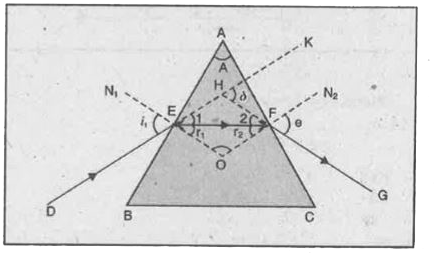
Refraction. The phenomenon of change in path of a ray of light as it passes from one medium into another is called refraction.
Let a ray DE strikes the face AB of the prism at an angle of incidence i and emerges out at an angle e. Let `r_(1)` and `r_(2)` be the angles of refraction and `delta` be exterior angle of deviation.
`delta` is exterior angle of triangle HEF
`:. delta=1+2=(i-r_(1))+(e-r_(2))`
or `delta=i+e-(r_(1)+r_(2))` ...(1)
In quadrilateral AEOF, we have
`/_ AEO + A +/_AFO +/_O=360^(@)`
or `90^(@)+A+90^(@)+ /_O=360^(@)`
or `A+ /_O=180^(@)`

Also, in triangle FEO,
`r_(1)+r_(2)+ /_O=180^(@)`
`A+ /_O=r_(1)+r_(2)+ /_O`
or `A=r_(1)+r_(2)` ...(ii)
Substituting in equation (i), we have
`delta=i+e-A`
or `A+delta=i+e`
For small angled prism,
At face AB,
`(sin i)/(sin r_(1))=(i)/(r_(1))=(mu)`
or `i=mu r_(1)`
Similarly, at face AC,
`e=mu r_(2)`
Putting the value of i and e in equation (iii), we get
`delta=mu r_(1)+ mu r_(2)-A=mu(r_(1)+r_(2))-A`
Using equation (ii), we get
`delta=(mu-1)A` ...(iv)
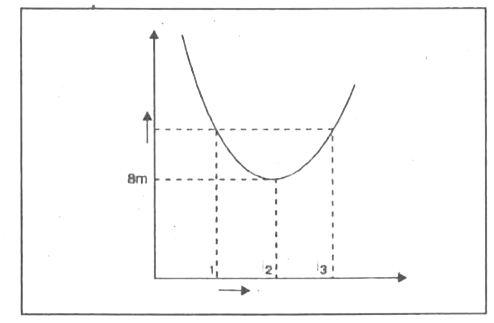
If we repeat the experiment with different angles of incidence, then we get a graph as shown in the figure when i is increased, `delta` decreases first, reaches a minimum and starts increasing again. For a particular value of `delta`, there are two angles of incidence `i_(1)` and `i_(2)`, At minimum deviation,

`delta=delta_(m)` and `i_(1)=i_(2)=i`
Hence `r_(1)=r_(2)=r`
`:. r+r=2A` or `r=(A)/(2)`
And `delta_(m)=i+i-A`
or `2i=A+delta_(m)`
or `i=(A+delta_(m))/(2)`
Now `mu=(sin i)/(sin r)=(sin(A+delta_(m))/(2))/(sin (A)/(2))`
Promotional Banner

Topper's Solved these Questions

  • OPTICS

    MBD -HARYANA BOARD|Exercise OBJECTIVE TYPE QUESTIONS|26 Videos
  • OPTICS

    MBD -HARYANA BOARD|Exercise SHORT ANSWER TYPE QUESTIONS|46 Videos
  • MODEL TEST PAPER - 2

    MBD -HARYANA BOARD|Exercise SET - D ( LONG ANSWER TYPE QUESTIONS)|4 Videos
  • PRINCIPLES OF COMMUNICATION

    MBD -HARYANA BOARD|Exercise Objective Type Questions|19 Videos

Similar Questions

Explore conceptually related problems

Discuss the phenomenon of refraction through a prism. Prove that delta = (mu -) A where the symbols have their usual meaning.

Derive the relation F=ma , where the symbols have their usual meanings.

Derive graphically the relation v=u+at ,where the symbols have their usual meaning.

Choose the correct arrangement, where the symbols have their usual meanings

Derive graphically the eqaution v = u + at , where the symbols have their usual meanings.

Derive the relation F=ma , where the symbols have their usual meanings. What is one newton?

Show that for radioactive decay N(t) = NO e-λt , where symbols have their usual meaning.

Select the incorrect relation. (Where symboles have their usual meanings):-

Show by means of graphical method that : " "v=u+at where the symbols have their usual meanings.

MBD -HARYANA BOARD-OPTICS-LONG ANSWER TYPE QUESTIONS
  1. The refractive index of a medium 'x' with respect to a medium 'y' is 2...

    Text Solution

    |

  2. Prove that (-mu1)/(u)+(mu2)/(v) = (mu2 - mu1)/( R) when refraction occ...

    Text Solution

    |

  3. An equiconvex lens of refractive index mu(2) is placed such that the r...

    Text Solution

    |

  4. An equiconvex lens of refractive index mu(2) is placed such that the r...

    Text Solution

    |

  5. Derive lens maker's formula for a thin biconvex lens.

    Text Solution

    |

  6. Draw a ray diagram to show the formation of the image of an object pla...

    Text Solution

    |

  7. State and prove prism formula.

    Text Solution

    |

  8. Discuss the phenomenon of refraction through a prism. Prove that delta...

    Text Solution

    |

  9. Draw the ray diagram for simple microscope. Write expression for its ...

    Text Solution

    |

  10. Draw a labelled diagram of compound microscope. Derive expression for...

    Text Solution

    |

  11. The magnifying power of a compound microscope is

    Text Solution

    |

  12. Draw a labelled ray diagram showing the image formation in an astrono...

    Text Solution

    |

  13. Draw ray diagram for an astronomical telescope. Define magnification ...

    Text Solution

    |

  14. Derive formula for fringe width using Young's double slit method for ...

    Text Solution

    |

  15. Define fringe width in interference and derive its expression.

    Text Solution

    |

  16. The fringe width in Young’s double slit experiment increases when

    Text Solution

    |

  17. Explain two methods of Polarisation.

    Text Solution

    |

  18. MALUS LAW

    Text Solution

    |