Home
Class 12
PHYSICS
The magnifying power of a compound micro...

The magnifying power of a compound microscope is

Text Solution

Verified by Experts
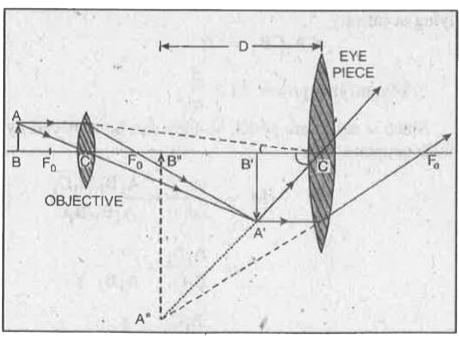
It is an instrument used to see highly magnified image of tiny objects.

Construction. It consists of an objective of small focal length and short aperture. The eye piece has moderate focal length and aperture larger than objective. The lenses are held co-axially at the free ends of a coaxial tube at a fixed distance. The hold of the tube can be moved by rack and pinion arrangement.
Let a tiny object AB be placed in front of objective at a distance more than `f_(0)`. Its real and enlarged image is formed at A.B.. The image A.B. acts as an object for eye piece and forms final image at A.. B.. i.e., at a distance D, the least distance of distinct vision.
 Magnifying Power of Microscope is defined as the ratio of the angle subtended on the eye by the final image to the angle subtended on the eye by the object, when both the final image and the object are situated at least distance of distinct vision.
Magnifying power, `M = (beta)/(alpha)`
Since angles are small, therefore `tan beta = beta` and `tan alpha=alpha`
`:. M=(tan beta)/(tan alpha)=(A.. B.. // D)/(AB // D)=(A.. B..)/(AB)`
or `M=(A..B..)/(A.B.) xx (A.B.)/(AB)=M_(e) xx M_(0)`,
where `M_(e)` and `M_(0)` are the magnifying powers of eye piece and the objective.
`M_(0)=(A.B.)/(AB)=(CB.)/(CB)`
But CB is nearly equal to (`-f_(0)`) and CB. is equal to the length of the tube L (since the image A.B. is formed very close to eye lens]
`M_(0)=(L)/((-f_(0)))`
Also `M_(e)=1+(D)/(f_(e))` [As in simple microscope]
Promotional Banner

Topper's Solved these Questions

  • OPTICS

    MBD -HARYANA BOARD|Exercise OBJECTIVE TYPE QUESTIONS|26 Videos
  • OPTICS

    MBD -HARYANA BOARD|Exercise SHORT ANSWER TYPE QUESTIONS|46 Videos
  • MODEL TEST PAPER - 2

    MBD -HARYANA BOARD|Exercise SET - D ( LONG ANSWER TYPE QUESTIONS)|4 Videos
  • PRINCIPLES OF COMMUNICATION

    MBD -HARYANA BOARD|Exercise Objective Type Questions|19 Videos

Similar Questions

Explore conceptually related problems

Lateral magnification of objective of compound microscope is 100 and angular magnification of its eyepiece is 20. The magnifying power of compound microscope is

The magnifiying power of a compound microscope increase with

The magnifying power of a compound microscope can be increased by

In order to increase the magnifying power of a compound microscope

The magnification produced by the objective lens of a compound microscope is 25. The focal length of eye piece is 5 cm and it forms find image at least distance of distinct vision. The magnifying power of the compound microscope is

When the final image is formed at infinity the magnifying power of compound microscope is (using new Cartesian sign conventions)

The magnifying power of compound microscope in terms of the magnification m_0 due to objective and magnifyging power m_E by the eye-piece is given by

A compound microscope has tube length 300 mm and an objective of focal length 7.5 mm and an eyepiece of certain focal length. When eyepiece is replaced by another lens of focal length 20 mm, the magnifying power of compound microscope is increased by 100. The focal length of previous eyepiece is

MBD -HARYANA BOARD-OPTICS-LONG ANSWER TYPE QUESTIONS
  1. The refractive index of a medium 'x' with respect to a medium 'y' is 2...

    Text Solution

    |

  2. Prove that (-mu1)/(u)+(mu2)/(v) = (mu2 - mu1)/( R) when refraction occ...

    Text Solution

    |

  3. An equiconvex lens of refractive index mu(2) is placed such that the r...

    Text Solution

    |

  4. An equiconvex lens of refractive index mu(2) is placed such that the r...

    Text Solution

    |

  5. Derive lens maker's formula for a thin biconvex lens.

    Text Solution

    |

  6. Draw a ray diagram to show the formation of the image of an object pla...

    Text Solution

    |

  7. State and prove prism formula.

    Text Solution

    |

  8. Discuss the phenomenon of refraction through a prism. Prove that delta...

    Text Solution

    |

  9. Draw the ray diagram for simple microscope. Write expression for its ...

    Text Solution

    |

  10. Draw a labelled diagram of compound microscope. Derive expression for...

    Text Solution

    |

  11. The magnifying power of a compound microscope is

    Text Solution

    |

  12. Draw a labelled ray diagram showing the image formation in an astrono...

    Text Solution

    |

  13. Draw ray diagram for an astronomical telescope. Define magnification ...

    Text Solution

    |

  14. Derive formula for fringe width using Young's double slit method for ...

    Text Solution

    |

  15. Define fringe width in interference and derive its expression.

    Text Solution

    |

  16. The fringe width in Young’s double slit experiment increases when

    Text Solution

    |

  17. Explain two methods of Polarisation.

    Text Solution

    |

  18. MALUS LAW

    Text Solution

    |

