Home
Class 12
PHYSICS
The fringe width in Young’s double slit ...

The fringe width in Young’s double slit experiment increases when

Text Solution

Verified by Experts
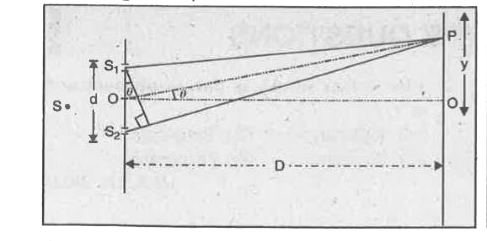
Fringe Width. It is the distance between any two successive fringes in interference pattern.
Let `S_(1), S_(2)` be the two fine slits illuminated by a monochromatic sources of wavelength `lambda`.
Intensity of light at any point P on the screen at a distance D from the slit depends upon the path difference between `S_(2)P` and `S_(1)P`.

From `S_(1)` draw `S_(1)A` perpendicular to `S_(2)P`. Since `/_S_(2)S_(1)A to theta` [D is very large as compared to d], therefore, `/_S_(1)AS_(2) to 90^(@)` and `AP ~~ S_(1)P`.
`:. "Path difference" = S_(2)P-S_(1)P = (S_(2)A + AP) - S_(1)P` or `"Path difference" = S_(2)A = d sin theta`
Since `theta` is very small, `sin theta` can be replaced by `tan theta` .
`:. "Path difference" = d tan theta = d(y)/(D)`
Constructive interference [Bright Fringes). For bright fringes, the path difference should be equal to an even multiple of `lambda // 2`.
`:. (dy)/(D)=2n(lambda)/(2)=n lambda`
or `y=n(lambda D)/(d)`
If n = 0, `y_(0)=0`, which is the position of central maxima.
If n = 1, `y_(1)=(D)/(d)lambda`, which is the position of first maxima.
If n = 2, `y_(2)=(2D)/(d)lambda`, which is the position of
Similarly `y_(n-1)=(n-1)(D)/(d)lambda`
and `y_(n)=n(D)/(d)lambda`
Fringe width `beta=y_(n)-y(n-1)=(D)/(d)lambda[n-(n-1)]`
`beta=(D)/(d)lambda` ...(i)
Destructive interference [Dark Fringes]. For dark fringes, the path difference should be an old multiple of `1 // 2`.
`(d)/(D)y=(2n-1)(lambda)/(2)`
or `y=(D)/(d)(2n-1)(lambda)/(2)`
If n = 1, `y_(1)=(D)/(d)(lambda)/(2)`, which is the position of 1st minima.
If n = 2, `y_(1)=(D)/(d)(2lambda)/(2)`, which is the position of 2nd minima.
If n = 3, `y_(1)=(D)/(d)(3lambda)/(2)`, which is the position of 3rd minima.
`:.` Fringe width, `beta=y_(3)-y_(2)=(D)/(d)lambda`
or `beta=(D)/(d)lambda` ...(ii)
From (i) and (ii), we conclude that bright and dark fringes have equal fringe width.
`beta prop D`
`prop lambda`
`prop (1)/(d)`
If d = 0, `beta= infty` i.e. dark and bright bands will be infinitely well spaced and there will be uniform illumination.
Promotional Banner

Topper's Solved these Questions

  • OPTICS

    MBD -HARYANA BOARD|Exercise OBJECTIVE TYPE QUESTIONS|26 Videos
  • OPTICS

    MBD -HARYANA BOARD|Exercise SHORT ANSWER TYPE QUESTIONS|46 Videos
  • MODEL TEST PAPER - 2

    MBD -HARYANA BOARD|Exercise SET - D ( LONG ANSWER TYPE QUESTIONS)|4 Videos
  • PRINCIPLES OF COMMUNICATION

    MBD -HARYANA BOARD|Exercise Objective Type Questions|19 Videos

Similar Questions

Explore conceptually related problems

The fringe width in Young's double slit experiment can be increased by decreasing

How does the fringe width, in Young's double-slit experiment, change when the distance of separation between the slits and screen is doubled ?

The fringe width in a Young's double slit experiment can be increased. If we decrease

The fringe width in a Young's double slite experiment can be increased by decreasing

With a monochromatic light, the fringe-width obtained in a Young’s double slit experiment is 0.133 cm. The whole set- up is immersed in water of refractive index 1.33, then the new fringe-width is

Find the angular fringe width in Young's double slit experiment using a monochromatic light of wavelength 500 nm when the slits are separated by 2.5 mm.

Find out the expression for Fringe width in Young's double' slit' 'experiment.

How would the angular separation of interference fringes in Young's double slit experiment change when the distance of separation between slits and screen is doubled ?

The shape of the interference fringes in Young’s double slit experiment when D (distance between slit and screen) is very large as compared to fringe width is nearly

MBD -HARYANA BOARD-OPTICS-LONG ANSWER TYPE QUESTIONS
  1. The refractive index of a medium 'x' with respect to a medium 'y' is 2...

    Text Solution

    |

  2. Prove that (-mu1)/(u)+(mu2)/(v) = (mu2 - mu1)/( R) when refraction occ...

    Text Solution

    |

  3. An equiconvex lens of refractive index mu(2) is placed such that the r...

    Text Solution

    |

  4. An equiconvex lens of refractive index mu(2) is placed such that the r...

    Text Solution

    |

  5. Derive lens maker's formula for a thin biconvex lens.

    Text Solution

    |

  6. Draw a ray diagram to show the formation of the image of an object pla...

    Text Solution

    |

  7. State and prove prism formula.

    Text Solution

    |

  8. Discuss the phenomenon of refraction through a prism. Prove that delta...

    Text Solution

    |

  9. Draw the ray diagram for simple microscope. Write expression for its ...

    Text Solution

    |

  10. Draw a labelled diagram of compound microscope. Derive expression for...

    Text Solution

    |

  11. The magnifying power of a compound microscope is

    Text Solution

    |

  12. Draw a labelled ray diagram showing the image formation in an astrono...

    Text Solution

    |

  13. Draw ray diagram for an astronomical telescope. Define magnification ...

    Text Solution

    |

  14. Derive formula for fringe width using Young's double slit method for ...

    Text Solution

    |

  15. Define fringe width in interference and derive its expression.

    Text Solution

    |

  16. The fringe width in Young’s double slit experiment increases when

    Text Solution

    |

  17. Explain two methods of Polarisation.

    Text Solution

    |

  18. MALUS LAW

    Text Solution

    |

