MALUS LAW

Text Solution

Verified by Experts
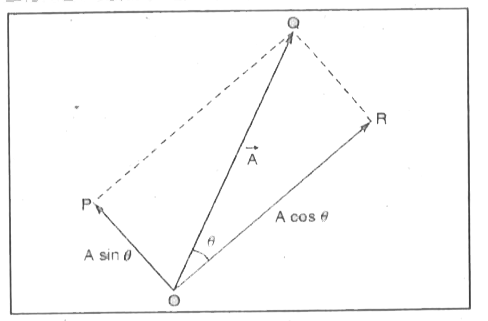
Malus law. It states that the intensity of polarised light transmitted through the analyser varies as the square of cosine of the angle between the plane of transmission of analyser and polariser.
i.e. `I prop cos^(2) theta`
Proof
Let OQ = amplitude (A) of vibration of electric vector transmitted by the polariser.
`theta = "angle between the plane of analyser and polariser"`.
 Let us resolve `vecA` into two components.

(i) A `cos theta` along OR (i.e. parallel to the plane of transmission of analyser)
(ii) A `sin theta` along OP (i.e. perpendicular to the plane of transmission of analyser)
Since only A `cos theta` component is transmitted through the analyser, so the intensity of light transmitted through the analyser is given by :
`I = (A cos theta)^(2)`
or `I = A^(2) cos^(2) theta`
or `I = I_(0) cos^(2) theta`
where `I_(0)= A^(2)` is the intensity of incident light from the polariser.
So. Eq. (1) can be written as
`I prop cos^(2) theta`.
Special cases
(i) When the plane of polariser and analyser are parallel to each other.
i.e. `theta= 0^(@)`
 From Eq. (1), we have
`I=I_(0)`
i.e. maximum intensity.
(ii) When the plane of polariser and analyser are perpendicular to each other. From> i.e. `theta= 0^(@)`
From Eq. (1), we have
I = 0
i.e. zero intensity.
Promotional Banner

Topper's Solved these Questions

  • OPTICS

    MBD -HARYANA BOARD|Exercise OBJECTIVE TYPE QUESTIONS|26 Videos
  • OPTICS

    MBD -HARYANA BOARD|Exercise SHORT ANSWER TYPE QUESTIONS|46 Videos
  • MODEL TEST PAPER - 2

    MBD -HARYANA BOARD|Exercise SET - D ( LONG ANSWER TYPE QUESTIONS)|4 Videos
  • PRINCIPLES OF COMMUNICATION

    MBD -HARYANA BOARD|Exercise Objective Type Questions|19 Videos

Similar Questions

Explore conceptually related problems

GAY LUSSAC'S LAW, AVOGADRO'S LAW

We Know About Universal Law Of Gravitation|Questions|Law Of Orbits (1st Law)|Questions|Law Of Areas (2nd Law)|Questions|Law Of Harmonics (3rd Law)|Questions|Summary

Methods OF Determination OF Atomic Weight || Law OF Isomorphism || Volatile Chloride Law || Specific Heat Method || Law OF Chemical Combination || Law OF Conservation OF Mass || Law OF Definite Proportion || Law OF Multiple Proportion || Law OF Combining Volume

Gas Laws–Charles’s law||Boyle’s law,Gay-lussac's Law||Avogadro’s Law||Open Vessel Concept

State Of Matter|Gas Laws|Boyle's Law|Charle's Law|Gay Lussac's Law|Avogadro's Law|Questions|Ideal Gas Equation

Laws Of Chemical Combination|Law Of Conservation Of Mass|Law Of Definite Proportion|Law Of Multiple Proportion|OMR

Law Of Mass Action And Rate Law

Laws Of Motion - Problems On Newton'S Law

Triangle Law || Parallelogram Law OF Addition

MBD -HARYANA BOARD-OPTICS-LONG ANSWER TYPE QUESTIONS
  1. The refractive index of a medium 'x' with respect to a medium 'y' is 2...

    Text Solution

    |

  2. Prove that (-mu1)/(u)+(mu2)/(v) = (mu2 - mu1)/( R) when refraction occ...

    Text Solution

    |

  3. An equiconvex lens of refractive index mu(2) is placed such that the r...

    Text Solution

    |

  4. An equiconvex lens of refractive index mu(2) is placed such that the r...

    Text Solution

    |

  5. Derive lens maker's formula for a thin biconvex lens.

    Text Solution

    |

  6. Draw a ray diagram to show the formation of the image of an object pla...

    Text Solution

    |

  7. State and prove prism formula.

    Text Solution

    |

  8. Discuss the phenomenon of refraction through a prism. Prove that delta...

    Text Solution

    |

  9. Draw the ray diagram for simple microscope. Write expression for its ...

    Text Solution

    |

  10. Draw a labelled diagram of compound microscope. Derive expression for...

    Text Solution

    |

  11. The magnifying power of a compound microscope is

    Text Solution

    |

  12. Draw a labelled ray diagram showing the image formation in an astrono...

    Text Solution

    |

  13. Draw ray diagram for an astronomical telescope. Define magnification ...

    Text Solution

    |

  14. Derive formula for fringe width using Young's double slit method for ...

    Text Solution

    |

  15. Define fringe width in interference and derive its expression.

    Text Solution

    |

  16. The fringe width in Young’s double slit experiment increases when

    Text Solution

    |

  17. Explain two methods of Polarisation.

    Text Solution

    |

  18. MALUS LAW

    Text Solution

    |

