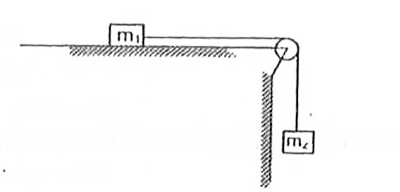
A block of mass `m_(1)=2` kg is kept on a smooth horizontal table. Another block of mass `m_(2)=1` kg is connected to `m_(1)` by a light inextensible string passing over a smooth pulley as shown in the figure. If the blocks are released, what will be the (a) acceleration of each block (b) tension in the string?
Text Solution
Verified by Experts
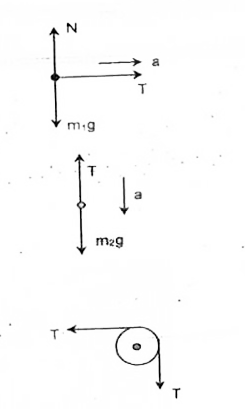
From the F.B.D. of `m_(1)` `N=m_(1)g " " ...(1)` `T=m_(1)a " " ...(2)` From the F.B.D. of `m_(2)` `m_(2)g-T=m_(2)a " " ...(3)` (a) From (2) and (3), `m_(2)g=(m_(1)+m_(2))a` `therefore a=(m_(2))/(m_(1)+m_(2))g " " ...(4)` `=(1)/(3) xx 9.8 m//s^(2)=3.26 m//s^(2)` (b) From (2) and (4), `T=m_(1)a=(m_(1) m_(2))/(m_(1)+m_(2)) g = (2xx1)/(2+1)xx9.8N=6.52N`.
FIITJEE|Exercise NUMERICAL BASED QUESTIONS DECIMAL TYPE|5 Videos
MAGNETIC
FIITJEE|Exercise Numerical Based Type|2 Videos
Similar Questions
Explore conceptually related problems
Two blocks of masses of 40 kg and 30 kg are connected by a weightless string passing over a frictionless pulley as shown in the figure.
Two masses of 10 kg and 20 kg are connected with an inextensible string passing over two smooth pulleys as shown in the figure. The acceleration of 20 kg mass will be :
Two blocks A and B , each of mass 10 kg , are connected by a light string passing over a smooth pulley as shown in the figure. Block A will remain at rest if the friction on it is
Two masses M_(1)=5kg,M_(2)=10 kg are connected at the ends of an inextensible string passing over a frictionless pulley as shown. When masses are released, then acceleration of masses will be
Two unequal masses of 1kg and 2kg are connected by an inextensible light string passing over a smooth pulley as shown in figure. A force F = 20N is applied on 1kg block find the acceleration of either block (g = 10m//s^(2)) .
Consider the situation shown in the figure. The surface is smooth and the string and the pulley are light. Find the acceleration of each block and tension in the string.
The strings are inextensible and light : the pulleys are smooth and light. Find the acceleration of each block and tensions in the strings.
A block of mass m_(1) lies on a smooth horizontal table and is connected to another freely hanging block of mass m_(2) by a light inextensible string passing over a smooth fixed pulley situated at the edge o fthe table. Initially the system is at rest with m_(1) a distance d from the pulley. Then the time taken for m_(1) to reach the pulley is.
Three blocks of masses m_(1)=4kg, m_(2)=2kg, m_(3)=4kg are connected with ideal strings passing over a smooth, massless pulley as shown in figure. The acceleration of blocks will be (g=10m//s^(2))
Two unequal masses of 1 kg and 2 kg are attached at the two ends of a light inextensible string passing over a smooth pulley as shown in figure. If the system is released from rest, find the work done by string on both the blocks in 1 s. (Take g = 10 ms^(-2) )