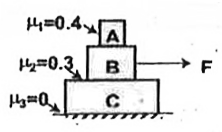
In the arrangement shown in the figure mass `m_(A)=2kg, m_(B)=4kg and m_(C)=6kg`. Co-efficient of static friction between A and B `(mu_(1))=0.4`, between B and C `(mu_(2))=0.3` and between C and ground `(mu_(3))=0`. A constant force F = 32 N is applied horizontally on block B. Find friction force developed between A and B and that between B and C.
Text Solution
Verified by Experts
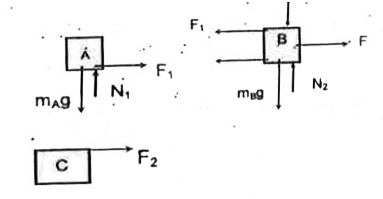
Maximum frictional force, `f_("1max")=0.4xx2xx10=8N` `f_("2max")=0.3 xx 6xx10=18N` Case 1: Assuming all blocks moves together. For block A: `f_(1)=2a` For block B: `32-f_(1)-f_(2)=4a` For Block C : - `f_(2)=6a` solving above equations, `f_(1)=5.33N, f_(2)=16N` `f_(1) lt f_("1max") and f_(2) lt f_("2max")`. Hence assumption is correct .
FIITJEE|Exercise NUMERICAL BASED QUESTIONS DECIMAL TYPE|5 Videos
MAGNETIC
FIITJEE|Exercise Numerical Based Type|2 Videos
Similar Questions
Explore conceptually related problems
In the show arrangement mass of A=1 kg, mass of B= 2kg. Coefficient of friction between A and B =0.2 There is no friction between B and ground. The frictional force exerted by A on B equals.
Given m_(A) = 30 kg, m_(B) = 10 kg, m_(C) = 20 kg . Between a & B mu_(1) = 0.3 , between B & C mu_(2) = 0.2 & between C & ground mu_(3) = 0.1 . The least horizontal force F to start motion of ant part of the system of three blocks resting upon one another as shown below is : (Take g = 10m//s^(2) )
Block B rests on a smooth surface .The coefficient of static friction between A and B is mu = 0.4 where F = 30 N then Acceleration of upper block is
Block B rests on a smooth surface .The coefficient of static friction between A and B is mu = 0.4 where F = 30 N then Acceleration of lower block is
In the arrangement shown in figure coefficient of friction between 5kg block and incline plane is mu=0.5 . Friction force acting on the 5kg block is
Two blocks of masses m and 2 m are placed one over the other as shown in figure.The coefficient of friction between m and 2m is mu and between 2m and ground is (mu)/(3) . If a horizontal force F is applied on upper block and T is tension developed in string, then choose the incorrect alternative.
A block A of mass 2 kg rests on another block B of mass 8 kg which rests on a horizontal floor. The coefficient of friction between A and B is 0.2 while that between B and floor is 0.5. when a horizontal force of 25 N is applied on the block B. the force of friction between A and B is
A block A of mass 2 kg rests on another block B of mass 8 kg which rests on a horizontal floor. The coefficient of friction between A and B is 0.2 while that between B and floor is 0.5 .When a horizontal floor F of 25 N is applied on the block B the force of friction between A and B is
In the figure m_(A) = m_(B) = m_(C) = 60 kg . The coefficient of friction between C and ground is 0.5 B and ground is 0.3, A and B is 0.4. C is pulling the string with the maximum possible force without moving. Then the tension in the string connected to A will be
In the arrangement shown in figure mass of blocks A,B and C is 18.5 kg .8 kg and 1.5 kg respectively . The bottom surface of A is A is smooth while coefficient of friction that between block A and C is mu_(1) = 1//3 between B and floor is mu_(2) = 1//5 System is relased from rest r = 0 and pulley are light and friction Calculate acceleration of block A ,B and C