Home
Class 12
PHYSICS
A uniform chain of mass m and length I ...

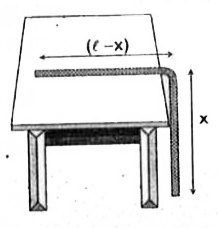
A uniform chain of mass m and length I is kept on the table with a part of it overhanging (see figure). If the coefficient of friction between the table and the chain is `1//3` then find the maximum length of the chain that can overhang such that the chain remain in equilibrium.

A

`L//3`

B

`L//2`

C

`L//4`

D

`2L//3`

Text Solution

Verified by Experts

The correct Answer is:
C


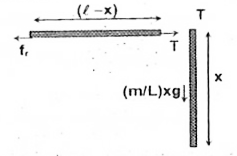
Let x be the length of the overhanging part
`f_(r)=mu[(m)/(L)(L-x)g]`
`T=f_(r)`
`T=(m)/(L)xxg`
`rArr mu((m)/(L))(L-x)g=(m)/(L) g x`
`rArr (1)/(3)(L-x)=x rArr x =(L)/(4)`
Promotional Banner

Topper's Solved these Questions

  • LAWS OF MOTION

    FIITJEE|Exercise COMPREHENSION - I|6 Videos
  • LAWS OF MOTION

    FIITJEE|Exercise COMPREHENSION - II|5 Videos
  • LAWS OF MOTION

    FIITJEE|Exercise SOLVED PROBLEMS (SUBJECTIVE)|11 Videos
  • KINEMATICS

    FIITJEE|Exercise NUMERICAL BASED QUESTIONS DECIMAL TYPE|5 Videos
  • MAGNETIC

    FIITJEE|Exercise Numerical Based Type|2 Videos

Similar Questions

Explore conceptually related problems

A uniform rope of total length l is at rest on a table with fraction f of its length hanging (see figure). If the coefficient of friction between the table and the chain is mu then

A rough inclined plane is inclined at 30° to the horizontal as shown in the figure. A uniform chain of length L is partly on the inclined plane and partly hanging from the top of the incline. If the coefficient of friction between chain and inclined plane is H, the maximum length of the hanging part to prevent the chain from falling vertically is 30°

A unifrom chain of mass M and length L lies on a table with nth part of it hanging off the table. Find the work required to slowly pull the hanging part up to the table.

A homogoneous chain of length L lies on a table. The coefficient of friction between the chain and the table is mu . The maximum length which can hang over the table in equilibrium is

A heavy uniform chain lies on a horizontal table-top. If the coefficient of friction between the chain and table surface is 0.25, then the maximum fraction of length of the chain, that can hang over one edge of the table is

A chain of mass m and length l is placed on a table with one-sixth of it hanging freely from the table edge. The amount of work. done to pull the chain on the table is

FIITJEE-LAWS OF MOTION-SOLVED PROBLEMS (OBJECTIVE)
  1. Three blocks of masses 3 kg, 6 kg and 1 kg are connected by a string p...

    Text Solution

    |

  2. A man of mass m=60kg is standing on weighing machine fixed on a triang...

    Text Solution

    |

  3. A U-shaped smooth wire has a semi-circular bending between A and B as ...

    Text Solution

    |

  4. A massive platform of mass M is moving with speed v=6ms^(-1) At t = 0,...

    Text Solution

    |

  5. An iron nail is dropped from a height h on the level of a sand bed. If...

    Text Solution

    |

  6. A uniform chain of mass m and length I is kept on the table with a pa...

    Text Solution

    |

  7. In the given figure, the wedge is acted upon by a constant horizontal ...

    Text Solution

    |

  8. A pendulum is hanging from the ceiling of a cage. If the cage moves up...

    Text Solution

    |

  9. In fig. the block of mass M is at rest on the floor . At what accelera...

    Text Solution

    |

  10. A block pulley arrangement is shown in the figure. If f(1) and f(2) re...

    Text Solution

    |

  11. Three identical ideal springs, each of spring constant K = 2000 N/m ar...

    Text Solution

    |

  12. A car of mass m = 1000 kg is moving with constant speed v = 10 m/s on ...

    Text Solution

    |

  13. A block of mass m is supported by a string passing through a smooth pe...

    Text Solution

    |

  14. A person is sitting in a travelling train and facing the engine. He to...

    Text Solution

    |

  15. An amusement park ride called "The spinning Terror" is a large vertica...

    Text Solution

    |

  16. Two blocks A and B of equal mass m are connected through a massless st...

    Text Solution

    |

  17. A particle moves along the X-axis as x=u(t-2s)=at(t-2)^2.

    Text Solution

    |

