Text Solution
Verified by Experts



Topper's Solved these Questions
LAWS OF MOTION
FIITJEE|Exercise ASSIGNMENT PROBLEMS (SUBJECTIVE) (Level-I) (Short Answer type question)|2 VideosLAWS OF MOTION
FIITJEE|Exercise ASSIGNMENT PROBLEMS (SUBJECTIVE)(Level-I)(Fill in the blanks)|2 VideosLAWS OF MOTION
FIITJEE|Exercise MATRIX MATCH TYPE|4 VideosKINEMATICS
FIITJEE|Exercise NUMERICAL BASED QUESTIONS DECIMAL TYPE|5 VideosMAGNETIC
FIITJEE|Exercise Numerical Based Type|2 Videos
Similar Questions
Explore conceptually related problems
FIITJEE-LAWS OF MOTION-Exercise
- A baseball of mass m is thrown upward with some initial speed. If air ...
Text Solution
|
- If a small sports car collides head on with a massive track, which veh...
Text Solution
|
- A body of mass m = 2kg changes its velocity v(1)=(1+2j+3k)m//s " to " ...
Text Solution
|
- In the shown figure the tension in the horizontal cord is 30N. Find th...
Text Solution
|
- Two balls of masses m(1)=5kg, m(2)=10kg are connected by a light inext...
Text Solution
|
- With what acceleratin a should the box of figure desecend so that the ...
Text Solution
|
- A block of mass M is pulled along a horizontal frictionless surface by...
Text Solution
|
- A pendulum is hanging from the ceiling of a car having an acceleration...
Text Solution
|
- Find the accelerations of rod A and wedge B in the arrangement shown i...
Text Solution
|
- Two blocks 'A' and 'B' having masses m(A) and m(a), respectively are c...
Text Solution
|
- Find the relation between acceleration of the two blocks m(1) and m(2)...
Text Solution
|
- The block A is kept over a plan B. The maximum horizontal acceleration...
Text Solution
|
- In the figure shown co-efficient of friction between the block B and C...
Text Solution
|
- A block of mass 2 kg is pressed against a rigid vertical wall by a hor...
Text Solution
|
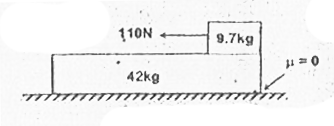
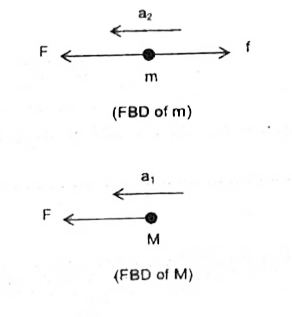
- A 42 kg slab rests on a frictionless floor A 9.7 kg block rests on the...
Text Solution
|