Home
Class 12
PHYSICS
When we apply a horizontal force on a bo...

When we apply a horizontal force on a body kept on horizontal floor, a horizontal force starts opposing the net applied force. This force is called frictional force and is always tangential to the contact surface. Frictional force on a moving body is called kinetic friction which is directly proportional to the normal force `(f_(k)=mu_(k)N)` where `mu_(k)` is a constant depending upon the surfaces and is called the coefficient of kinetic friction. Frictional force on a static body is called static friction. Maximum value of static friction force is `(f_(s) le mu_(s)N)`, where `mu_(s)` is coefficient of static friction.

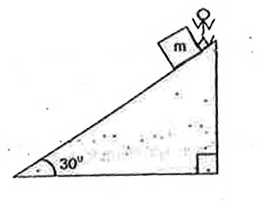
Now a man wants to slide down a block of mass m which is kept on a fixed inclined plane of inclination `30^(@)` as shown in figure initially, the block is not sliding. To just start sliding the man pushes the block down the inclined with a force F. Now the block starts accelerating. To move it downwards with constant speed, the man starts pulling the block with same force. Surfaces are such that ratio of maximum static friction to kinetic friction is 2. Now, answer the following questions.
If man continues pushing the block by force F, its acceleration would be

A

`g//6`

B

`g//4`

C

`g//2`

D

`g//3`

Text Solution

Verified by Experts

The correct Answer is:

D
Promotional Banner

Topper's Solved these Questions

  • LAWS OF MOTION

    FIITJEE|Exercise ASSERTION REASONING TYPE|1 Videos
  • LAWS OF MOTION

    FIITJEE|Exercise NUMERICAL BASED QUESTIONS|5 Videos
  • LAWS OF MOTION

    FIITJEE|Exercise COMPREHENSION - I|6 Videos
  • KINEMATICS

    FIITJEE|Exercise NUMERICAL BASED QUESTIONS DECIMAL TYPE|5 Videos
  • MAGNETIC

    FIITJEE|Exercise Numerical Based Type|2 Videos

Similar Questions

Explore conceptually related problems

A block of mass 2 kg rests on a horizontal surface. If a horizontal force of 5 N is applied on the block, the frictional force on it is ("take", u_(k)=0.4, mu_(s)=0.5)

Assertion: Frictional force is the component of contact force parallel to the surface. Reason: Friction force always opposes the motion of a body.

For the surface mu=0.4 find the work done by the applied force, friction and net force.

Frictional force always opposes motion of a body.

The angle between the resultant contact force and the normal force exerted by a body on the other is called the angle of friction. Show that it lamda be the angle of friction and mu the coefficient of static friction. lamdaletan^-1mu .

If a body has kinetic energy. T, moving on a rough horizontal surface stops at distance y. The frictional force exerted on the body is

A body of weight 50 N placed on a horizontal surface is just moved by a force of 28.2 N. the frictional force and the narmal reaction are
