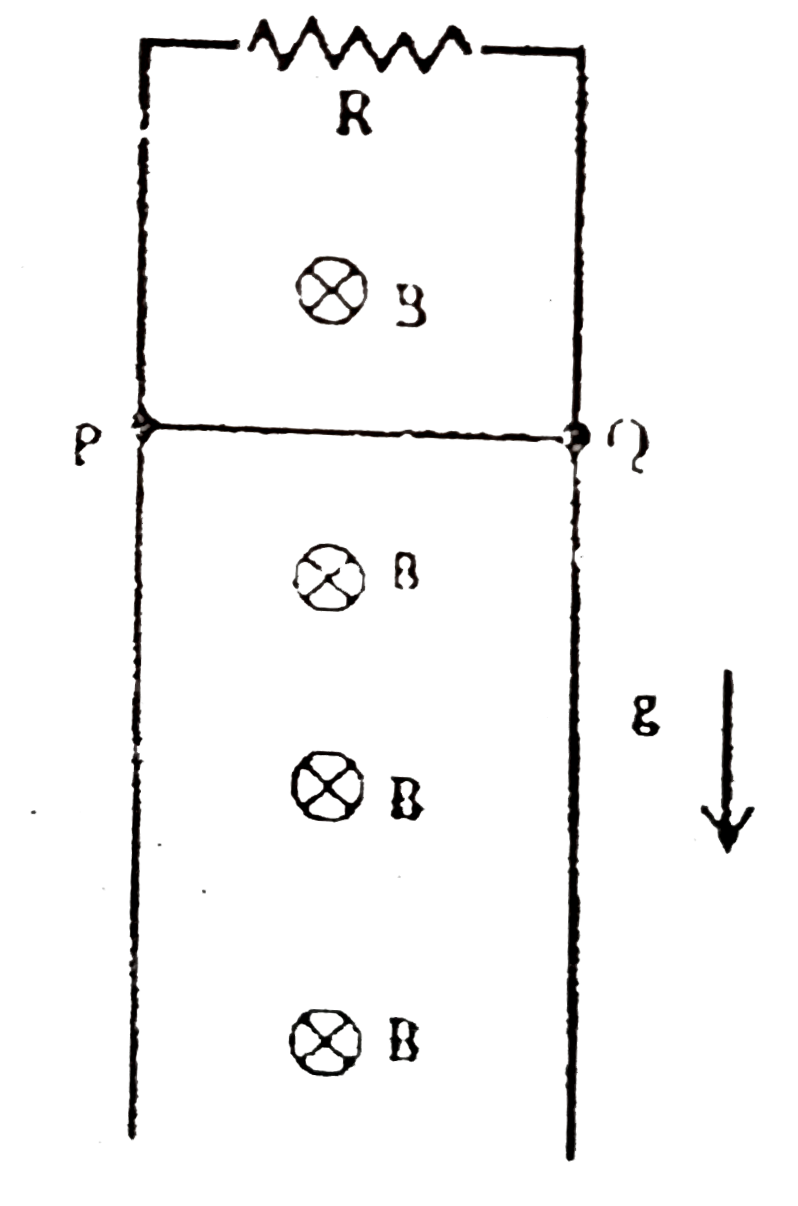
A
B
C
D
Text Solution
Verified by Experts
The correct Answer is:



Topper's Solved these Questions
ELECTROMAGNETIC INDUCTION
FIITJEE|Exercise Comprehension Based Type Comprehension -I|3 VideosELECTROMAGNETIC INDUCTION
FIITJEE|Exercise Comprehension Based Type Comprehension -II|2 VideosELECTROMAGNETIC INDUCTION
FIITJEE|Exercise SOLVED PROBLEMS ( SUBJECTIVE)|10 VideosELASTICITY AND WAVES
FIITJEE|Exercise Assignment Problems (Objective) Level-II|15 VideosELECTROMAGNETIC INDUCTION AND AC CURRENT
FIITJEE|Exercise Example|15 Videos
Similar Questions
Explore conceptually related problems
FIITJEE-ELECTROMAGNETIC INDUCTION-SOLVED PROBLEMS ( OBJECTIVE)
- Shown in the figure is a circular loop of radius r and resistance R. A...
Text Solution
|
- shown in the figure is a small loop that is kept co-axially with the b...
Text Solution
|
- A conducting bar is pulled with a constant speed v on a smooth conduct...
Text Solution
|
- The coefficient of mutual inductance of the two coils is 0.5 H. If the...
Text Solution
|
- A resistance coil is held horizontally and a magnet is allowed to fall...
Text Solution
|
- A rod PQ mass 'm' and length l can slide without friction on two verti...
Text Solution
|
- A square loop of side 1 m is placed in a perpendicular magnetic field....
Text Solution
|
- A small square loop of wire of side l is placed inside a large square ...
Text Solution
|
- A coil of inductance 8.4mH and resistance 6Omega is connected to a 12V...
Text Solution
|
- A uniform but time-varying magnetic field B(t) exists in a circular re...
Text Solution
|
- When a magnet is released from rest along the axis of a hollow conduct...
Text Solution
|
- A conducting loop is pulled with a constant velocity towards a region ...
Text Solution
|
- A loop is kept so that its center lies at the origin of the pointing a...
Text Solution
|
- Shown in the figure is an R-L circuit. Just after the key (K) is close...
Text Solution
|
- A conducting loop of resistance R and radius r has its center at the o...
Text Solution
|