Home
Class 12
PHYSICS
A transparent slab of thickness d has a ...

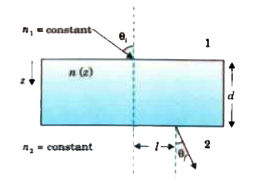
A transparent slab of thickness d has a refractive index n(z) that increases with z. Here z is the vertical distance inside the slab, measured from the top. The slab is placed between two media with uniform refractive indices `n_(1) and n_(2) (gtn_(1))`, as shown in the figure. A ray of light is incident with angle `theta_(i)`, from medium 1 and emerges in medium 2 with refraction and `theta_(f)`, with a lateral displacement l.

Which of the following statement(s) is (are) true ?

A

l is independent of `n_(2)`

B

`n_(1) sin theta_(1) = n_(2) sin theta_(f)`

C

l is independent of n(z)

D

`n_(1) sin theta_(1) = (n_(2)-n_(1))sin theta_(f)`

Text Solution

Verified by Experts

The correct Answer is:

A, B

Clearly there is no role of `n_(2)` in deciding value of 1 and hence option (a) is correct.
Using Snell.s law `mu sin theta= const`, we can understand that option (b) is correct.
Bending of light in medium will depend on how n(z) varies with the height. Hence, option (c) is wrong. We can understand that if option (b) is correct then (d) cannot be correct. Option (d) is wrong. Only options (a) and (b) are correct.
Promotional Banner

Topper's Solved these Questions

  • RAY OPTICS AND OPTICAL INSTRUMENTS

    MODERN PUBLICATION|Exercise OBJECTIVE TYPE QUESTIONS (D. MULTIPLE CHOICE QUESTIONS)|5 Videos
  • RAY OPTICS AND OPTICAL INSTRUMENTS

    MODERN PUBLICATION|Exercise OBJECTIVE TYPE QUESTIONS (ASSERTION REASON TYPE QUESTIONS)|10 Videos
  • RAY OPTICS AND OPTICAL INSTRUMENTS

    MODERN PUBLICATION|Exercise OBJECTIVE TYPE QUESTIONS (JEE (ADVANCED) FOR IIT ENTRANCE)|20 Videos
  • NUCLEI

    MODERN PUBLICATION|Exercise CHAPTER PRACTICE TEST FOR BOARD EXAMINATION|15 Videos
  • SEMICONDUCTOR ELECTRONICS METERIALS DEVICES AND SIMPLE CIRCUITS

    MODERN PUBLICATION|Exercise CHAPTER PRACTICE TEST FOR BOARD EXAMINATION|12 Videos

Similar Questions

Explore conceptually related problems

A transparent slab of thickness d has a refractive index n(z) that increases with z. Here z is the vertical distance inside the slab, measured from the top. The slab is placed between two media with uniform refractive indices n_(1) and n_(2)(gtn_(1)) , theta_(i) , from medium 1 and emerges in medium 2 with refraction angle theta_(f) with a lateral displacement l. Which of the following statement(s) is (are) true?

A wide slab consisting of two media of refractive indices n_1 and n_2 is placed in air as shown in figure. A ray of light is incident from medium n_1 to n_2 at an angle theta where sin(theta) is slightly larger than 1/(n_1) . Take refractive index of air as 1. Which of the following statements is/are correct?

A ray of light is incident on a parallel slab of thickness t and refractive index n. If the angle of incidence theta is small, than the lateral displacement in the incident and emergent ray will be

A ray of light enters a rectangular glass slab of refractive index sqrt(3) at an angle of incidence 60^(@) . It travels a distance of 5cm inside the slab and emerges out of the slab. The perpendicular distance between the incident and the emergent rays is

A ray of light is incident on a glass slab of thickness t, at an angle i,r is the angle of refraction in the glass slab. Distance travelled in the glass slab is

A ray of light passes from vacuum into a medium of refractive index n . If the angle of incidence is twice the angle of refraction , then the relation between the angle of incidence and the refractive index is

A slab of water is on the top of a glass slab of refractive index 2. At what angle to the normal must a ray be incident on the top sureface of th eglass slab so that it is reflected from the bottom surface as shown in figure ?

A light ray is incident at an angle 45∘ on parallel sided glass slab and emerges out grazing the vertical surface. The refractive index of the slab is

A ray of light passes throught a plane glass slab of thickness t and refractive index mu = 1.5 . The angle between incident ray and emergent ray will be

MODERN PUBLICATION-RAY OPTICS AND OPTICAL INSTRUMENTS-OBJECTIVE TYPE QUESTIONS (C. MULTIPLE CHOICE QUESTIONS)
  1. Which of the following entities related to spherical mirrors do not de...

    Text Solution

    |

  2. Which of the following always forms virtual image for real objects ?

    Text Solution

    |

  3. An object O is placed at the bottom of a container in which water is f...

    Text Solution

    |

  4. The focal length of the objective of a compound microscope is f0 and ...

    Text Solution

    |

  5. Light ray is travelling from a medium of refractive index mu in to air...

    Text Solution

    |

  6. Astronomical telescope is used to observe a planet and final image of ...

    Text Solution

    |

  7. Convex lens of focal length f is used as simple microscope. D is the l...

    Text Solution

    |

  8. For a light ray passing through a prism

    Text Solution

    |

  9. There is a solid transparent sphere with a point object embedded at it...

    Text Solution

    |

  10. There is a thin double convex lens having surfaces of radius of curvat...

    Text Solution

    |

  11. Convergent beam of light is passed through a diverging lens. Light ray...

    Text Solution

    |

  12. A convergent beam is incident on a convex mirror. Reflected light

    Text Solution

    |

  13. Identical objective lenses are used to make Astronomical telescope and...

    Text Solution

    |

  14. Properly cut diamond sparkles because

    Text Solution

    |

  15. A convex lens is used to form image of an object on screen. When half ...

    Text Solution

    |

  16. A transparent slab of thickness d has a refractive index n(z) that inc...

    Text Solution

    |

  17. A plano-covex lens is made of a material of refractive index n. When a...

    Text Solution

    |

  18. A transparent thin film of uniform thickness and refractive index n(1)...

    Text Solution

    |

  19. A ray OP of monochromatic light is incident on the face AB of prism AB...

    Text Solution

    |

  20. For an isosceles prism of angle A and refractive index mu, it is found...

    Text Solution

    |
