Home
Class 12
PHYSICS
From the top of a tower a stone is throw...

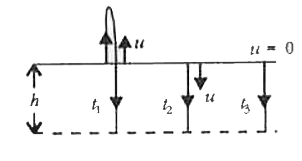
From the top of a tower a stone is thrown up which reaches the ground in a time `t_(1)`. A second stone thrown down with same speed reaches the ground in a time `t_(2)`. A third stone released from rest from the same location reaches the gound in a time `t_(3)`. then

A

`(1)/(t_(3))=(1)/(t_(2))-(1)/(t_(1))`

B

`t_(3)^(2)=t_(1)^(2)-t_(2)^(2)`

C

`t_(3)=(t_(1)+t_(2))/(2)`

D

`t_(3)=sqrt(t_(1)t_(2))`

Text Solution

Verified by Experts

The correct Answer is:
D


Let h be the height of the tower. Then from the laws of motion (under gravity), we get
`h=-ut_(1)+(1)/(2)g t_(1)^(2)` . . (i), When projected upwards with velocity u.
`h=ut_(2)+(1)/(2)g t_(2)^(2)` . . (ii) , When thrown downwards with velocity u.
Also, `h=(1)/(2)g t_(3)^(2)` . . (iii) , when releases from rest.
From (i), we get `(h)/(t_(1))=-u+(1)/(2)g t_(1)` . . (iv)
From (ii), we get `(h)/(t_(2))=u+(1)/(2)g t_(2)` . . (v)
Adding (iv) and (v), we get
`h((1)/(t_(1))+(1)/(t_(2)))=(1)/(2)g(t_(1)+t_(2))`,
putting the values of h from (iii)
`impliest_(3)=sqrt(t_(1)t_(2))`.
Promotional Banner

Topper's Solved these Questions

  • KARNATAKA CET 2001

    KCET PREVIOUS YEAR PAPERS|Exercise Physics|60 Videos
  • KARNATAKA CET 2003

    KCET PREVIOUS YEAR PAPERS|Exercise PHYSICS|60 Videos

Similar Questions

Explore conceptually related problems

A body is thrown up from the top of a tower with some velocity reaches the ground in 16 second. The same body if thrown with same velocity in downward direction reaches the ground in 4 second. If the body is just dropped from the tower, then it will reach the ground in time:

A stone is thrown upwards from the top of a tower with some initial speed and it reaches the ground in second. Now it is allowed to fall with the same initial speed downward and it reaches the ground in 1 second In how much time will it reach the ground if the stone is allowed to fall freely under gravity from the same place:

A body when released from the top of a tower of height h reaches the ground in time T. At what time it is at a height h/2 above the ground?

A particle is thrown vertically upwards from the top of a tower with a certain velocity and takes 8s to reach the foot of the tower. The same when thrown with the same speed downwards, it reaches the foot of the tower in 2s. Calculate what time the particle would take to reach the foot of the tower when dropped freely. Taking g=9.8ms^(-2) calculate the height of the tower and the initial speed of the projectile.

Two stones are thrown from the top of a tower, one straight down with an initial speed and the second straight up with the same speed. When the two stones hit the ground, they will have speeds in the ratio :

A block released from rest from the top of a smooth inclined plane of angle of inclinatione, reaches the bottom in time t_(1) The same block, released from rest from the top of another smooth inclined plane of angle of inclination theta_(2) reaches the bottom in time ty. If the two inclined planes have the same height, the relation between t_(1) and t_(2) is :

A stone is thrown up vertically and the height x feet reached by it in time t seconds is given by x=80t-16t^(2) . The stone reaches the maximum height in time (seconds)

Two stones are thrown from the top of a towerone straight down with an initial speed u and the second straight up with the same speed u. When the two stones hit the ground, they will have speeds in the ratio

From the top of a tower of two stones, whose masses are in the ratio 1: 2 are thrown on straight up with an initial speed u and the second straight down with the same speed u. Then, neglecting air resistance

A stone is thrown vertically upwards and the height x ft, reached by the stone in t seconds is given by x=80t-16t^(2) . The stone reaches the maximum height in

KCET PREVIOUS YEAR PAPERS-KARNATAKA CET 2002-PHYSICS (MCQ.s)
  1. When 100 V d.c. is applied across a coil, a current of 1 A flows throu...

    Text Solution

    |

  2. In the circuit shown in the figure, the a.c. source gives a voltage V=...

    Text Solution

    |

  3. In the Borh model of the hydrogen atom, let R,V and E represent the ra...

    Text Solution

    |

  4. In a sample of radioactive material, what percentage of the initial nu...

    Text Solution

    |

  5. A caesium photocell , with a steady potential difference of 60 V acros...

    Text Solution

    |

  6. The equation y=Acos^(2)[2pint-2pi(x)/(lamda)] represents a wave with

    Text Solution

    |

  7. A light points fixed to one prong of a tuning fork touches a vertical ...

    Text Solution

    |

  8. Three point charges are placed at the corner of an equilateral triangl...

    Text Solution

    |

  9. Two copper balls, each weighing 10 g are kept in air 10 cm apart. If o...

    Text Solution

    |

  10. What fraction of the energy drawn from the charging battery is stored ...

    Text Solution

    |

  11. A projectile is moving at 20ms^(-1) at its highest point, where it bre...

    Text Solution

    |

  12. A body is projected vertically upwards from the surface of a planet of...

    Text Solution

    |

  13. From the top of a tower a stone is thrown up which reaches the ground ...

    Text Solution

    |

  14. Five rods of same dimensions are arranged as shown in the figure. They...

    Text Solution

    |

  15. The energy spectrum of a black body exhibits a maximum around a wavele...

    Text Solution

    |

  16. n identical bulbs, each designed to draw a power p from a certain volt...

    Text Solution

    |

  17. A and B are two conductors carrying a current i in the same direction ...

    Text Solution

    |

  18. The current-voltage graph for a given metallic conductor at two differ...

    Text Solution

    |

  19. The variation of the intensity of magnetisation (I) with respect to th...

    Text Solution

    |

  20. An aluminium ring B faces an electromagnet A. The current I through A ...

    Text Solution

    |

