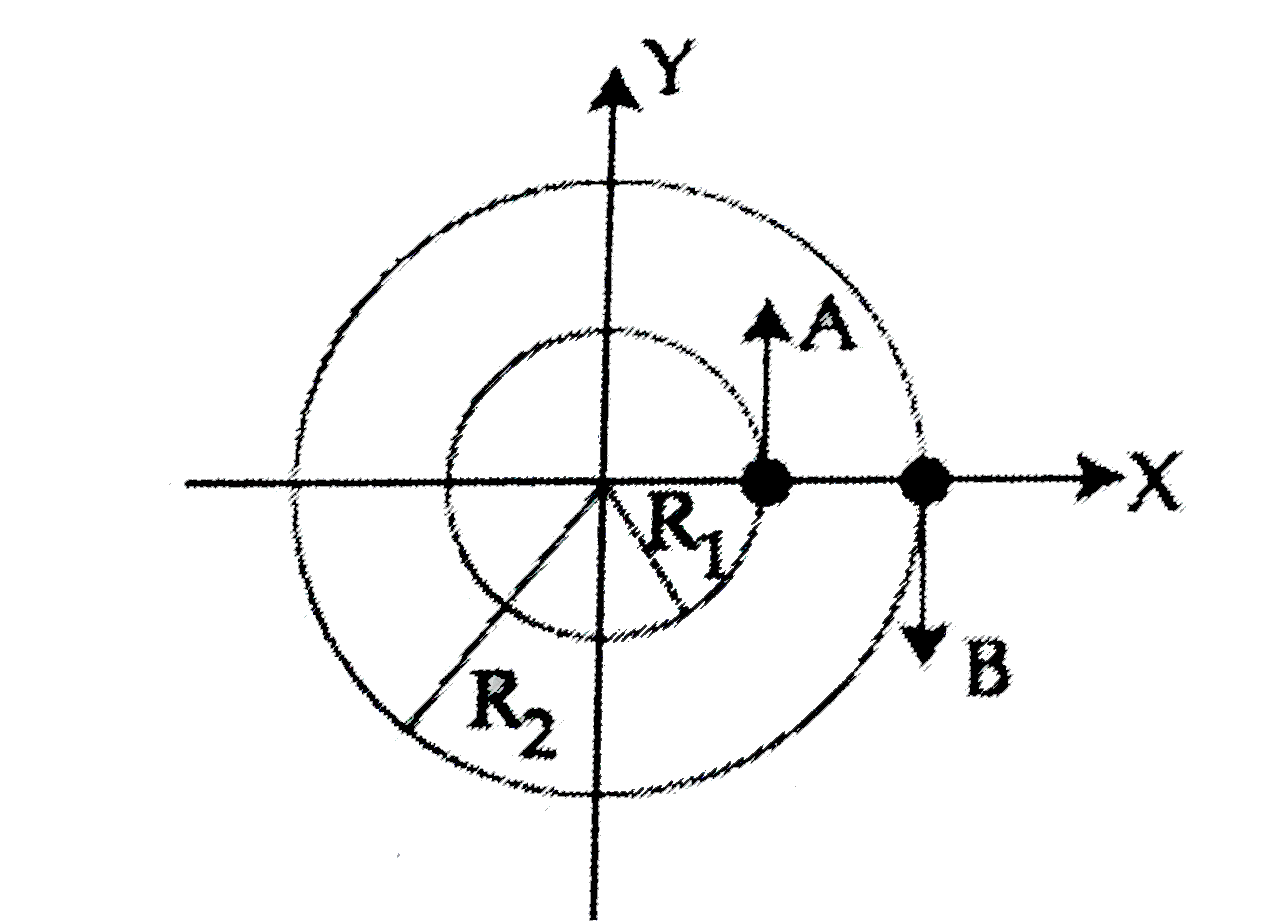
Two particles A,B are moving on two concentric circles of radii `R_1)` and `R_2` with equal angular speed `omega`. At`t=0`,their positions and direction fo motion are shown in the figure :
Two particles A and B are moving in uniform circular motion in concentric circles of radii r_(A) and r_(B) with speed u_(A) and u_(B) respectively. Their time period of rotation is the same. The ratio of angular speed of a to that of B will be:
Two particles are moving in different circles in same plane with different angular velocities as shown in figure. At t = 0, initial positions of particles A and B are shown by dots on the respective circles. Initial distance between particles is 1m. Particle A move anticlockwise in the first circle whereas B moves clockwise in the second circle. Angle described (rotated) by A and B in time 't' are theta_(A)=((pi)/2t) and theta_(B)=(pit) respectively. here theta is in radian and t is in second. Radius of each circle is shown in diagram. At time t=2 second, the angular velocity of the particle A with respect to the particle B is
Two particles are moving in different circles in same plane with different angular velocities as shown in figure. At t = 0, initial positions of particles A and B are shown by dots on the respective circles. Initial distance between particles is 1m. Particle A move anticlockwise in the first circle whereas B moves clockwise in the second circle. Angle described (rotated) by A and B in time 't' are theta_(A)=((pi)/2t) and theta_(B)=(pit) respectively. here theta is in radian and t is in second. Radius of each circle is shown in diagram. At time t=1 sec. the magnitude of acceleration of A with respect to B is
Two particles are moving in different circles in same plane with different angular velocities as shown in figure. At t = 0, initial positions of particles A and B are shown by dots on the respective circles. Initial distance between particles is 1m. Particle A move anticlockwise in the first circle whereas B moves clockwise in the second circle. Angle described (rotated) by A and B in time 't' are theta_(A)=((pi)/2t) and theta_(B)=(pit) respectively. here theta is in radian and t is in second. Radius of each circle is shown in diagram. Find the magnitude of acceleration of A at t=1 sec
The capacitance of two concentric spherical shells of radii R_(1) and R_(2) (R_(2) gt R_(1)) is
Two particles A and B are revolving with constant angular velocity on two concentric circles of radius 1m and 2m respectively as shown in figure. The positions of the particles at t = 0 are shown in figure. The positions of the particles at t=0 are shown in figure. if m_(A)=2kg, m_(B)= 1kg and vec(P)_(A) and vec(P)_(B) are linear momentum of the particle then what is the maximum value of |vec(P)_(A)+vec(P)_(B)| in kg-m/sec in subsequent motion of two particles.
Two racing cars having masse m_(1) and m_(2) move in concentric circle of radii r_(1) and r_(2) respectively. If their angular speed are same , then ratio of their linear speed is
Two particles of masses m_(1) and m_(2) are moving in concentric circle of radii r_(1) and r_(2) such that their period are same. Then the ratio of their centripetal acceleration is
Two racing cars having masses m_(1) and _(2) move in concentric circles of radi r_(1) and r_(2) respectively . If their angular speeds are same , then the ration of their linear speeds is