

Home
Class 12
PHYSICS
A ball is thrown vertically up (taken as...

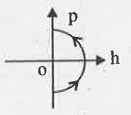
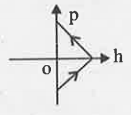
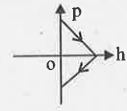
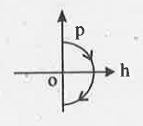
A ball is thrown vertically up (taken as + z-axis) from the ground. The correct momentum-height (p-h) diagram is:

A

B

C

D

Text Solution

AI Generated Solution

The correct Answer is:
To solve the problem regarding the momentum-height (p-h) diagram for a ball thrown vertically upward, we will follow these steps: ### Step 1: Understand the Motion of the Ball When a ball is thrown vertically upward, it moves against the force of gravity. Initially, it has a certain velocity (u) and as it rises, its velocity decreases due to the acceleration due to gravity (g). **Hint:** Remember that the velocity decreases as the ball rises until it reaches its maximum height, where the velocity becomes zero. ### Step 2: Use the Equation of Motion We can use the third equation of motion to relate velocity (v), initial velocity (u), acceleration (a), and height (h): \[ v^2 = u^2 - 2gh \] Here, we take acceleration due to gravity as negative since it acts downward. **Hint:** The equation shows that as height (h) increases, the velocity (v) decreases. ### Step 3: Relate Momentum to Velocity Momentum (p) is given by: \[ p = mv \] Where m is the mass of the ball. From the equation of motion, we can express velocity in terms of height: \[ v = \sqrt{u^2 - 2gh} \] Thus, the momentum can be expressed as: \[ p = m \sqrt{u^2 - 2gh} \] **Hint:** The momentum depends on the square root of the height, indicating a non-linear relationship. ### Step 4: Analyze the Momentum-Height Relationship As the ball rises: - At ground level (h = 0), momentum is maximum (p = mu). - As height increases, momentum decreases until it reaches zero at maximum height (h = h_max). - After reaching maximum height, as the ball falls back down, momentum will become negative. **Hint:** The graph will show a parabolic relationship, decreasing to zero at maximum height and then becoming negative as the ball descends. ### Step 5: Determine the Correct Graph From the options given: - Options 2 and 3 are incorrect because they show linear relationships. - Between options 1 and 4, we need to determine the direction of momentum: - Option 1 suggests momentum starts negative and becomes positive. - Option 4 suggests momentum starts positive and becomes negative. Since the ball is thrown upwards, it starts with positive momentum and decreases to zero at maximum height, then becomes negative as it falls back down. Therefore, option 4 is correct. **Hint:** Look for the graph that starts positive, decreases to zero, and then goes negative. ### Final Answer The correct momentum-height (p-h) diagram is represented by **Option 4**.

To solve the problem regarding the momentum-height (p-h) diagram for a ball thrown vertically upward, we will follow these steps: ### Step 1: Understand the Motion of the Ball When a ball is thrown vertically upward, it moves against the force of gravity. Initially, it has a certain velocity (u) and as it rises, its velocity decreases due to the acceleration due to gravity (g). **Hint:** Remember that the velocity decreases as the ball rises until it reaches its maximum height, where the velocity becomes zero. ### Step 2: Use the Equation of Motion ...
Promotional Banner

Topper's Solved these Questions

  • GRAVITATION

    DISHA PUBLICATION|Exercise EXERCISE-2|30 Videos
  • LAWS OF MOTION

    DISHA PUBLICATION|Exercise Exercise-2 : Concept Applicator|30 Videos

Similar Questions

Explore conceptually related problems

When a ball is thrown vertically upwards, at the maximum height

A ball is thrown vertically upwards with a velocity u from the ground. The ball attains a maximum height H_("max") . Then find out the time and displacement at which ball have half of the maximum speed

A ball is thrown vertically upwards. What is its momentum at the highest point?

A ball is thrown vertically upwards from the ground. It crosses a point at the height of 25 m twice at an interval of 4 secs. The ball was thrown with the velocity of

A ball is thrown vertically upwards from the ground It crosses a point at the height of 25 m twice at an interval of 4 secs . The ball was thrown with the velocity of.

A ball is thrown vertically upwards from the ground. If T_1 and T_2 are the respective time taken in going up and coming down, and the air resistance is not ignored, then

A ball is thrown vertically upwards from the ground. Work done by air resistance during its time of flight is

A body is thrown vertically up from the ground. It reaches a maximum height of 100 m in 5 sec . After what time it will reach the ground from the maximum height position

An open elevator is ascending with constant speed v=10m//s. A ball is thrown vertically up by a boy on the lift when he is at a height h=10m from the ground. The velocity of projection is v=30 m//s with respect to elevator. Find (a) the maximum height attained by the ball. (b) the time taken by the ball to meet the elevator again. (c) time taken by the ball to reach the ground after crossing the elevator.

DISHA PUBLICATION-JEE MAINS- 2019 (HELD ON :9TH APRIL 2019 (SHIFT-I))-QUESTIONS
  1. In the density measurement of a cube, the mass and edge length are mea...

    Text Solution

    |

  2. The stream of a river is flowing with a speed of 2 km/h. A swimmer can...

    Text Solution

    |

  3. A ball is thrown vertically up (taken as + z-axis) from the ground. Th...

    Text Solution

    |

  4. A uniform cable of mass 'M' and length 'L' is placed on a horizonta...

    Text Solution

    |

  5. A body of mass 2 kg makes an elastic collision with another body at re...

    Text Solution

    |

  6. A stationary horizontal disc is free to rotate about its axis. When a ...

    Text Solution

    |

  7. The following bodies are made to roll up (without slipping) the same i...

    Text Solution

    |

  8. A solid sphere of radius a and mass m is surrounded by cocentric spher...

    Text Solution

    |

  9. A capillary tube of radius R is immersed in water and water rises in i...

    Text Solution

    |

  10. Following figure shows two processes A and B for a gas. If DeltaQ(A) a...

    Text Solution

    |

  11. For a given gas at 1 atm pressure, rms speed of the molecules is 200 m...

    Text Solution

    |

  12. An HCl molecule has rotational, translational and vibrational motions....

    Text Solution

    |

  13. A simple pendulum oscillating in air has period T. The bob of the pend...

    Text Solution

    |

  14. The pressure wave, P=0.01 sin [1000 t-3x]Nm^(-2), corresponds to the...

    Text Solution

    |

  15. A string is clamped at both the ends and it is vibrating in its 4^(th)...

    Text Solution

    |

  16. A system of three charges are placed as shown in the figure: If...

    Text Solution

    |

  17. Determine the charge on the capacitor in the following circuit:

    Text Solution

    |

  18. A capacitor with capacitance 5mu F is charged to 5 mu C . If the p...

    Text Solution

    |

  19. A wire of resistance R is bent to form a square ABCD as shown in the f...

    Text Solution

    |

  20. A rectangular coil (Dimension 5 cmxx2.5 cm) with 100 turns, carrying a...

    Text Solution

    |