Home
Class 12
CHEMISTRY
The plot that represents the zero order ...

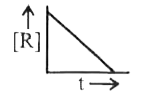
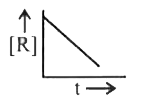
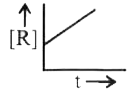
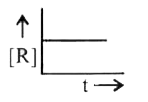
The plot that represents the zero order reaction is:

A

B

C

D

Text Solution

AI Generated Solution

The correct Answer is:

To determine the plot that represents a zero-order reaction, we can follow these steps: ### Step 1: Understand Zero-Order Reactions In a zero-order reaction, the rate of reaction is constant and does not depend on the concentration of the reactant. This means that the rate of reaction remains the same regardless of how much of the reactant is present. ### Step 2: Write the Rate Law For a zero-order reaction, the rate law can be expressed as: \[ \text{Rate} = k \] where \( k \) is the rate constant. ### Step 3: Relate Concentration to Time For a zero-order reaction, the concentration of the reactant \( [A] \) decreases linearly over time. The relationship can be expressed as: \[ [A] = [A_0] - kt \] where: - \( [A] \) is the concentration at time \( t \), - \( [A_0] \) is the initial concentration, - \( k \) is the rate constant, - \( t \) is time. ### Step 4: Plotting the Graph If we plot the concentration of the reactant \( [A] \) versus time \( t \), we will get a straight line with a negative slope. This indicates that the concentration decreases linearly over time. ### Step 5: Identify the Correct Plot Since the concentration decreases linearly, the plot of \( [A] \) vs. \( t \) will be a straight line. The plot that represents the zero-order reaction is a straight line with a negative slope. ### Conclusion The correct answer is that the plot representing a zero-order reaction is a straight line with a negative slope when plotting concentration vs. time. ---

To determine the plot that represents a zero-order reaction, we can follow these steps: ### Step 1: Understand Zero-Order Reactions In a zero-order reaction, the rate of reaction is constant and does not depend on the concentration of the reactant. This means that the rate of reaction remains the same regardless of how much of the reactant is present. ### Step 2: Write the Rate Law For a zero-order reaction, the rate law can be expressed as: \[ \text{Rate} = k \] ...
Promotional Banner

Topper's Solved these Questions

  • CHEMICAL KINETICS

    DISHA PUBLICATION|Exercise EXERCISE 1 : CONCEPT BUILDER (TOPICWISE)(TOPIC 3 : Theories of Rate of Reaction)|17 Videos
  • CHEMICAL KINETICS

    DISHA PUBLICATION|Exercise EXERCISE 2 : CONCEPT APPLICATOR|30 Videos
  • CHEMICAL KINETICS

    DISHA PUBLICATION|Exercise EXERCISE 1 : CONCEPT BUILDER (TOPICWISE) (TOPIC 1: Rate of Reaction, Rate Laws and Rate Constant)|11 Videos
  • CHEMICAL BONDING AND MOLECULAR STRUCTURE

    DISHA PUBLICATION|Exercise EXERCISE-2: CONCEPT APPLICATOR|30 Videos
  • CHEMISTRY IN EVERDAY LIFE

    DISHA PUBLICATION|Exercise Exercise|88 Videos

Similar Questions

Explore conceptually related problems

For a zero order reaction

In a zero order reaction:

For a zero order reaction :

Zero order reaction means that

Which of the following graphs formed plotted between t_(1//2) and initial concentration (a) represents a zero order reaction ?

DISHA PUBLICATION-CHEMICAL KINETICS -EXERCISE 1 : CONCEPT BUILDER (TOPICWISE) (TOPIC 2: Order of Reaction and Half Life Period)
  1. A hypothetical reaction A(2) + B(2) rarr 2AB follows the mechanism as ...

    Text Solution

    |

  2. The time taken for 90% of a first order reaction to be completed is a...

    Text Solution

    |

  3. A substance 'A' decomposes by a first order reaction starting initial...

    Text Solution

    |

  4. Half life of a first order reaction is 4s and the initial concentrati...

    Text Solution

    |

  5. 3A to B+C, it would be a zero order reaction when

    Text Solution

    |

  6. The reaction A toB follows first order reaction. The time taken for 0....

    Text Solution

    |

  7. For a first-order reaction A rarr B the reaction rate at reactant conc...

    Text Solution

    |

  8. For a reaction A + 2B rarr C, rate is given by R = K [A] [B]^(2). The ...

    Text Solution

    |

  9. In a first order reaction, the concentration of the reactant, decrease...

    Text Solution

    |

  10. In a reaction, when the concentration of reactant is increased two ti...

    Text Solution

    |

  11. The rate constant of a first order reaction is 6.9xx10^(-3)s^(-1). How...

    Text Solution

    |

  12. The plot that represents the zero order reaction is:

    Text Solution

    |

  13. For a chemical reaction t(1 // 2) is 2.5 hours at room temperature. H...

    Text Solution

    |

  14. Point out the wrong statement: For a first order reaction

    Text Solution

    |

  15. For a reaction (d x)/(d t) = K[H^(+)]^(n). If pH of reaction medium ch...

    Text Solution

    |

  16. Ethylene is produced by C(4)H(8) overset(Delta)to 2C(2)H(4)  The rat...

    Text Solution

    |

  17. Which one of the following statements for the order of a reaction is i...

    Text Solution

    |

  18. The rate of a first-order reaction is 0.04 mol L^(-1)s^(-1) at 10 sec...

    Text Solution

    |

  19. Mechanism of a hypothetical reaction X(2) + Y(2) rarr 2XY is given b...

    Text Solution

    |

  20. A first order reaction has a specific reaction rate of 10^(-2) sec^(-1...

    Text Solution

    |
