Home
Class 12
PHYSICS
A coherent parallel beam of microwaves o...

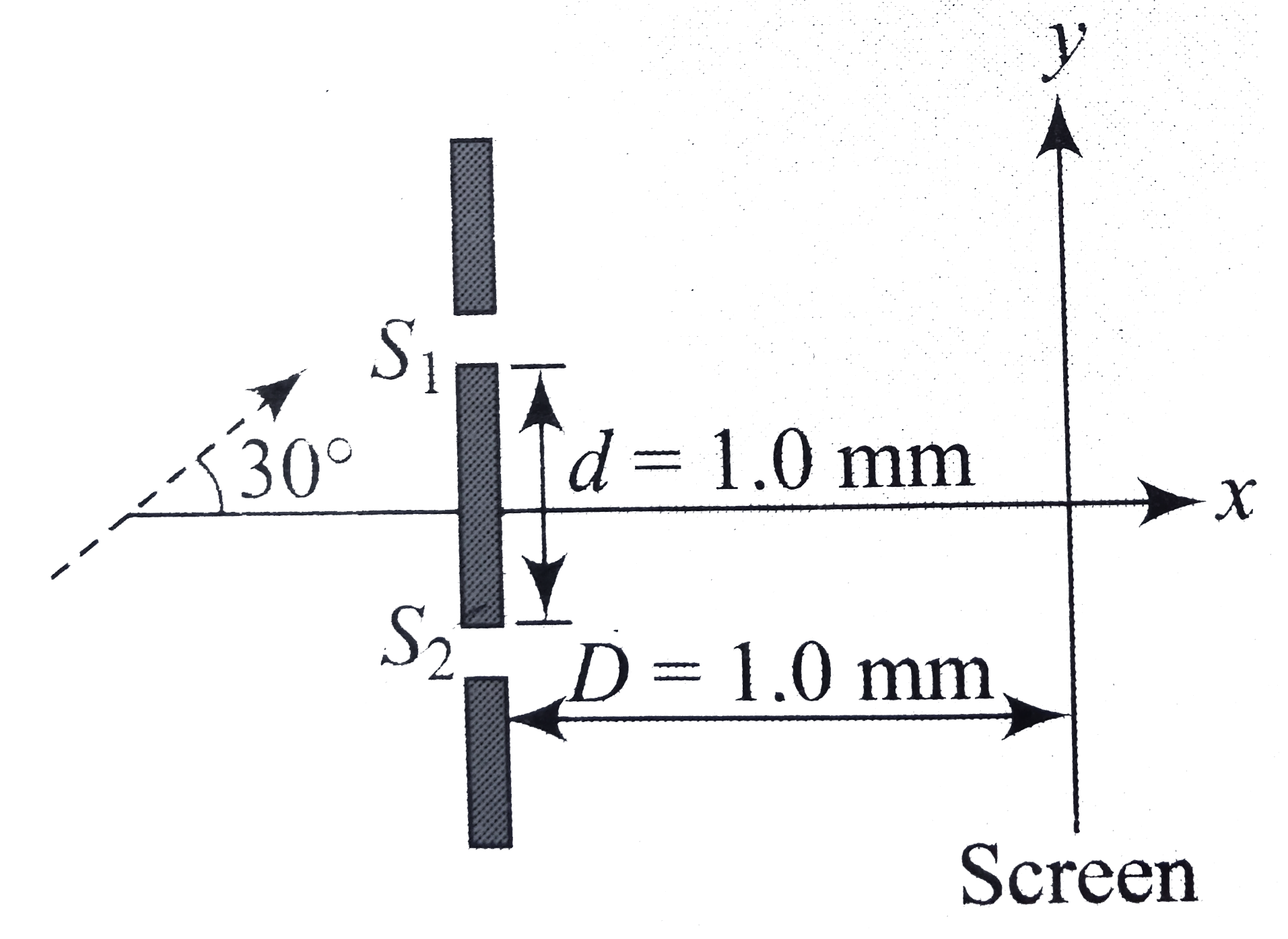
A coherent parallel beam of microwaves of wavelength `lambda = 0.5 mm` falls on aYoung's double- slit apparatus. The separation between the slits is 1.0 mm. The intensity of microwaves is measured on a screen placed parallel to the plane of the slits at a distance of 1.0 m from it as shown in Fig. 2.42.
If the incident beam makes an angle or `30^(@)` with the x-axis (as in the dotted arrow shown in the figure), find the y-coordinates of the first minima on either side of the central maximum.

Text Solution

Verified by Experts
KEY IDEA
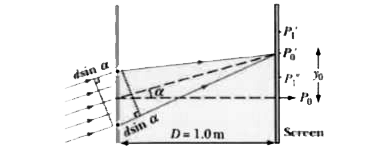
When the incident wave makes an angle `alpha= 30^(@)` with the x axis, the position of zero path difference, that is the central maximum, shifts from `P_(0)` to `P_(0).`

Here we can casily see that the waves arriving at slits are having an initial path difference of `d sin alpha`. To compensate for this, the central maxima should shift at a point where the path of the wave coming through the lower slit is longer by the same amount. Clearly, this will occur at an angle `alpha` to the central line. We have
`y_(0)=D tan alpha=(1.0 m) xx tan 30^(@)=(1)/(sqrt3) m.`
Therefore, the y coordinate to the first minimum `P_(1).` is the point where the path difference is `lambda // 2`. Therefore,
`d sin theta- d sin alpha=-(lambda)/(2)`
Solving, we get `sin theta = 3 // 4`. Therefore,
`y_(1)=((1.0m) xx (3 // 4))/([1- (9 // 16)]^(1 // 2))=(3)/(sqrt(7)) m.`
Similarly, the y coordinate of the first minimum `P_(1)..` is where the path difference is `-lambda // 2`.
`d sin theta-d sin alpha= -(lambda)/(2)`
Solving, we get `sin theta = 1 // 4`. Therefore,
`y_(1).=((1.0 m) xx (1 // 4))/([1-(1 // 16)]^(1 // 2))=(1)/(sqrt(15)) m`. (Answer)
Learn: How do we distinguish between the central maxima and other maxima? For this, we note that the central maximum is the point where the path difference is zero for all the wavelengths. The location of other maxima is at a path difference of `n lambda`, which depends on the wavelength. So, if we use white light to obtain the inter- ference pattern, the central maxima will be common to all the colors. Other fringes will be colored.
Promotional Banner

Topper's Solved these Questions

  • INTERFERENCE AND DIFFRACTION

    RESNICK AND HALLIDAY|Exercise CHECKPOINT|6 Videos
  • INTERFERENCE AND DIFFRACTION

    RESNICK AND HALLIDAY|Exercise PROBLEMS|61 Videos
  • HYDROGEN ATOM

    RESNICK AND HALLIDAY|Exercise PRACTICE QUESTIONS(Integer Type)|6 Videos
  • MAGNETIC FIELDS DUE TO CURRENTS

    RESNICK AND HALLIDAY|Exercise Practice Question (Integer Type)|4 Videos

