Home
Class 12
PHYSICS
A lens of focal length f is cut along th...

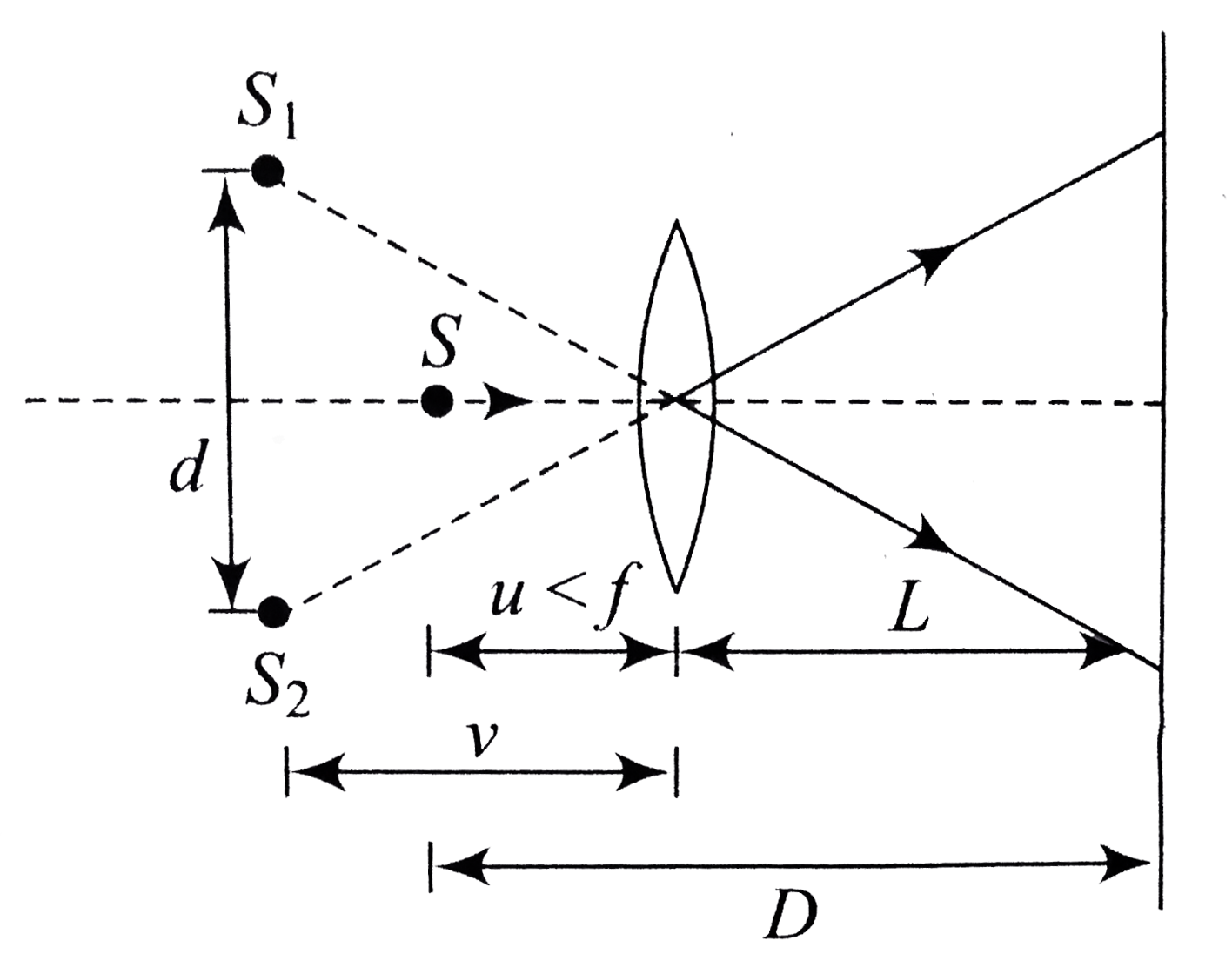
A lens of focal length f is cut along the diameter into two identical halevs. In this process, a layer of the lens t in thickness is lost, then the halves are put together to form a composite lens. In between the focal plane and the composite lens, a narrow slit is placed near the focal plane. The slit is emitting monochromatic `lambda`. Behind the lens, a screen is located at a distance L front it.

The expression for the number of visible maxima which are obtained through above said arrangement will turn out to be

A

`(Lt^(2))/(lambda f^(2))`

B

`(2Lt^(2))/(lambda f^(2))`

C

`(Lt)/(2lambda f^(2))`

D

`(Lt^(2))/(2lambda f^(2))`

Text Solution

Verified by Experts

The correct Answer is:

C
Promotional Banner

Topper's Solved these Questions

  • INTERFERENCE AND DIFFRACTION

    RESNICK AND HALLIDAY|Exercise PRACTICE QUESTIONS (Matrix-Match)|1 Videos
  • INTERFERENCE AND DIFFRACTION

    RESNICK AND HALLIDAY|Exercise PRACTICE QUESTIONS|7 Videos
  • INTERFERENCE AND DIFFRACTION

    RESNICK AND HALLIDAY|Exercise PRACTICE QUESTIONS (More than One Correct Choice Type)|23 Videos
  • HYDROGEN ATOM

    RESNICK AND HALLIDAY|Exercise PRACTICE QUESTIONS(Integer Type)|6 Videos
  • MAGNETIC FIELDS DUE TO CURRENTS

    RESNICK AND HALLIDAY|Exercise Practice Question (Integer Type)|4 Videos

Similar Questions

Explore conceptually related problems

A lens of focal length f is cut along the diameter into two identical halevs. In this process, a layer of the lens t in thickness is lost, then the halves are put together to form a composite lens. In between the focal plane and the composite lens, a narrow slit is placed near the focal plane. The slit is emitting monochromatic lambda . Behind the lens, a screen is located at a distance L front it. Find the fringe width for the pattern obtained under given arrangement on the screen.

A lens of diameter 5.0cm and focal length f = 25.0 cm was cut along the diameter into two identical halves. In the process, the layer of the lens alpha = 1.00 mm in thieckness was lost. Then the halves were put together to form a composite lens. In this focal plane a narrow slit was placed, emitting monochromatic light with wavelength lambda = 0.60 mu m . Behind the lens a screen was located at a distance b = 50 cm from it. Find: (a) the which of a fringe on the screen and the number of possible maxima, (b) the maximum width of the slit del_(max) at which the fringes on the screen will be still observed sufficiently sharp.

In Billet's Lens Arrangement, a convex lens of focal length 50 cm is cut along the diameter into two indentical halves Å and B and in the process a layer C of the lens thickness 1 mm is lost. Then the two halves A and B are put together to form a composite lens. Now, infront of this composite lens a source of light emitting wavelength lambda = 6000 Å is placed at a distance of 25 cm as shown in the figure. Behind the lens there is a screen at a distance 50 cm from it. Find the fringe width fo the interference pattern obtained on the screen.

The focal length of a convex lens is

An equiconvex lens of focal length 15 cm is cut into two equal halves in thickness. What is the focal length of each half ?

The focal length of a lens depends on

A diverging lens of focal length F is cut into two idential parts, each forming a plano concave lens, Fig. What is the focal length of each part ?

RESNICK AND HALLIDAY-INTERFERENCE AND DIFFRACTION -PRACTICE QUESTIONS (Linked Comprehension)
  1. The figure shows the interfernece pattern obtained in double slit expe...

    Text Solution

    |

  2. The figure shows the interference pattern obtained in a double-slit ex...

    Text Solution

    |

  3. The figure shows the interference pattern obtained in a double-slit ex...

    Text Solution

    |

  4. Angular width of central maxima in the Fraunhofer diffraction pattern ...

    Text Solution

    |

  5. Angular width of central maximum in the Fraunhoffer diffraction patter...

    Text Solution

    |

  6. An initially parallel cylindrical beam travels in a medium of refracti...

    Text Solution

    |

  7. An intially parallel cyclindrical beam travels in a medium of refracti...

    Text Solution

    |

  8. An initially parallel cylindrical beam travels in a medium of refracti...

    Text Solution

    |

  9. When waves from two herent sources, having amplitudes a and b superimp...

    Text Solution

    |

  10. When waves from two herent sources, having amplitudes a and b superimp...

    Text Solution

    |

  11. When waves from two herent sources, having amplitudes a and b superimp...

    Text Solution

    |

  12. When waves from two coherent source of amplitudes a and b superimpose...

    Text Solution

    |

  13. When waves from two herent sources, having amplitudes a and b superimp...

    Text Solution

    |

  14. Consider the situation shown in fig. The two slits S(1) and S(2) place...

    Text Solution

    |

  15. Consider the situation shown in fig. The two slits S(1) and S(2) place...

    Text Solution

    |

  16. Consider the situation shown in fig. The two slits S(1) and S(2) place...

    Text Solution

    |

  17. A lens of focal length f is cut along the diameter into two identical ...

    Text Solution

    |

  18. A lens of focal length f is cut along the diameter into two identical ...

    Text Solution

    |

  19. In a modified Young's double-slit experiment, source S is kept in fro...

    Text Solution

    |

  20. In a modified Young's double-slit experiment, source S is kept in fro...

    Text Solution

    |
