Home
Class 12
PHYSICS
The figure indicates three small patches...

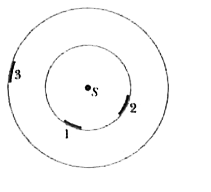
The figure indicates three small patches 1, 2, and 3 that lie on the surfaces of two imaginary spheres, the spheres are centered on an isotropic point source S of sound. The rates at which energy is transmitted through the three patches by the sound waves are equal. Rank the patches according to (a) the intensity of the sound on them and (b) their area, greatest first.

Text Solution

Verified by Experts

1 and 2 tie , then 3
Promotional Banner

Topper's Solved these Questions

  • WAVE - II

    RESNICK AND HALLIDAY|Exercise PROBLEMS|59 Videos
  • WAVE - II

    RESNICK AND HALLIDAY|Exercise PRACTICE QUESTIONS (SINGLE CORRECT CHOICE TYPE)|35 Videos
  • WAVE - II

    RESNICK AND HALLIDAY|Exercise PRACTICE QUESTIONS (INTEGER TYPE)|5 Videos
  • VECTORS

    RESNICK AND HALLIDAY|Exercise PRACTICE QUESTIONS|39 Videos
  • WAVES-I

    RESNICK AND HALLIDAY|Exercise Practice Questions (Integer Type)|4 Videos

Similar Questions

Explore conceptually related problems

A point source emits sound waves with an average power output of 80.0 W (a) Find the intensity 3.00 m from the source. (b) find the distance at which the intensity of the sound is 1.00xx10^-8(W)/(m^2)

A point isotropic sound source is located on the perpendicular to the plane of a ring drawn through the centre O of the ring. The distance between the point O and the source is l=1.00m, the radius of the ring is R=5.00m . Find the mean energy flow across the area enclosed by the ring if at the point O the intensity of sound is equal to I_(0)=30 mu W//m^(2) . The damping of the waves is negligible.

When a sound wave enters the ear, it sets the eardrum into oscillation, which in turn causes oscillation of 3 tiny bones in the middle ear called ossicles. This oscillation is finally transmitted to the fluid filled in inner portion of the ear termed as inner ear, the motion of the fluid disturbs hair cells within the inner ear which transmit nerve impulses to the brain with the information that a sound is present. The theree bones present in the middle ear are named as hammer, anvil and stirrup. Out of these the stirrup is the smallest one and this only connects the middle ear to inner ear as shown in the figure below. The area of stirrup and its extent of connection with the inner ear limits the sensitivity of the human ear consider a person's ear whose moving part of the eardrum has an area of about 50mm^2 and the area of stirrup is about 5mm^2 . The mass of ossicles is negligible. As a result, force exerted by sound wave in air on eardum and ossicles is same as the force exerted by ossicles on the inner ear. Consider a sound wave having maximum pressure fluctuation of 4xx10^-2Pa from its normal equilibrium pressure value which is equal to 10^5Pa . Frequency of sound wave in air is 332(m)/(s) . Velocity of sound wave in fluid (present in inner ear) is 1500(m)/(s) . Bulk modulus of air is 1.42xx10^5Pa . Bulk modulus of fluid is 2.18xx10^9Pa . Q. This person (without hearing aid machine) is sitting inside a busy restaurant where average sound intensity is 3.2xx10^-5(W)/(m^2) . How much energy in the form of sound is taken up by the person in his meal time of 1 h?

When a sound wave enters the ear, it sets the eardrum into oscillation, which in turn causes oscillation of 3 tiny bones in the middle ear called ossicles. This oscillation is finally transmitted to the fluid filled in inner portion of the ear termed as inner ear, the motion of the fluid disturbs hair cells within the inner ear which transmit nerve impulses to the brain with the information that a sound is present. The theree bones present in the middle ear are named as hammer, anvil and stirrup. Out of these the stirrup is the smallest one and this only connects the middle ear to inner ear as shown in the figure below. The area of stirrup and its extent of connection with the inner ear limits the sensitivity of the human ear consider a person's ear whose moving part of the eardrum has an area of about 50mm^2 and the area of stirrup is about 5mm^2 . The mass of ossicles is negligible. As a result, force exerted by sound wave in air on eardum and ossicles is same as the force exerted by ossicles on the inner ear. Consider a sound wave having maximum pressure fluctuation of 4xx10^-2Pa from its normal equilibrium pressure value which is equal to 10^5Pa . Frequency of sound wave in air is 332(m)/(s) . Velocity of sound wave in fluid (present in inner ear) is 1500(m)/(s) . Bulk modulus of air is 1.42xx10^5Pa . Bulk modulus of fluid is 2.18xx10^9Pa . Q. If the person is using an hearing aid, which increase the intensity of given sound wave change as perceived by inner ear?

When a sound wave enters the ear, it sets the eardrum into oscillation, which in turn causes oscillation of 3 tiny bones in the middle ear called ossicles. This oscillation is finally transmitted to the fluid filled in inner portion of the ear termed as inner ear, the motion of the fluid disturbs hair cells within the inner ear which transmit nerve impulses to the brain with the information that a sound is present. The theree bones present in the middle ear are named as hammer, anvil and stirrup. Out of these the stirrup is the smallest one and this only connects the middle ear to inner ear as shown in the figure below. The area of stirrup and its extent of connection with the inner ear limits the sensitivity of the human ear consider a person's ear whose moving part of the eardrum has an area of about 50mm^2 and the area of stirrup is about 5mm^2 . The mass of ossicles is negligible. As a result, force exerted by sound wave in air on eardum and ossicles is same as the force exerted by ossicles on the inner ear. Consider a sound wave having maximum pressure fluctuation of 4xx10^-2Pa from its normal equilibrium pressure value which is equal to 10^5Pa . Frequency of sound wave in air is 332(m)/(s) . Velocity of sound wave in fluid (present in inner ear) is 1500(m)/(s) . Bulk modulus of air is 1.42xx10^5Pa . Bulk modulus of fluid is 2.18xx10^9Pa . Q. Find the pressure amplitude of given sound wave in the fluid of inner ear.
