Home
Class 11
PHYSICS
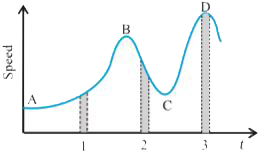
Figure. gives a speed-time graph of a pa...

Figure. gives a speed-time graph of a particle in motion along a constant direction. Three equal intervals of time are shown. In which interval is the average acceleration greatest in magnitude ? In which interval is the average speed greatest ? Choosing the positive direction as the constant direction of motion, give the signs of v and a in the three intervals. What are the accelerations at the points A, B, C and D ?

Text Solution

Verified by Experts

Acceleration magnitude greatest in 2, speed greatest in 3, `upsilon gt 0` in 1, 2 and 3, `a gt 0` in 1 and 3, `a lt 0` in 2, a = 0 at A, B, C, D.
Promotional Banner

Topper's Solved these Questions

  • MOTION IN A STRAIGHT LINE

    NCERT TELUGU|Exercise ADDITIONAL EXERCISES|5 Videos
  • MOTION IN A STRAIGHT LINE

    NCERT TELUGU|Exercise ADDITIONAL EXERCISES|5 Videos
  • MOTION IN A PLANE

    NCERT TELUGU|Exercise EXCERCISES|30 Videos
  • OSCILLATIONS

    NCERT TELUGU|Exercise Additional Exercises|6 Videos

Similar Questions

Explore conceptually related problems

In the x-t plot of a particle in one dimensional motion. Four different equal intervals of time are shown. In which interval, average speed is greatest

Figure. gives the x-t plot of a particle in one-dimensional motion. Three different equal intervals of time are shown. In which interval is the average speed greatest, and in which is it the least ? Give the sign of average velocity for each interval.

Is the direction of motion constant ?

The average acceleration in one time period in a simple harmonic motion is

Show that when a particle with uniform acceleration, the distances described in consecutive equal intervals of time are in A.P.

The speed-time graph of a particle moving along a fixed direction is shown in Fig. Obtain the distance traversed by the particle between (a) t = 0 s to 10 s, (b) t = 2s to 6s. What is the average speed of the particle over the intervals in (a) and (b) ?

NCERT TELUGU-MOTION IN A STRAIGHT LINE-EXERCISES
  1. A drunkard walking in a narrow lane takes 5 steps forward and 3 steps ...

    Text Solution

    |

  2. A jet airplane travelling at the speed of 500 km h^(-1) ejects its pro...

    Text Solution

    |

  3. A car moving along a straight highway with speed of 126 km h^(-1) is b...

    Text Solution

    |

  4. Two trains A and B of length 400 m each are moving on two parallel tra...

    Text Solution

    |

  5. On a two-lane road, car A is travelling with a speed of 36 km h^(-1). ...

    Text Solution

    |

  6. Two towns A and B are connected by a regular bus service with a bus le...

    Text Solution

    |

  7. A player throws a ball upwards with an initial speed of 29.4 ms^(-1). ...

    Text Solution

    |

  8. Read each statement below carefully and state with reasons and example...

    Text Solution

    |

  9. A ball is dropped from a height of 90 m on a floor. At each collision ...

    Text Solution

    |

  10. Explain clearly, with examples, the distinction between : (a) magnit...

    Text Solution

    |

  11. A man walks on a straight road from his home to a market 2.5 km away w...

    Text Solution

    |

  12. We have carefully distinguished between average speed and magnitude of...

    Text Solution

    |

  13. Look at the graphs (a) to (d) (Fig.) carefully and state, with reasons...

    Text Solution

    |

  14. Figure. shows the x-t plot of one-dimensional motion of a particle. Is...

    Text Solution

    |

  15. A police van moving on a highway with a speed of 30 km h^(-1) fires a ...

    Text Solution

    |

  16. Suggest a suitable physical situation for each of the following graphs...

    Text Solution

    |

  17. Figure. gives the x-t plot of a particle executing one-dimensional sim...

    Text Solution

    |

  18. Figure. gives the x-t plot of a particle in one-dimensional motion. Th...

    Text Solution

    |

  19. Figure. gives a speed-time graph of a particle in motion along a const...

    Text Solution

    |

  20. A three-wheeler starts from rest, accelerates uniformly with 1 ms^(-2)...

    Text Solution

    |
