Home
Class 11
PHYSICS
The speed of a car as a function of time...

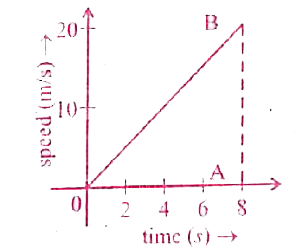
The speed of a car as a function of time as shown figure. Find the acceleration and distance travelled by the car in 8 seconds .

Text Solution

Verified by Experts

An instinctive answer to (i) might be that the force on the wall in case (a) is normal to the wall, while that in case (b) is inclined at 30° to the normal. This answer is wrong. The force on the wall is normal to the wall in both cases. How to find the force on the wall? The trick is to consider the force (or impulse) on the ball due to the wall using the second law, and then use the third law to answer (i). Let u be the speed of each ball before and after collision with the wall, and m the mass of each ball. Choose the x and y axes as shown in the figure, and consider the change in momentum of the ball in each case :
Case (a)
`(p_x)_("initial")` = mu `(p_y)_("initial") = 0`
`(p_x)_("final")` = -mu `(p_y)_("final") = 0`
Impulse is the change in momentum vector. Therefore ,
x-component of impulse = – 2 m u
y-component of impulse = 0
Impulse and force are in the same direction. Clearly, from above, the force on the ball due to the wall is normal to the wall, along the negative x-direction. Using Newton’s third law of motion, the force on the wall due to the ball is normal to the wall along the positive x-direction. The magnitude of force cannot be ascertained since the small time taken for the collision has not been specified in the problem.
case (b)
`(p_x)_("initial") = ` mu cos `30^@ , (p_y)_("initial") = ` - mu sin `30^@`
`(p_x)_("final")` = - mu cos `30^@ , (p_y)_("final") = ` - mu sin `30^@`
Note while `p_x` changes sign after collision , `p_y` does not. therefore
x - component of impulse = - mu `cos 30^@`
y = component impulse = 0
The direction of impulse (and force) is the same as in (a) and is normal to the wall along the negative x direction. As before, using Newton’s third law, the force on the wall due to the ball is normal to the wall along the positive x direction. The ratio of the magnitudes of the impulses imparted to the balls in (a) and (b) is
2mu/(2mu cos `30^@`) = `(2)/(sqrt3) = 1.2`
Promotional Banner

Topper's Solved these Questions

  • LAW OF MOTION

    NCERT TAMIL|Exercise EXERCISE|23 Videos
  • LAW OF MOTION

    NCERT TAMIL|Exercise EXERCISE (ADDITIONAL EXERCISE)|17 Videos
  • KINETIC THEORY OF GASES

    NCERT TAMIL|Exercise EVALUATION (Numerical Problems)|8 Videos
  • LAWS OF MOTION

    NCERT TAMIL|Exercise EXERCISE (V. Numerical Problems)|14 Videos

Similar Questions

Explore conceptually related problems

The speed of a car as a function of time is shown in figure. Find the distance travelled by the car in 8 seconds and its acceleration.

The displacement of a particle as a function of time is shown in figure. It indicates that:

The acceleration of a cart started at t=0 varies with time as shown in figure. Find the distance travelled in 30 seconds and draw the position time graph.

A car is moving with the accelaration 2 m/ s^(2) from rest. Find the distance traveled by the car in 10th second.

From the velocity time plot shown in figure find the distance travelled by the particle dureing the first 40 seconds. Also find the average velocity during this period.

A particle starts from rest with a constant acceleration. At a time t second, the speed is found to be 100 m/s and one second later the speed becomes 150 m/s. Find a. the acceleration and b. the distance travelled during the (t+1)^(th) second.

A body starting from rest has an acceleration of 25ms^(-2) . Find the distance travelled by it in 20^("th") second.

A driver takes 0.20 second to apply the brakes (reaction time). If he is driving car at a speed of 54kmh^(-1) and the brakes cause a deceleration of 6.0ms^(-1) ? Find the distance travelled by car after he sees the need to put the brakes.

Figure shows the speed versus time graph for a particle. Find the distance travelled by the particle during the time t=0 to t=3s.

Observe the motion of a car as shown in the figure and answer the following questions : Compare the distance covered by the car through the path ABC and AC. What do you observe? Which path gives the shortest distance to reach D from A? Is it the path ABCD or the path ACD or the path AD?

NCERT TAMIL-LAW OF MOTION-EXERCISE (ADDITIONAL EXERCISE)
  1. The speed of a car as a function of time as shown figure. Find the acc...

    Text Solution

    |

  2. Figure shows the position-time graph of a body of mass 0.04 kg. Sugg...

    Text Solution

    |

  3. Figure shows a man standing stationary with respect to a horizontal c...

    Text Solution

    |

  4. A stone of mass m tied to the end of a string revolves in a vertical c...

    Text Solution

    |

  5. A helicopter of mass 1000 kg rises with a vertical acceleration of 15 ...

    Text Solution

    |

  6. A stream of water flowing horizontally with a speed of 15 ms^(-1) push...

    Text Solution

    |

  7. Ten one-rupee coins are put on top of each other on a table. Each coin...

    Text Solution

    |

  8. An aircraft executes a horizontal loop at a speed of 720 "kmh"^(-1) wi...

    Text Solution

    |

  9. A train rounds an unbanked circular bend of radius 30 m at a speed of ...

    Text Solution

    |

  10. A block of mass 25 kg is raised by a 50 kg man in two different ways a...

    Text Solution

    |

  11. A monkey of mass 40 kg climbs on a rope. which can stand a maximum ten...

    Text Solution

    |

  12. Two bodies A and B of masses 5 kg and 10 kg in contact with each othe...

    Text Solution

    |

  13. A block of mass 15 kg is placed on a long trolly . The coefficient of ...

    Text Solution

    |

  14. The rear side of a truck is open and a box of 40 kg mass is placed 5 m...

    Text Solution

    |

  15. A long plying record revolves with a speed of 33 (1)/(3) "rev min"^(-1...

    Text Solution

    |

  16. You may have seen in a circus a motorcyclist driving in vertical loop...

    Text Solution

    |

  17. A 70kg man stands in contact against the inner wall of a hollow cylind...

    Text Solution

    |

  18. A thin circular wire of radius R rotatites about its vertical diameter...

    Text Solution

    |
