Home
Class 12
PHYSICS
For the potentiometer circuit shown in t...

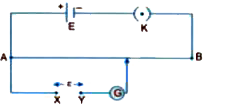
For the potentiometer circuit shown in the given figure, points X and Y represent the two terminals of an unknown emf `epsi` . A student observed that when the jockey is moved from the end A to the end B of the potentiometer wire, the direction of the deflection in the galvanometer remains in the same direction. What may be the two possible faults in the circuit that could result in this observations ? If the galvanometer deflection at the end B is (i) more, (ii) less, than that at the end A which of the two faults," listed above, would be there in the circuit ? Give reasons in support of your answer in each case.

Text Solution

Verified by Experts

Two possible faults in the circuit can be :
1. Positive terminal of unknown emf source e is not connected to point A, where positive terminal of battery E has been connected.
2. Emf of battery E is less than the unknown emf `epsi` .
(i) If on sliding the jockey from the end A to end B galvanometer deflection gradually increases then it means that connections of unknown emf `epsi` are wrong because then in accordance with Kirchhoff.s laws potential is gradually increasing from A to B.
(ii) If on sliding the jockey from the end A to end B galvanometer deflection decreases but null point is not obtained then it means that the emf of battery E is less than unknown emf `epsi` and hence deflection is in one direction only.
Promotional Banner

Topper's Solved these Questions

  • CURRENT ELECTRICITY

    U-LIKE SERIES|Exercise LONG ANSWER QUESTIONS - II|8 Videos
  • CURRENT ELECTRICITY

    U-LIKE SERIES|Exercise SELF ASSESSMENT TEST (SECTION A (MULTIPLE CHOICE QUESTIONS))|6 Videos
  • CURRENT ELECTRICITY

    U-LIKE SERIES|Exercise SHORT ANSWER QUESTIONS|42 Videos
  • CBSE SAMPLE QUESTION PAPER 2019-20 (SOLVED)

    U-LIKE SERIES|Exercise SECTION D|6 Videos
  • DUAL NATURE OF RADIATION AND MATTER

    U-LIKE SERIES|Exercise SELF ASSESSMENT TEST SECTION-C (VERY SHORT ANSWER QUESTIONS)|3 Videos

Similar Questions

Explore conceptually related problems

Potentiometer and Circuits with symmetry

Potentiometer and Circuits with symmetry

In the following diagram the deflection in the galvanometer in a potentiometer circuit is zero. Then:-

What is the potential difference between the ends A and B of the given potentiometer wire, in the following circuit ? The galvanometer G shows no deflection.

It is advised that the jockey is not to be rubbed on potentiometer wire while using it?

If there is no deflection in the galvanometer connected in a circuit shown in figure, then the ratio of lengths AC/CB is

In a potentiometer circuit, all the +ve terminals should be connected at

A and B are two conductors carrying a current i in the same direction x and y are two electron beams moving in the same direction. Then

U-LIKE SERIES-CURRENT ELECTRICITY -LONG ANSWER QUESTIONS - I
  1. In a metre bridge the null point is found at a distance of 60.0 cm fro...

    Text Solution

    |

  2. The reading of an ideal ammeter, in the circuit shown here, equals (i)...

    Text Solution

    |

  3. For the potentiometer circuit shown in the given figure, points X and ...

    Text Solution

    |

  4. (a) For the circuit shown in the figure, how would the balancing lengt...

    Text Solution

    |

  5. Two cells of emf 1.5 V and 2 V and internal resistance 1Omega and 2Ome...

    Text Solution

    |

  6. Calculate the value of the resistance R in the circuit shown in Fig. s...

    Text Solution

    |

  7. Using Kirchhoff's rules determine the value of unknown resistance R in...

    Text Solution

    |

  8. State Kirchhoff's rules of current distribution in an electrical netwo...

    Text Solution

    |

  9. State Kirchhoff's rules. Use these rules to write the expressions for ...

    Text Solution

    |

  10. State Kirchhoff's rules. Apply these rules to the loops PRSP and PRQP...

    Text Solution

    |

  11. In the circuit shown , R1=4Omega, R2=R3 =15Omega, R4 = 30 Omega and e...

    Text Solution

    |

  12. Two cells of same emf epsi but internal resistances r1 and r2 are co...

    Text Solution

    |

  13. In the electric network shown in the Fig., use Kirchhoff's rules to ca...

    Text Solution

    |

  14. Using Kirchhoff's rules, calculate the potential difference between B ...

    Text Solution

    |

  15. Two heating elements of resistances R1 and R2 when operated at a cons...

    Text Solution

    |

  16. A potentiometer wire of length 1 m is connected to a driver cell of e...

    Text Solution

    |

  17. A 10 m long wire of uniform cross-section and 20Omega resistance is u...

    Text Solution

    |

  18. A circuit using a potentiometer and battery of negligible internal res...

    Text Solution

    |

  19. In the Fig., a long uniform potentiometer wire AB is having a constan...

    Text Solution

    |

  20. Two conductors are made of the same material and have the same length....

    Text Solution

    |
