Home
Class 10
MATHS
Prove that the diagonals of a rectangle ...

Prove that the diagonals of a rectangle ABCD with vertices A(2, -1), B(5, -1), C(5, 6) and D(2, 6) are equal and bisect each other.

Text Solution

Verified by Experts
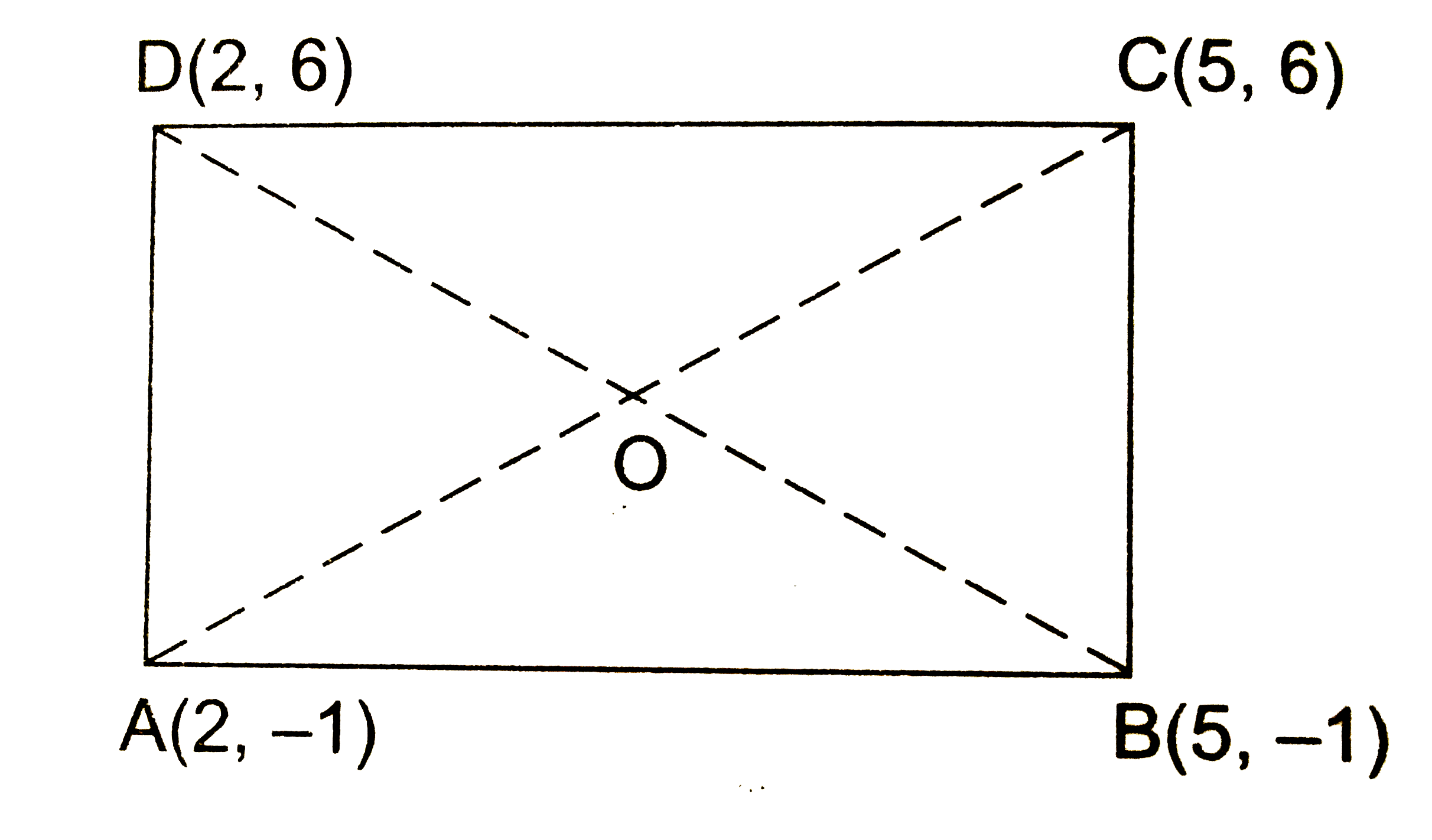

Diagonal `AC = sqrt((5-2)^(2) + (6+1)^(2))`
` = sqrt(3^(2) + 7^(2)) = sqrt(9 + 49) = sqrt(58)`
Diagonal `BD = sqrt((5-2)^(2) + (-1-6)^(2))`
` = sqrt(3^(2) + (-7)^(2)) = sqrt(9+49) = sqrt(58)`
`therefore` Diag. AC = Diag. BD.
Midpoint of `AC = ((5+2)/(2), (6-1)/(2)) = ((7)/(2), (5)/(2))`
Midpoint of `BD = ((5+2)/(2), (-1+6)/(2)) = ((7)/(2), (5)/(2))`
Promotional Banner

Topper's Solved these Questions

  • COORDINATE GEOMETRY

    RS AGGARWAL|Exercise Multiple Choice Questions (Mcq)|34 Videos
  • COORDINATE GEOMETRY

    RS AGGARWAL|Exercise Exercise 6C|24 Videos
  • CONSTRUCTIONS

    RS AGGARWAL|Exercise Test Yourself|10 Videos
  • HEIGHTS AND DISTANCES

    RS AGGARWAL|Exercise Multiple Choice Questions (Mcq)|25 Videos

Similar Questions

Explore conceptually related problems

Prove that the diagonals of a rectangle with verticles (0,0),(a,0),(a,b) and (0,b) bisect each other and are equal.

Prove that the diagonals of a rectangle bisect each other and are equal.

The area of the quadrilateral ABCD where A(0,4,1), B(2,3,-1), C(4,5,0) and D(2,6,2), is equal to

The diagonals of a rectangle are equal and bisect each other

The area of the quadrilateral ABCD where A (0,4,1) , B(2,3,-1), c (4,5,0)and D(2,6,2) is to :

The quadrangle with the vertices A(3, 5, 6), B(1, -5, 7), C(8, -3, -1) , and D (4, 7, -2) is a

Prove that the points A(0, 4, 1), B(2, 3, -1), C(4, 5, 0) and D(2, 6, 2) are vertices of a square.

The vertices of a reactangle ABCD are A (-1, 0) B (2,0), C (a,b) and D(-1, 4). Then the length of the diagonal AC is

RS AGGARWAL-COORDINATE GEOMETRY-Exercise 6D
  1. Points A(-1, y) and B(5, 7) lie on a circle with centre O(2, -3y) . Fi...

    Text Solution

    |

  2. If the point A(0, 2) is equidistant from the points B(3, p) and C(p, 5...

    Text Solution

    |

  3. ABCD is rectangle whose three vertices are B(4, 0), C(4, 3) and D(0, 3...

    Text Solution

    |

  4. If the point P(k-1, 2) is equidistant from the point A(3, k) and B(k,...

    Text Solution

    |

  5. Find the ratio in which the point P(x, 2) divides the join of A(12, 5)...

    Text Solution

    |

  6. Prove that the diagonals of a rectangle ABCD with vertices A(2, -1), B...

    Text Solution

    |

  7. Find the lengths of the medians AD and BE of Delta ABC whose vertices ...

    Text Solution

    |

  8. If the point C(k, 4) divides the join of A(2, 6) and B(5, 1) in the ra...

    Text Solution

    |

  9. Find the point on x-axis which is equidistant from points A(-1, 0) and...

    Text Solution

    |

  10. Find the distance between the points ((-8)/(5), 2) "and" ((2)/(5), 2)

    Text Solution

    |

  11. Find the value of a so that the point (3,a) lies on the line represent...

    Text Solution

    |

  12. If the points A(4, 3) and B(x, 5) lie on a circle with the centre O(2,...

    Text Solution

    |

  13. If P(x, y) is equidistant from the points A(7, 1) and B(3, 5), find th...

    Text Solution

    |

  14. If the centroid of Delta ABC having vertices A(a, b), B(b, c) and C(c,...

    Text Solution

    |

  15. Find the centroid of Delta ABC whose vertices are A(2, 2), B(-4, -4) a...

    Text Solution

    |

  16. In what ratio does the point C(4, 5) divide the join of A(2, 3) and B(...

    Text Solution

    |

  17. If the points A(2, 3), B(4, k) and C(6, -3) are collinear, find the va...

    Text Solution

    |

