Home
Class 12
PHYSICS
A proton of energy 200 MeV enters the ma...

A proton of energy `200 MeV` enters the magnetic field of `5 T`. If direction of field is from south to north and motion is upward, the force acting on it will be

Text Solution

Verified by Experts
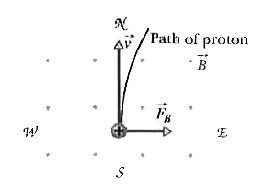
Because the proton is charged and moving through a magnetic field, a magnetic force `vec(F)_(B)` can act on it. Because the initial direction of the proton velocity is not along a magnetic field line, `vec(F)_(B)` is not simply zero.
Magnitude : To find the magnitude of `vec(F)_(B)`, we can use Eq. 28-3 `(F_(B) - |q|v B sin phi)` provided we first find the proton.s speed v. We can find v from the given kinetic energy because `K = 1//2 mv^(2)`, Solving for v, we obtain
`v = sqrt((2K)/(m)) = sqrt(((2)(5.3 MeV)(1.60 xx 10^(-13)J//MeV))/(1.67 xx 10^(-27)kg))`
`= 3.2 xx 10^(-7) m//s`
Equation 28-3 then yields
`F_(B) = |q|v B sin phi`
`= (1.60 xx 10^(-19) C)(3.2 xx 10^(7) m//s) xx (1.2 xx 10^(-3)T) (sin 90^(@))`
`= 6.1 xx 10^(-15)N`.
This may seem like a small force, but it acts on a particle of small mass, producing a large acceleration, namely,
`a = (F_(B))/(m) = (6.1 xx 10^(-15)N)/(1.67 xx 10^(-27) kg) = 3.7 xx 10^(12) m//s^(2)`.
Direction : To find the direction of `vec(F)_(B)`, we use the fact that `vec(F)_(B)` has the direction of the cross product `q vec(v) xx vec(B)`. Because the charge q is positiv , `vec(F)_(B)` must have the same direction as `vec(v) xx vec(B)`, which can determined with the right-hand rule for cross products (as in Fig.) We know that `vec(v)` is directed horizontally from south to north and `vec(B)` is directed vertically up. The right-hand rule shows us that the deflecting force `vec(F)_(B)` must be directed horizontally from west to east, as Fig. shows.
If the charge of the particle were negative, the magnetic deflecting force would be directed in the opposite direction - that is, horizontally from east to west. This is predicted automatically by Eq. 28-2 if we substitute a negative value for q.

An downward view of a proton moving from south to north with velocity `vec(v)` in a chamber. A magnetic field is directed vertically upward in the chamber, as represented by the array of dots (which resemble the tips of arrows). The proton is deflected toward the east.
Promotional Banner

Topper's Solved these Questions

  • MAGNETIC FORCE

    RESNICK AND HALLIDAY|Exercise Check point|6 Videos
  • MAGNETIC FORCE

    RESNICK AND HALLIDAY|Exercise Problems|49 Videos
  • MAGNETIC FIELDS DUE TO CURRENTS

    RESNICK AND HALLIDAY|Exercise Practice Question (Integer Type)|4 Videos
  • MOTION ALONG A STRAIGHT LINE

    RESNICK AND HALLIDAY|Exercise PRACTICE QUESTIONS ( Integer Type )|3 Videos

Similar Questions

Explore conceptually related problems

A 5 MeV proton moves vertically downward through a magnetic field of induction 1.5 "weber"//m^(2) pointing horizontally from south to north. The force acting on the proton, mass of proton = 1.6 × 10⁻²⁷ kg . will be

A proton and an alpha-particle enter a magnetic field in a direction perpendicular to it. If the force acting on the proton is twice that acting on the alpha-particle , the ratio of their velocities is

A neutron enters a magnetic field region, normally to the direction of magnetie field. Find the value of magnetic force on it.

An electron is moving vertically downwards. If it passes through a magnetic field which is directed from south to north in a horizontal plane, then in which direction the electron would be deflected?

A charged particle entering a magnetic field from outside in a direction perpendicular to the field

A proton and a deuteron with the same initial kinetic energy enter a magnetic field in a a direction perpendicular to the direction of the field . The ratio of the radii of the circular trajectories described by them is

An electron beam enters a magnetic field right angles to it as shown in the Figure. The direction of force acting on the electron beam will be :

