Home
Class 12
PHYSICS
A mass spectrometer is a device which se...

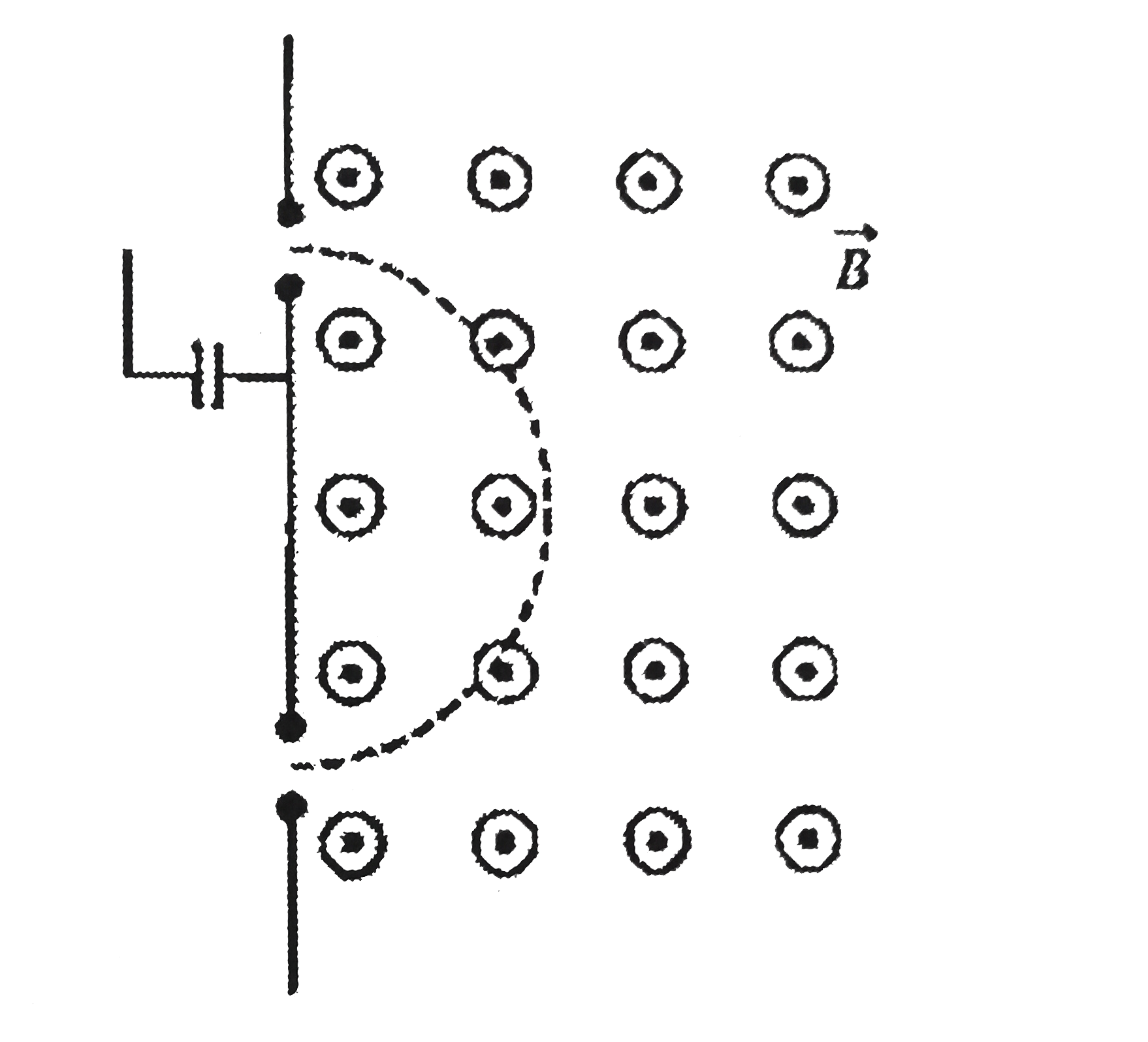
A mass spectrometer is a device which selelct particle of equal mass. An ion with an electric charge `qgt0`. Starts at rest from s ource S and is accelerated through a potential difference V. it passes thorugh a hole into a region of constant magnetic field `vecB` perpendicular to the plane of the paper as shown in the figure. The particle is deflected by the magnetic field and emerges thorugh the bottom hole at a distance d from the top hole. The mass of the particle is:

Text Solution

Verified by Experts
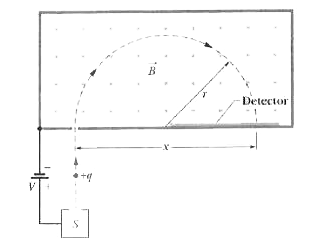
(1) Because the (uniform magnetic field causes the (charged) ion to follow a circular path, we can relate the ion.s mass m to the path.s radius r with `(r = mv|q|B)`. From Fig. we see that r = x/w (the radius is half the diameter). From the problem statement,

A positive ion is accelerated from its sources S by a potential difference V, enters a chamber of uniform magnetic field `vec(B)`, travels through a semicircle of radius r, and strikes a detector at a distance x.
We know the magnitude B of the magnetic field. However, we lack the ion.s speed v in the magnetic field after the ion has been accelerated due to the potential difference V. (2) To relate v and V, we use the fact that mechanical energy `(E_(mec) = K + U)` is conserved during the acceleration.
Finding speed. : When the ion emerges from the source, its kinetic energy is approximately zero. At the end of the acceleration, its kinetic energy is `1//2 mv^(2)`. Also, during the acceleration, the positive ion moves through a change in potential of -V. Thus, because the ion has positive charge q, its potential energy changes by -qV. If we now write the conservation of mechanical energy as
`Delta K + Delta U = 0`,
we get
`(1)/(2) mv^(2) - qV = 0`
or `v = sqrt((2qV)/(m))`
Finding mass : Substituting this value for v into Eq. 28-8 given us
`r = (mv)/(qB) = (m)/(qB)sqrt((2qV)/(m)) = (1)/(B) sqrt((2mV)/(q))`.
Thus, `x = 2r = (2)/(B)sqrt((2mV)/(q))`.
Solving this for m and substituting the given data yield
`m = (B^(2) qx^(2))/(8V)`
`= ((0.080000T)^(2)(1.6022 xx 10^(-19)C)(1.6254m)^(2))/(8(1000.0V))`
`= 3.3863 xx 10^(-25)kg = 203.93 u`.
Promotional Banner

Topper's Solved these Questions

  • MAGNETIC FORCE

    RESNICK AND HALLIDAY|Exercise Check point|6 Videos
  • MAGNETIC FORCE

    RESNICK AND HALLIDAY|Exercise Problems|49 Videos
  • MAGNETIC FIELDS DUE TO CURRENTS

    RESNICK AND HALLIDAY|Exercise Practice Question (Integer Type)|4 Videos
  • MOTION ALONG A STRAIGHT LINE

    RESNICK AND HALLIDAY|Exercise PRACTICE QUESTIONS ( Integer Type )|3 Videos

Similar Questions

Explore conceptually related problems

A mass spectrometer is a device which selelct particle of equal mass. An ion with an electric charge qgt0 . Starts at rest from s ource S and is accelerated through a potential difference V. it passes thorugh a hole into a region of constant magnetic field vecB perpendicular to the plane of the paper as shown in the figure-4.233. The particle is deflected by the magnetic field and emerges thorugh the bottom hole at a distance d from the top hole. The mass of the particle is:

An alpha- particle moves from E to W in a magnetic field perpendicular to the plane of the paper and into the paper. The particle is defelcted towards

A proton and alpha - particle are accelerated with same potential difference and they enter in the region of constant magnetic field B perpendicular to the velocity of particles. Find the ratio of radius of curvature of alpa - particle .

A charged particle enters a uniform magnetic field perpendicular to it. The magnetic field

A charged particle of mass m and charge q is accelerated through a potential difference of V volts. It enters a region of uniform magnetic field which is directed perpendicular to the direction of motion of the particle. Find the radius of circular path moved by the particle in magnetic field.

A charged particle of mass m and charge q is accelerated through a potential differences of V volts. It enters of uniform magnetic field B which is directed perpendicular to the direction of motion of the particle. The particle will move on a circular path of radius

A particle of mass m carrying charge q is accelerated by a potential difference V. It enters perpendicularly in a region of uniform magnetic field B and executes circular arc of radius R, then q/m equals

A particle of charges Q and mass m travels through a potential difference V from rest. The final momentum of the particle is

