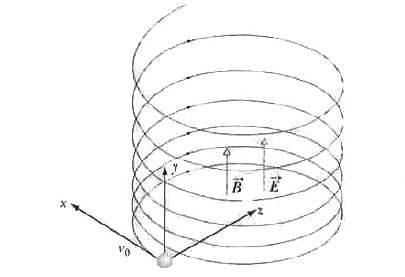
(1) In this case, we cannot say that that path is circular or a helix with uniform pitch. The motion is rather complicated, here we have to use the Lorentz force.
(2) The forces due to parallel electric and magnetic fields on a charged particle moving perpendicular to the fields will be at right angles to each other (electric foece being along the direction of `vec(E)` while magnetic force being perpendicular to the plane containing `vec(v)` and `vec(B)`). Therefore, the magnetic force will not effect the motion of charged particle in the direction of electric superposition and vice versa. So, the problem is equivalent to superposition of two independent motions as shown.
Calculations : For motion of particle under electric field alone,
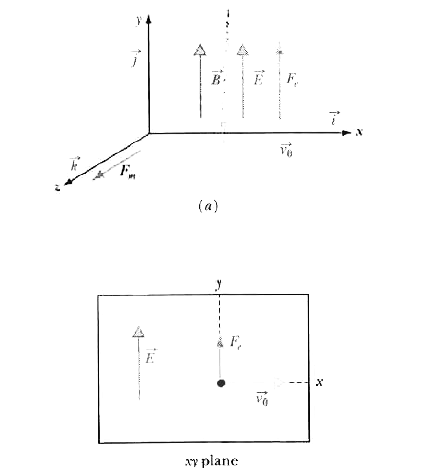
(a) Force on a charged particle in uniform electric and magnetic field. (b) Force on it due to electric field alone. Note that the charge is positive, so the force is in the direction of the electric field. This force is independent of the velocity.
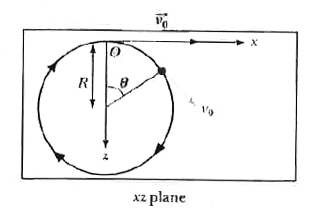
The force due to the magnetic field is always perpendicular to the velocity. So, under its influence, the particle will move in a circular path.
So, the angular position of the particle at time t in the xz plane (or in a plane parallel to xz plane) will be given by
`theta = omega t = (q B)/(m)t`.
Hence, in accordance with Fig., we have
`v_(x) = v_(0) cos theta = v_(0) cos omega t = v_(0) cos ((qB)/(m))t`,
and `v_(z) = v_(0) sin 0 = v_(0) sin omega t = v_(0) sin ((qB)/(m))t`.
Note that magnetic field does not do any work on the charged particle, so it can change the direction of the velocity `v_(0)`, but not its magnitude. Also, the angular velocity of its circular motion is independent of its velocity.
So, in the light of Eqs. we have
`vec(v) = v_(x)hat(i) + v_(y)hat(j) + v_(z) hat(k)`
`= v_(0)cos ((qB)/(m)t) hat(i) + ((qB)/(m)t) hat(j) + ((qB)/(m)t) hat(k)`.
Since in this case
`hat(i) = (vec(v)_(0))/(v_(0)) , hat(j) = (vec(E))/(E) = (vec(B))/(B)`, and `hat(k) = (vec(v)_(0) xx vec(B))/(v_(0)B)`
Therefore, we have
`vec(v) = v_(0) cos[(qB)/(m)t] [(vec(v)_(0))/(v_(0))] + (qE)/(m)t [vec(E))/(E)] + [v_(0) sin ((qB)/(m)t)[(vec(v)_(0) xx vec(B))/(v_(0)B)]`.
The answer seems to be quite complicated, on analysis of the motion, we see that in the y-direction, the motion is uniformly accelerated. THe motion in xz plane is circular. So, the resultant path is a helix with non-uniform pitch. The path looks like that shown in Fig. As before, the particle repeatedly touches the y axis (if it was projected from the origin) after regular time intervals of T when it has completed one circle. But now the motion along the y axis is accelerated, so the distance between successive points on the y axis where it touches is not the same.