Home
Class 12
PHYSICS
A perfectly reflecting solid hemisphere ...

A perfectly reflecting solid hemisphere of radius R is placed in the path of a parallel beam of light of large aperture. If the beam carrries an intensity l, find the force exerted by the beam on the hemisphere.

Text Solution

Verified by Experts

KEY IDEA
The light beam is incident on the sphere as a parallel beam. However, since the normal at every point in not parallel to the normal at other points, the beam will not be reflected as a parallel beam.
Calculation : For the analysis, let us consider a small element of surface at angle q to horizontal direction. This element of the shape of ring subtends an angle dq at the center as shown in Fig.
The momentum of a photon is
`p=(h)/(lambda)`.
From symmetry, we can say that the impulse on the sphere in all direction perpendicular to incident beam directionis zero. The momentum of the photon in x direction changes as can be seen in Fig. Therefore,
`Deltap_(x)=(h)/(lambda)-(-(h)/(lambda)cos 2theta)`
`=(h)/(lambda)(1+cos 2 theta)=(h)/(lambda)xx2cos^(2)theta`.
The number of photons incident unit time on this element is given by
`(IdAxxlambda)/(hc)`
The number of photons incident unit time on this elemetn is given by
`(IdAxxlambda)/(hc)`
Note carefully that dA is a cross - section area of incident beam and not the element of the sphere. Area of the element is given by
`dA_(e)=Rd thetaxx2piR sin theta`
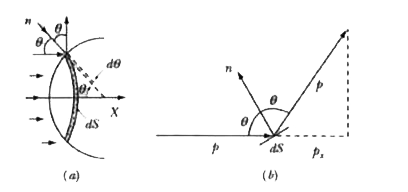
(a) A plane beam is incident on a perfectly reflecting sphere (b) Change in momentum of a photon.
Therefore, the area of cross - section of incident beam would be lesser by a factor of `cos theta`.
`dA=2piR^(2)sin theta d theta xx cos theta`
Thus,
`dF=("Number of photons incident")/("Time")xxDeltap_(x)`
`=(Ixx2piR^(2)sin theta cos theta d theta)/(hc)xxlambdaxx(h)/(lambda)xx2cos^(2)theta`
`=(4piR^(2)I)/(c)cos^(3)theta sin theta d theta`.
Also,
`F int dF`
`=(4piR^(2)I)/(c)int_(0)^(pi//2)cos^(3)theta sin theta d theta`
`=(piR^(2)I)/(c)`
Note : If the sphere were a perfect absorber, the force exerted by light beam on the sphere would be the same.

Promotional Banner

Topper's Solved these Questions

  • PHOTONS AND MATTER WAVES

    RESNICK AND HALLIDAY|Exercise Check points|3 Videos
  • PHOTONS AND MATTER WAVES

    RESNICK AND HALLIDAY|Exercise PROBLEMS|50 Videos
  • OSCILLATIONS

    RESNICK AND HALLIDAY|Exercise Practice Questions|57 Videos
  • RELATIVITY

    RESNICK AND HALLIDAY|Exercise PRACTICE QUESTIONS (Integer Type)|5 Videos

Similar Questions

Explore conceptually related problems

A concave lens is placed in the path of a uniform parallel of beam of light falling on a screen as shown . Then

A sphere of radius 1.00 cm is placed in the path of a parallel beam of light of large aperture. The intensity of the light is 0.50 W cm^-2 . If the sphere completely absorbs the radiation falling on it, find the force exerted by the light beam on the sphere.

A glass slab is placed in the path of a beam of convergent light. The point of convergence of light

When a thin metal plate is placed in the path of one of the interfering beams of light

There is a parallel beam of light of larger aperture . Let I be the intensity of light . Perfectly reflecting sphere of radius r is kept in the path of this parallel beam . Find the force exerted by the light beam on sphere .

A parallel beam of the light is incident normally on a plane surface absorbing 40% of the light and reflecting the rest. If the incident beam carries 10 watt power, find the force exerted by it on the surface.

A parallel beam of light falls on a solid tranparent sphere. Q. Which is corret?
