Home
Class 12
PHYSICS
Two identical, small, charged spheres, e...

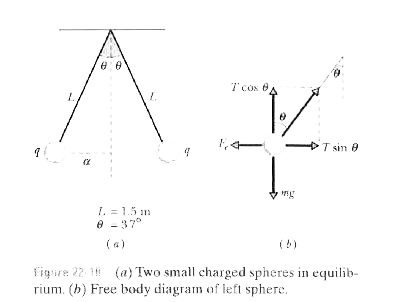
Two identical, small, charged spheres, each having a mass of `4.0xx10^(-2)`kg hang in equilibrium as shown in Fig. 22-10a. The length of each string is 1.5m and the angle `theta` is `37.0^(@)`. Find the magnitude of the charge on each sphere.

Text Solution

Verified by Experts

KEY IDEA
From Fig. 22-10a, we can see that the two spheres exert repulsive forces on each other. If they are held close to each other and released, they will move outward from the center and settle into the configuration in Fig. 22-10a after the damped oscillations due to air resistance have vanished.
The key phrase "in equilibrium" helps us to classify this as an equilibrium problem, which we approach as we did equilibrium problems in the chapter on Newton.s Laws in (Volume 1) with the added feature that one of the forces on a sphere is an electric force. We analyze this problem by drawing the free-body diagram for the left-hand sphere in Fig. 22-10b. The sphere is in equilibrium under the application of forces T from the string, the electric force `F_(e )` from the other sphere, and the gravitational force mg.
Calculations: Because the sphere is in equilibrium, the forces in the horizontal and vertical directions must separately add up to zero.
`sum F_(x)=T sin theta-F_(e ) " " (22-11)`
`sum F_(y)=T cos theta-mg " " (22-12)`
Frow Eq. 22-12, we see that `T=mg//cos theta`, thus, T can be eliminated from Eq. 22-11 if we make this substitution. This gives a value for the magnitude of the electric force `F_(e ): `
`F_(e )=mg tan theta =(4xx10^(-2)kg) (10 m//s^(2)) tan 37^(@)=0.3N`.
Considering the geometry of the triangle in Fig. 22-10a, we see that `sin theta=alpha//L`. Therefore,
`a=L sin theta=(1.5m)sin37^(@)=0.9m`
The separation of the spheres is `2a=1.8m`. From Coulomb.s law (Eq. 22-10), the magnitude of the electric froce is
`F_(e )=k_(e ) (|q|^(2))/(r^(2))`
where r = 2a = 1.8m and |q| is the magnitude of the charge on each sphere. This equation can be solved for `|q|^(2)` to give
`|q|^(2)=(F_(3)r^(2))/(k_(e ))=(0.3xx(1.8)^(2))/(9xx10^(9)Nm^(2)//C^(2))=1.08xx10^(-10)C^(2)`
`|q|=6sqrt(3)muC`
Promotional Banner

Topper's Solved these Questions

  • ELECTRIC CHARGES AND FIELDS

    RESNICK AND HALLIDAY|Exercise Check points|9 Videos
  • ELECTRIC CHARGES AND FIELDS

    RESNICK AND HALLIDAY|Exercise Problems|63 Videos
  • ELASTICITY

    RESNICK AND HALLIDAY|Exercise PRACTICE QUESTIONS (Integer Type)|3 Videos
  • ELECTRIC POTENTIAL

    RESNICK AND HALLIDAY|Exercise (PRACTICE QUESTIONS) Integer Type|1 Videos

Similar Questions

Explore conceptually related problems

Two identical small charged spheres, each having a mass m, hang in equilibrium as shown in fig. the ligth of each string is l, and the angle made by any string with the vertical is theta . Find the magnitude of the charge on each sphere.

The force between two small charged spheres having charges of 1xx10^(-7)C and 2xx10^(-7)C placed 20 cm apart in air is

Three identical point charges, each of mass m and charge q, hang from three strings as shown in fig. The value of q in term of m, L, and q is

A small object is suspended at rest from two strings as shown in fig. The magnitude of the force exerted by each string on the object is 10sqrt(2)N . Find the magnitude of the mass of the object.

In an experiment using the Cavendish balance, the smaller spheres have a mass of 5.0xx10^(-3) kg each, the larger spheres have a mass 12.0 kg each, the length of the rod is 100.0 cm, the torsion constant of the fibre is 3.56xx10^(-8) Nm per rad, the angle of twist is 4.86xx10^(-3) rad, and the distance between the centres of each pair of heavy and light spheres is 15.0 cm. Compute the value of the gravitational constant G from this data.

Three uniform spheres, each having a mass M=5kg and radius a=2.5m are kept in such a way that each touches the other two. Find the magnitude of the gravitational force in GN on any of the spheres due to the other two.

Two identical charges repel each other with a force equal to 10mg wt when they are 0.6m apart in air. (g=10ms^(-2) ) .The value of each charge is - - -- 10^(-6)C

In an experiment using the Cavendish balance , the smaller spheres have a mass of 20 kg each , the larger spheres have a mass 5 kg each , the length of the rod is 50.0 cm the torsion constant of the fibre is 4.8 xx 10^(-8) Nm per radian , the angle of twist is 7 xx 10^(-3) rad , and the distance between the centres of each pair of heavy and light spheres is 100 cm . Compute the value of the gravitational constant G from this data .

Two identical ladders, each of mass M and length L are resting on the rough horizontal surface as shown in the figure. A block of mass m hangs from P. if the system is in equilibrium, find the magnitude and the direction of frictional force at A and B.
