KEY IDEAS
Charges `q_(1), q_(2), and q_(3)` produce electric field vectors `vecE_(1), vecE_(2) and vecE_(3)`, respectively, at the origin, and the net electric field is the vector sum `vecE=vecE_(1)+vecE_(2)+vecE_(3)`. To find this sum, we first must find the magnitudes and orientations of the three field vectors.
Magnitudes and directions: To find the magnitude of `vecE_(1)`, which is due to `q_(1)`, we use Eq. 20-20, substituting d for r and 2Q for q and obtaining `E_(1)=(1)/(4pi epsilon_(0))(2Q)/(d^(2))`.
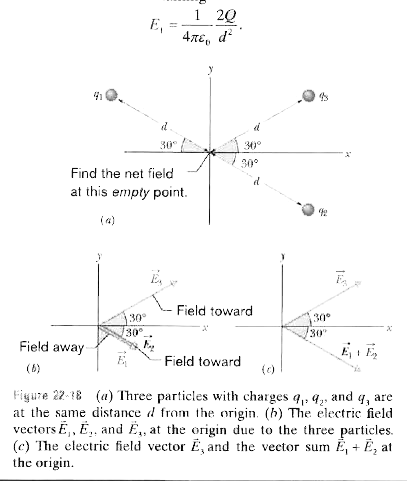
Similarly, we find the magnitudes of `vecE_(2) and vecE_(3)` to be
`E_(2)=(1)/(4pi epsilon_(0))(2Q)/(d^(2)) and E_(3)=(1)/(4pi epsilon_(0)) (4Q)/(d^(2))`.
We next must find the orientations of the three electric field vectors at the origin. Because `q_(1)` is a positive charge, the field vector it produces points directly away from it, and because `q_(2) and q_(3)` are both negative, the field vectors they produce point directly toward each of them. Thus, the three electric fields produced at the origin by the three charged particles are oriented as in Fig. 22-18b.
Adding the fields: We can now add the fields vectorially just as we add force vectors. However, here we can use symmetry to simplify the procedure. From Fig. 22-18b, we see that electric fields `vecE_(1) and vecE_(2)` have the same direction. Hence, their vector sum has that direction and has the magnitude
`E_(1)+E_(2)=(1)/(4pi epsilon_(0)) (2Q)/(d^(2))+(1)/(4pi epsilon_(0))(2Q)/(d^(2))=(1)/(4pi epsilon_(0)) (4Q)/(d^(2))`,
which happens to equal the magnitude of field `vecE_(3)`.
We must now combine two vectors, `vecE_(3)` and the vector sum `vecE_(1)+vecE_(2)`, that have the same magnitude and that are oriented symmetrically about the x axis, as shown in Fig. 22-18c. From the symmetry of Fig. 22-18c, we realize that the equal y components of our two vectors cancel (one is upward and the other is downward and the equal x components add (both are rightward). Thus, the net electric field `vecE` at the origin is in the positive direction of the x axis and has the magnitude
`E=2E_(3x)=2E_(3) cos 30^(@)`
`=(2) (1)/(4pi epsilon_(0)) (4Q)/(d^(2)) (0.866)=(6.93Q)/(4pi epsilon_(0)d^(2))`. (Answer)


