Home
Class 12
PHYSICS
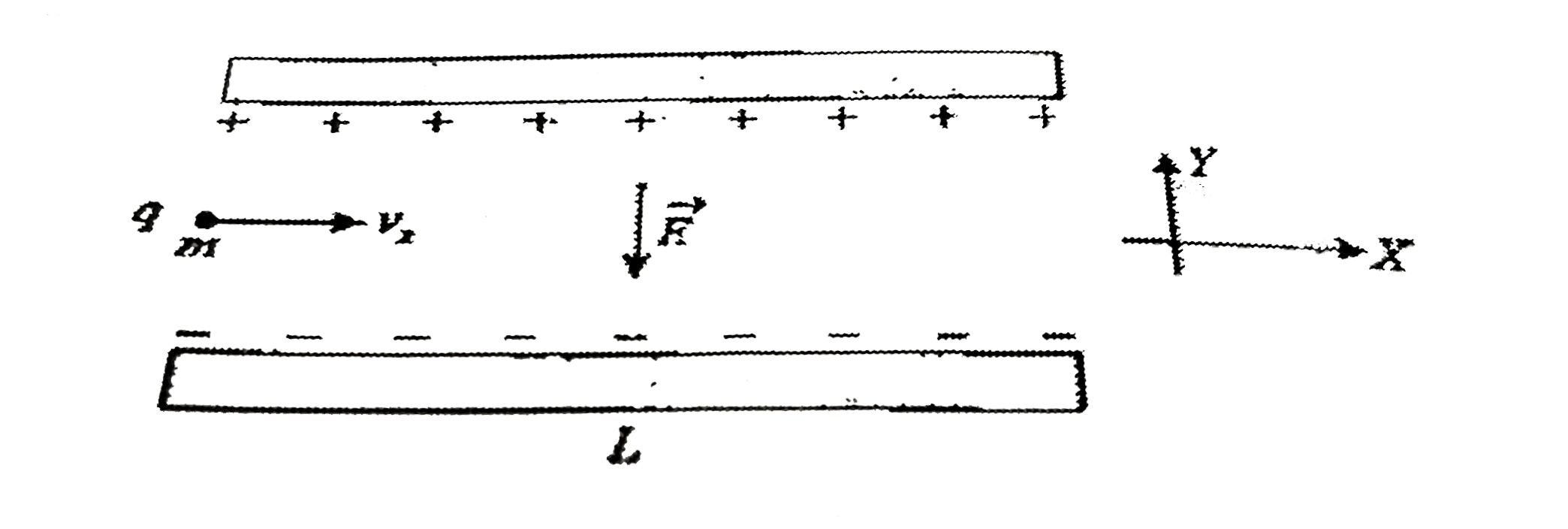
Figure shows an assembly of deflecting p...

Figure shows an assembly of deflecting plates A and B ofan ink-jet printer which causes moving ink droplets to deflect at desired displacements by continuously varying electric field between the plates. An ink drop with a mass `m = 1.3 xx 10^(-10)kg` and a negative charge of magnitude `q = 1.5x x 10^(-13)C` enters the region between the plates, initially moving along the x-axis with speed `v_(x), = 10m//s`. The length of plates is `L = 1.6cm`. The plates are connected with a varying voltage and thus produce an electric field at all points between them. Assume that field `vec(E)` for some duration is constant and it is acting in downward direction as shown and has a magnitude of `E = I .4 xx 10^(6) N//C`, find the vertical deflection of the drop at the far edge ofthe plate? As the gravitational force on the drop is very small relative to the electrostatic force acting on the drop, it can be neglected for this analysis. `[6.4 xx 10^(-4)m]`

Text Solution

Verified by Experts

KEY IDEAS
The drop is negatively charged and the electric field is directed downward. From Eq. 22-45, a constant electrostatic force of magnitude QE acts upward on the charged drop. Thus, as the drop travels parallel to the x axis at constant speed `v_(x)`, it accelerates upward with some constant acceleration `a_(y)`.
Calculations: Applying Newtons.s second law (F = ma) for components along the y axis, we find that
`a_(y)=(F)/(m)=(QE)/(m). " " (22-47)`
Let t represent the time required for the drop to pass through the region between the plates. During t the vertical and horizontal displacements of the drop are
`y=(1)/(2) a_(y)t^(2) and L=v_(x)t," " (22-48)`
respectively. Eliminating t between these two equations and substituting Eq. 22-47 for `a_(y)`, we find
`y=(QEL^(2))/(2mv_(x)^(2))`
`=((1.5xx10^(-13)C)(1.4xx10^(6)N//C)(1.6xx10^(-2)m)^(2))/((2)(1.3xx10^(-10)kg)(18m//s)^(2))`
`=6.4xx10^(-4)m=0.64mm.` (Answer)
Promotional Banner

Topper's Solved these Questions

  • ELECTRIC CHARGES AND FIELDS

    RESNICK AND HALLIDAY|Exercise Check points|9 Videos
  • ELECTRIC CHARGES AND FIELDS

    RESNICK AND HALLIDAY|Exercise Problems|63 Videos
  • ELASTICITY

    RESNICK AND HALLIDAY|Exercise PRACTICE QUESTIONS (Integer Type)|3 Videos
  • ELECTRIC POTENTIAL

    RESNICK AND HALLIDAY|Exercise (PRACTICE QUESTIONS) Integer Type|1 Videos

Similar Questions

Explore conceptually related problems

A particle of mass m and charge(-q) enters the region between the two charged plates intially moving along x - axis with speed V_(x) . The length of plate is L and a uniform electric field E is maintained between the plates . Show that the verticles deflection of the particle at the far edge of the palte is qEL^(2)//(2m v_(x)^(2)) .

What is the displacement current between the square plate of side 1 cm is of a capacitor, if electric field between the plates is changing at the rate of 3 xx 10^(6) Vm^(-1)s^(-1) ?

A Water of mass 3.2xx10^(-18)kg and carrying a charge of 1.6xx10^(-19)C is suspended stationary betwaeen two plates of an electric field. Given g=10 m//s^(2) , the intensity of the electric field required is

A parallel plate capacitor has a plate area of 300 cm""^(2) electric field between the plates continuously changes at a rate of 9 xx 10 ^(10) V s^(-1) . Calculate the displacement current developed between both the plates .

An oil drop with charge 1.6xx10^(-18)C is balanced in air between two metallic plates 10 mm apart. Calculate the voltage required between the plates if mass of the drop is 2.4xx10^(-14)kg .

A positively charged oil droplet remins stationary in the electric field between two horizontal plates separated by a distance of 1 cm . The charge on the drop is 10^(-15) C and mass of the droplet is 10^(-11) g , the potential difference between the plates and if the polarity is reversed , the instantaneous of the droplet are

Calculate the voltage required to balanced an oil drop carrying 10 electrons, when located between plates of a capacitor, which are 5mm apart. Given mass of drop = 3xx10^(-16) kg , charge on electron = 1.6xx10^(-19)C and g = 9.8 m//s^(2) .
