Home
Class 12
PHYSICS
Find the electric field at (A) (a) due t...

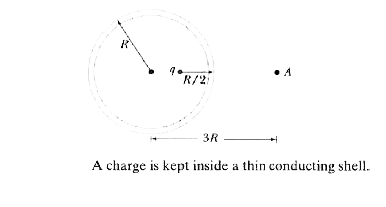
Find the electric field at (A) (a) due to q, (b) due to charges induced on the inner surface of the shell and (c ) due to charges induced on the outer surface of the shell (Fig. 22-41).

Text Solution

Verified by Experts

KEY IDEA
First we note that the charge q is not symmetrically located in the shell. Nevertheless, the electric field due to a point charge is easy to calculate.
`E_(q)=(q)/(4pi epsilon_(0)(5R//2)^(2))=(q)/(25pi epsilon_(0)R^(2))`.
For finding the electric field due to the inner shell, we note that since the charge q is not symmetrically placed, the charge distribution on inner surface will not be symmetric. At the points close to q, charge density will be higher and lower at points farther away from the shell. If the charge was distributed uniformly, we could possibly use the formula for the electric fiedl due to a uniformly charged shell at an external point. But this is not the case here. Not only that, we are not even aware of the pattern in which the induced charges will be distributed.
Calculations: This dilemma can be easily resolved by concept of electrostatic shielding. We know that the effect of the charge q will be cancelled by the charges induced on the inner surface of the cavity:
`vecE_(q)+vecE_("induced")=vec0`.
`E_("in")=(q)/(25pi epsilon_(0)R^(2))`.
To find the electric field due to the charge on the outer surface, we again do not know the pattern of induced charges on that surface. Without that, we cannot find the electric field at A. Let us use a neat trick. Suppose the charge q was at the center of the shell. What would the charge distribution on the outer surface look like? Yes, it would be uniform. From this position, when we move q, the charge on outer surface will not come to know about it because it has shielded from cavity. So the charge on the outer surface will still be uniform. Therefore, we can use the formula of the electric field due to a uniform shell:
`vecE_("outer")=(kq)/(R^(2))`.
So, the net electric field will be `vecE_("net")=(kq)/(R^(2))`.
Promotional Banner

Topper's Solved these Questions

  • ELECTRIC CHARGES AND FIELDS

    RESNICK AND HALLIDAY|Exercise Check points|9 Videos
  • ELECTRIC CHARGES AND FIELDS

    RESNICK AND HALLIDAY|Exercise Problems|63 Videos
  • ELASTICITY

    RESNICK AND HALLIDAY|Exercise PRACTICE QUESTIONS (Integer Type)|3 Videos
  • ELECTRIC POTENTIAL

    RESNICK AND HALLIDAY|Exercise (PRACTICE QUESTIONS) Integer Type|1 Videos

Similar Questions

Explore conceptually related problems

Figure shows a conducting sphere with a cavity. A point charge q_(1) is placed inside cavity, and q_(2) is placed out side the sphere vec(E)_("in") is electric field due to charge induced on surface of cavity. vec(E)_("out") is electric field due to charge induced on outer surface of sphere and vec(E)_("net") is net field at any point. Two closed gaussian surface S_(1) & S_(2) are also drawn in the figure.

A conducting sphere carrying charge Q is surrounded by a spherical conducting shell. a. What is the net charge on the inner surface of the shell? b. Another charge q is placed outside the shell. Now, what is the net charge on the inner surface of the shell? c. If q is moved to a position between the shell and the sphere, what is the net charge on the inner surface of the shell? d. Are your answer valid if the sphere and shell are not concentric?

A conducting spherical shell having inner radius a and outer radius b carries a net charge Q. If a point charge q is placed at the centre of this shell, then the surface charge density on the outer surface of the shell is given as:

A solid insulating sphere of radius a carries a net positive charge 3Q , uniformly distributed throughout its volume. Concentric with this sphere is a conducting spherical shell with inner radius b and outer radius c and having a net charge -Q, as shown in figure a. Consider a spherical Gaussian surface of radius rgtc, the net charge enclosed by this surface is ............. b. The direction of the electric field rgtc is ............. c. The electric field at rgtc is ............... . d. The electric field in the region with radius r, which cgtrgtb, is ............... e. Consider a spherical Gaussian surface of radius r, where cgtrgtb , the net charge enclosed by this surface is ................ . f. Consider a spherical Gaussian surface of radius r, where bgtrgta , the net charge enclosed by this surface is ................. . g. The electric field in the region bgtrgta is ................ . h. Consider a spherical Gaussian surface of radius rlta . Find an expression for the net charge Q(r) enclosed by this surface as a function of r. Note that the charge inside the surface is less than 3Q. i. The electric field in the region rlta is ................. . j. The charge on the inner surface of the conducting shell is .......... . k. The charge on the outer surface of the conducting shell is .............. . l. Make a plot of the magnitude of the electric field versus r.
