Home
Class 12
PHYSICS
In Fig., particles 2 and 4, of charge -e...

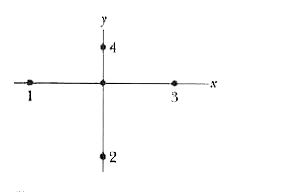
In Fig., particles 2 and 4, of charge -e are fixed in place on a y axis, at `y_(2) = -10.0 cm` and `y_(4) = 5.00 cm`. Particles 1 and 3, of charge -e can be moved along the x axis. Particle 5, of charge +e, is fixed at the origin. Initially particle 1 is at `x_(1) = -10.0 cm` and particle 3 is at `x_(3) = 10.0 cm` (a) To what x value must particle 1 be moved to rotate the direction of the net electric force `vec(F)_("net")` on particle 5 by `60^(@)` counterclockwise? (b) With particle 1 fixed at its new position, to what x value must you move particle 3 to rotate `vec(F)_("net")` back to its original direction ?

Text Solution

Verified by Experts

(a) -402 cm, (b) 4.02 cm
Promotional Banner

Topper's Solved these Questions

  • ELECTRIC CHARGES AND FIELDS

    RESNICK AND HALLIDAY|Exercise Practice Questions (Single Correct Choice Type)|45 Videos
  • ELECTRIC CHARGES AND FIELDS

    RESNICK AND HALLIDAY|Exercise Practice Questions (More than one correct Type )|3 Videos
  • ELECTRIC CHARGES AND FIELDS

    RESNICK AND HALLIDAY|Exercise Check points|9 Videos
  • ELASTICITY

    RESNICK AND HALLIDAY|Exercise PRACTICE QUESTIONS (Integer Type)|3 Videos
  • ELECTRIC POTENTIAL

    RESNICK AND HALLIDAY|Exercise (PRACTICE QUESTIONS) Integer Type|1 Videos

Similar Questions

Explore conceptually related problems

A particle move along y-axis according to equation y +3+4 cos omega t . The motion of the particle is

In Fig., the three particles are fixed in place and have charges q_(1) = q_(2) = +5e and q_(3) = +2e . Distance a = 3.00 mu m . What are the (a) magnitude and (b) direction of the net electric field at point P due to the particles ?

In Fig., particle 1 of charge +6.0 mu C and particle 2 of charge -2.0 mu C are held at separation L = 10.0 cm on an x axis. If particle 3 of unknown charge q_(3) is to be located such that the net electrostatic force on it from particles 1 and 2 is zero, what must be the (a) x and (b) y coordinates of particle 3 ?

Two charged particles are attached to an x axis: Particle 1 of charge -4.00 xx 10^(-7) C is at position x = -5.00 cm and particle 2 of charge +4.00 xx 10^(-7)C is at position x = 10.cm. Midway between the particles, what is their net electric field in unit-vector notation ?

V_(x) is the velocity of a particle of a particle moving along the x- axis as shown. If x=2.0m at t=1.0s , what is the position of the particle at t=6.0s ?

Three particles are fixed on an x axis. Particle 1 of charge q_(1) is at x = -a, and particle 2 charge q_(2) is at x = +a. If their net electrostatic force on particle 3 of charge +Q is to be zero, what must be the ratio q_(1)//q_(2) when particle 3 is at (a) x = +0.750 a and (b) x = +1.50 a ?

Two charged particles are placed at a distance 1.0 cm apart. What is the minimum possible magnitude of the electric force acting o each charge?

RESNICK AND HALLIDAY-ELECTRIC CHARGES AND FIELDS-Problems
  1. Two equally charged particles, held 3.2xx10^(-3) m apart, are releas...

    Text Solution

    |

  2. The charges and coordinates of two charged particles held fixed in an ...

    Text Solution

    |

  3. In Fig., particles 2 and 4, of charge -e are fixed in place on a y axi...

    Text Solution

    |

  4. In crystals of the salt cesium, cesium ions Cs^(+) form the eight corn...

    Text Solution

    |

  5. Two particles are fixed on an x axis. Particle 1 of charge 50 mu C is ...

    Text Solution

    |

  6. In Fig., particles 1 and 2 of charge q(1) = q(2) = +4e are on a y axis...

    Text Solution

    |

  7. In Fig. a, particle 1 (of charge q(1)) and particle 2 (of charge q(2))...

    Text Solution

    |

  8. A particle of charge 3.00 mu C is separated by 0.120 m from a particle...

    Text Solution

    |

  9. Figure shows an arrangement of four charged particles, with angle thet...

    Text Solution

    |

  10. In Fig., three charged particles lie on an x axis. Particles 1 and 2 a...

    Text Solution

    |

  11. Two charged particles are fixed to an x axis : Particle 1 of charge q(...

    Text Solution

    |

  12. At what distance along the central perpendicular axis of a uniformly c...

    Text Solution

    |

  13. Assume that a honeybee is a sphere of diameter 1.000 cm with a charge ...

    Text Solution

    |

  14. A thin nonconducting rod with a uniform distribution of positive charg...

    Text Solution

    |

  15. Two large parallel copper plates are 8.0 cm apart and have a uniform e...

    Text Solution

    |

  16. Figure shows an uneven arrangement of electrons (e) and protons (p) on...

    Text Solution

    |

  17. In Fig., positive charge q = 9.25 pC is spread uniformly along a thin ...

    Text Solution

    |

  18. In Fig., two curved plastic rods, one of charge +q and the other of ch...

    Text Solution

    |

  19. A charged particle creates an electric field of magnitude 300 N/C at a...

    Text Solution

    |

  20. In Fig., a nonconducting rod of length L = 8.15 cm has a charge -q = -...

    Text Solution

    |
