Text Solution
Verified by Experts



Topper's Solved these Questions
ELECTRIC CHARGES AND FIELDS
RESNICK AND HALLIDAY|Exercise Practice Questions (Single Correct Choice Type)|45 VideosELECTRIC CHARGES AND FIELDS
RESNICK AND HALLIDAY|Exercise Practice Questions (More than one correct Type )|3 VideosELECTRIC CHARGES AND FIELDS
RESNICK AND HALLIDAY|Exercise Check points|9 VideosELASTICITY
RESNICK AND HALLIDAY|Exercise PRACTICE QUESTIONS (Integer Type)|3 VideosELECTRIC POTENTIAL
RESNICK AND HALLIDAY|Exercise (PRACTICE QUESTIONS) Integer Type|1 Videos
Similar Questions
Explore conceptually related problems
RESNICK AND HALLIDAY-ELECTRIC CHARGES AND FIELDS-Problems
- An electron with a speed of 2.60 xx 10^(8) cm//s enters and electric f...
Text Solution
|
- An electron is released from rest on the axis of an electric dipole is...
Text Solution
|
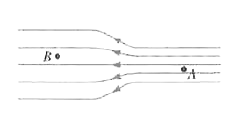
- In Fig. the electric field lines on the left have twice the separation...
Text Solution
|
- Figure shows a distance ring of radius R = 43.0 cm. Two small charged ...
Text Solution
|
- Figure shows two concentric rings, of radii R and R' = 4.00 R, that li...
Text Solution
|
- A circular plastic disk with radius R = 2.00 cm has a uniformly distri...
Text Solution
|
- Charge is uniformly distributed around a ring of radius R = 4.60 cm, a...
Text Solution
|
- In Fig., the three particles are fixed in place and have charges q(1) ...
Text Solution
|
- In Fig., the four particles fixed in palce and have charges q(1) = q(2...
Text Solution
|
- An electric dipole consisting of charges of magnitude 1.50 nC separat...
Text Solution
|
- An electron is released from rest in a uniform electric field of magni...
Text Solution
|
- An electron enters a region of uniform electric field with an initial ...
Text Solution
|
- A uniform electric field exists in a region between two oppositely cha...
Text Solution
|
- An electric dipole consists of charges + 2e and -2e separated by 0.78...
Text Solution
|
- At some instant the velocity components of an electron moving between ...
Text Solution
|
- A charged particles produces an electric field with a magnitude of 2.0...
Text Solution
|
- In Fig. a "semi-infinite" nonconducting rod (that is, infinite in one ...
Text Solution
|
- Figure shows two charged particles on an x axis : -q = -3.20 xx 10^(-1...
Text Solution
|
- In Fig. an electron (e) is to be released from rest on the central axi...
Text Solution
|
- Figure shows the three circular arcs centered on the origin of a coord...
Text Solution
|