Home
Class 12
PHYSICS
A conducting spherical shell of outer ra...

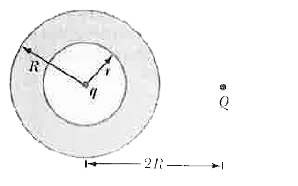
A conducting spherical shell of outer radius R and inner radius r = 3R/4 has no net charge on it. At its center there is a point charge q, and at a distance 2R from its center there is a point charge Q (Fig.) . (a) What is the magnitude of the electrostatic force on the charge q at the center due to the shell ? (b) What is the magnitude of net force on it?

Text Solution

Verified by Experts

(a) `(kqq)/(4R^(2))` towards right , (b) 0
Promotional Banner

Topper's Solved these Questions

  • ELECTRIC CHARGES AND FIELDS

    RESNICK AND HALLIDAY|Exercise Practice Questions (Single Correct Choice Type)|45 Videos
  • ELECTRIC CHARGES AND FIELDS

    RESNICK AND HALLIDAY|Exercise Practice Questions (More than one correct Type )|3 Videos
  • ELECTRIC CHARGES AND FIELDS

    RESNICK AND HALLIDAY|Exercise Check points|9 Videos
  • ELASTICITY

    RESNICK AND HALLIDAY|Exercise PRACTICE QUESTIONS (Integer Type)|3 Videos
  • ELECTRIC POTENTIAL

    RESNICK AND HALLIDAY|Exercise (PRACTICE QUESTIONS) Integer Type|1 Videos

Similar Questions

Explore conceptually related problems

A point charge q is placed at a distance of r from the centre O of an uncharged spherical shell of inner radius R and outer radius 2R. The electric potential at the centre of the shell will be

A non-conducting spherical shell of radius R surrounds a point charge q (q at center). The electric flux through a cap of the shell of half angle theta is:

A conducting spherical shell having inner radius a and outer radius b carries a net charge Q. If a point charge q is placed at the centre of this shell, then the surface charge density on the outer surface of the shell is given as:

A regular pentagon has four charges each +q at four of its vertices. At the centre of the pentagon, a charge +q is kept. If the distance of a vertex from the center is a the magnitude of the net force acting on the charge at the center is

A thin spherical conducting shell of radius R has a charge q. Another charge Q is placed at the centre of the shell. The electrostatic potential at a point P a distance R/2 from the centre of the shell is

A small conducting spherical shell with inner radius a and outer radius b is concentric with a larger conducting sphereical shell with inner radius c and outer radius d. The inner shell has total charge +2q and the outer shell has charge +4q . a. Make a plot of the magnitude of the electric field versus r. b. Calculate the electric field ("magnitude and direction in terms of q") and the distance r from the common centre of the two shell for (i) rlta, (ii)altrltb, (iii) bltrltc, (iv) cltrltd , (v) rgtd . Show uour result in a graph with radial component of vecE as function of r . c. What is the total charge on the i. inner surface of the small shell, ii. outer surface of the small shell, iii. inner surface of the large shell, iv. outer surface of the large shell?

A small conducting spherical shell with inner radius a and outer radius b is concentric with a larger conducting spherical shell with inner radius c and outer radius d ( as shown in Fig . 2.121). The inner shell has a total charge + 2 q , and the outer shell has a total charge + 4 q . Calculate the electric field in terms of q and the distance r from the common center of the two shells for The graph of the radial component of E as a function of r will be

Consider an initially neutral hollow conducting spherical shell with inner radius r and outer radius 2r. A point charge +Q is now placed inside the shell at a distance r/2 from the centre. The shell is then grounded by connecting the outer surface to the earth. P is an external point at a distance 2r from the point charge +Q on the line passing through the centre and the point charge +Q as shown in the figure. The magnitude of the force on a test charge +q placed at P will be

RESNICK AND HALLIDAY-ELECTRIC CHARGES AND FIELDS-Problems
  1. Charge is uniformly distributed around a ring of radius R = 4.60 cm, a...

    Text Solution

    |

  2. In Fig., the three particles are fixed in place and have charges q(1) ...

    Text Solution

    |

  3. In Fig., the four particles fixed in palce and have charges q(1) = q(2...

    Text Solution

    |

  4. An electric dipole consisting of charges of magnitude 1.50 nC separat...

    Text Solution

    |

  5. An electron is released from rest in a uniform electric field of magni...

    Text Solution

    |

  6. An electron enters a region of uniform electric field with an initial ...

    Text Solution

    |

  7. A uniform electric field exists in a region between two oppositely cha...

    Text Solution

    |

  8. An electric dipole consists of charges + 2e and -2e separated by 0.78...

    Text Solution

    |

  9. At some instant the velocity components of an electron moving between ...

    Text Solution

    |

  10. A charged particles produces an electric field with a magnitude of 2.0...

    Text Solution

    |

  11. In Fig. a "semi-infinite" nonconducting rod (that is, infinite in one ...

    Text Solution

    |

  12. Figure shows two charged particles on an x axis : -q = -3.20 xx 10^(-1...

    Text Solution

    |

  13. In Fig. an electron (e) is to be released from rest on the central axi...

    Text Solution

    |

  14. Figure shows the three circular arcs centered on the origin of a coord...

    Text Solution

    |

  15. Two charged particles lie along x axis as shown in Fig. The particle w...

    Text Solution

    |

  16. In the situation described in Problem 63, find the condition that a ch...

    Text Solution

    |

  17. A semi-infinite charged rod is arranged so that its one end coincides ...

    Text Solution

    |

  18. A positive charge q is placed in front of a conducting solid body at a...

    Text Solution

    |

  19. A conducting spherical shell of outer radius R and inner radius r = 3R...

    Text Solution

    |

  20. A pellet with charge +Q is centered inside a spherical cavity in a con...

    Text Solution

    |
