Home
Class 12
PHYSICS
A glass tube has several different cross...

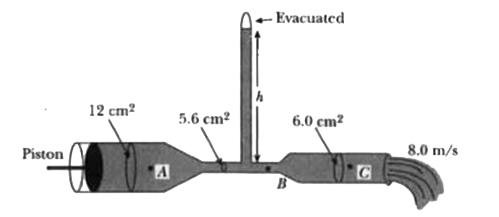
A glass tube has several different cross-sectional areas with the values indicated in the figure . A piston at the left end of the tube exerts pressure so that mercury within the tube flows from the right end with a speed of `8.0` m/s . Three points with in the tube are labeled A , B and C . (Atmospheric pressure is `1.01 xx 10^(5) N//m^(2)` , Density of mercury is `13600 kg //m^(3)`) .

What is the total pressure at point B ?

A

`1.01 xx 10^(5) Pa`

B

`4.27 xx 10^(5) Pa`

C

`3.64 xx 10^(4) Pa`

D

`6.44 xx 10^(4) Pa`

Text Solution

Verified by Experts

The correct Answer is:

C
Promotional Banner

Topper's Solved these Questions

  • FLUIDS

    RESNICK AND HALLIDAY|Exercise PRACTICE QUESTIONS (Matrix - Match )|7 Videos
  • FLUIDS

    RESNICK AND HALLIDAY|Exercise PRACTICE QUESTIONS (Integer Type )|5 Videos
  • FLUIDS

    RESNICK AND HALLIDAY|Exercise PRACTICE QUESTIONS (More than One Correct Choice Type )|10 Videos
  • ELECTROMAGNETIC WAVES

    RESNICK AND HALLIDAY|Exercise PRACTICE QUESTIONS (Integer Type)|3 Videos
  • FORCE AND MOTION - I

    RESNICK AND HALLIDAY|Exercise PRACTICE QUESTIONS (Integer Type)|3 Videos

Similar Questions

Explore conceptually related problems

A glass tube has several different cross-sectional areas with the values indicated in the figure . A piston at the left end of the tube exerts pressure so that mercury within the tube flows from the right end with a speed of 8.0 m/s . Three points with in the tube are labeled A , B and C . (Atmospheric pressure is 1.01 xx 10^(5) N//m^(2) , Density of mercury is 13600 kg //m^(3) ) . At what speed is mercury flowing past the point labeled B ?

A glass tube has several different cross-sectional areas with the values indicated in the figure . A piston at the left end of the tube exerts pressure so that mercury within the tube flows from the right end with a speed of 8.0 m/s . Three points with in the tube are labeled A , B and C . (Atmospheric pressure is 1.01 xx 10^(5) N//m^(2) , Density of mercury is 13600 kg //m^(3) ) . At what speed is mercury flowing past the point labeled A ?

Suppose the pressure at the surface of mercury in as barometer tube is P_1 and the pressure at the surface of mercury in the cup is P_2 .

In the figure, the cross-sectional area of the smaller tube is a and that of the larger tube is 2a . A block of mass m is kept in the smaller tube having the base area that of the tube. The difference between water levels of the two tubes is

Water (density rho ) is flowing through the uniform tube of cross-sectional area A with a constant speed v as shown in the figure. Find the magnitude of force exerted by the water on the curved corner of the tube is (neglect viscous forces)

The U-tube acts as a water siphon. The bend in the tube is 1m above the water surface. The tube outlet is 7m below the water surface. The water issues from the bottom of the siphon as a free jet at atmospheric pressure. Determine the speed of the free jet and the minimum absolute pressure of the water in the bend. Given atmospheric pressure =1.01xx 10^(5)N//m^(2),g=9.8 m//s^(2) and density of water =10^(3)kg//m^(3) .

A glass tube of length l_(0) and of uniform cross-section is to be filled with mercury so that the length of the tube unoccoupied by mercury remains same at all temperatures. If gamma_(g)=3alpha , calculate length of mercury column.

What will be the length of mercury column in a barometer tube, when the atmospheric pressure is 76 cm of mercury and the tube is inclined at an angle of 30 ^(@) with the horizontal direction ?

A capillary tube is dipped in water with the lower and 10 cm below the surface. Water rises in the tube to a height of 5 cm. The pressure required to blow a bubble at the lower end of the tube will be (atmospheric pressure = 10^5 Nm^(-2) and g = 10 m//s^2 )
