Home
Class 12
PHYSICS
A mobile phone lies along the principal ...

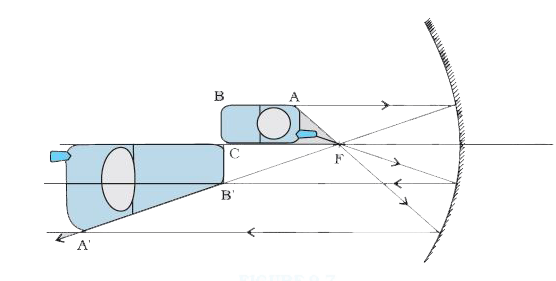
A mobile phone lies along the principal axis of a concave mirror, as shown in Fig. 9.7. Show by suitable diagram, the formation of its image. Explain why the magnification is not uniform. Will the distortion of image depend on the location of the phone with respect to the mirror?

Text Solution

Verified by Experts

The ray diagram for the formation of the image of the phone is shown in Fig. 9.7. The image of the part which is on the plane perpendicular to principal axis will be on the same plane. It will be of the same size, i.e., B′C = BC. You can yourself realise why the image is distorted.
Promotional Banner

Topper's Solved these Questions

  • RAY OPTICS AND OPTICAL INSTRUMENTS

    NCERT GUJARATI|Exercise EXERCISES|40 Videos
  • NUCLEI

    NCERT GUJARATI|Exercise ADDITIONAL EXERCISES|9 Videos
  • SEMICONDUCTOR ELECTRONICS: MATERIALS, DEVICES AND SIMPLE CIRCUITS

    NCERT GUJARATI|Exercise ADDITIONAL EXERCISES|8 Videos

Similar Questions

Explore conceptually related problems

An infinitely long rod lies along the axis of a concave mirror of focal length f. The near end of the rod is distance u gt f from the mirror. Its image will have length

A short linear object of length b lies along the axis of a concave mirror of focal length f at a distanee u from the pole of the mirror. The size of the image is approximately equal to

A particle is dropped along the axis from a height (f)/(2) on a concave mirror of focal length f as shown in figure. Find the maximum speed of image .

As shown in the figure, a thin rod AB of length 10 cm is placed on the principal axis of a concave mirror such that it.s end B is at a distance of 40 cm from the mirror. If the focal length of the mirror is 20 cm, find the length of the image of the rod

A short object of length L is placed along the principal axis of a concave mirror away from focus. The object distance is u. If the mirror has a focal length f, what will be the length of the image ? You may take L lt lt |v- f|.

A convex lens of focal length 15 cm and a concave mirror of focal length 30 cm are kept with their optic axis PQ and RS parallel but separated in vertical directiion by 0.6 cm as shown . The distance between the lens and mirror is 30 cm . An upright object AB of height 1.2 cm is placed on the optic axis PQ of the lens at a distance of 20 cm from the lens . if A'B' is the image after refraction from the lens and the reflectiion from the mirror , find the distance of A'B' from the pole of the mirror and obtain its magnification . Also locate positions of A' and B' with respect to the optic axis RS.

When a pin is moved along the principal axis of a small concave mirror, the image position coincides with the object at a point 0.5 m from the mirror refer figure . If the mirror is placed at a depth of 0.2 m in a transparent liquid, the same phenomenon occurs when the pin is placed 0.4 m from the mirror . The refractive index of the liquid is :-

A thin rod of length f//3 is placed along the optic axis of a concave mirror of focal length f such that its image which is real and elongated, just touches the rod. The magnification is "_____________"

In an experiment to determine the focal length (f) of a concave mirror by the u-v method, a student places the object pin A on the principal axis at a distance x from the pole P. The student looks at the pin and its inverted image from a distance keeping his/her eye in line with PA. When the student shifts his/her eye towards left, the image appears to the right of the object pin. Then,

NCERT GUJARATI-RAY OPTICS AND OPTICAL INSTRUMENTS-EXERCISES
  1. A mobile phone lies along the principal axis of a concave mirror, as s...

    Text Solution

    |

  2. A small candle, 2.5 cm in size is placed at 27 cm in front of a concav...

    Text Solution

    |

  3. A 4.5 cm needle is placed 12 cm away from a convex mirror of focal len...

    Text Solution

    |

  4. A tank is filled with water to a height of 12.5 cm. The apparent depth...

    Text Solution

    |

  5. Figures 9.31(a) and (b) show refraction of a ray in air incident at 60...

    Text Solution

    |

  6. A small bulb is placed at the bottom of a tank containing water to a d...

    Text Solution

    |

  7. A prism is made of glass of unknown refractive index. A parallel beam ...

    Text Solution

    |

  8. Double-convex lenses are to be manufactured from a glass of refractive...

    Text Solution

    |

  9. A beam of light converges at a point P. Now a lens is placed in the pa...

    Text Solution

    |

  10. An object of size 3.0cm is placed 14cm in front of a concave lens of f...

    Text Solution

    |

  11. What is the focal length of a convex lens of focal length 30cm in cont...

    Text Solution

    |

  12. A compound microscope consists of an objective lens of focal length 2....

    Text Solution

    |

  13. A person with a normal near point (25 cm) using a compound microscope ...

    Text Solution

    |

  14. A small telescope has an objective lens of focal length 144cm and an e...

    Text Solution

    |

  15. (a) A giant refracting telescope at an observatory has an objective le...

    Text Solution

    |

  16. Use the mirror equation to deduce that: (a) an object placed between...

    Text Solution

    |

  17. A small pin fixed on a table top is viewed from above from a distance ...

    Text Solution

    |

  18. (a) Figure 9.32 shows a cross-section of a 'light pipe' made of a glas...

    Text Solution

    |

  19. Answer the following questions: (a) You have learnt that plane and c...

    Text Solution

    |

  20. Answer the following questions: (b) A virtual image, we always say, ...

    Text Solution

    |

  21. Answer the following questions: (c) A diver under water, looks obliq...

    Text Solution

    |
