Home
Class 12
PHYSICS
A convex lens, of focal length 25 cm, an...

A convex lens, of focal length 25 cm, and a concave mirror, of radius of curvature 20 cm. are placed co-axially 4 cm aprat from each other. An incident beam, parallel to the principal axis, is incident on the convex lens. Find the position and nature of the image formed by this combination.

Text Solution

Verified by Experts
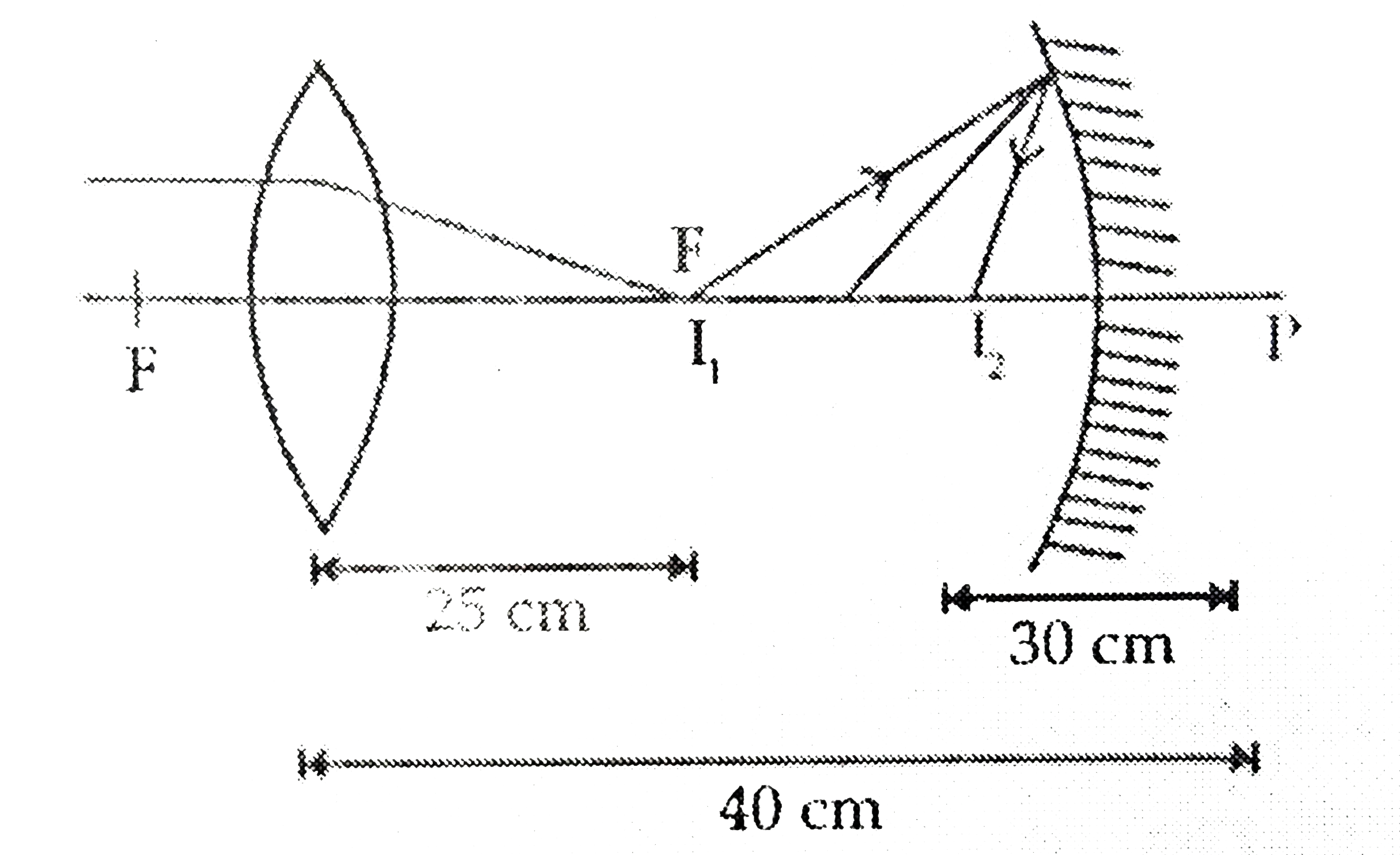

For image `l_1` :
` u=-prop " "u=-15 cm`
` (1)/(upsilon)-(1)/(u)=(1)/(f) " " (1)/(upsilon)+(1)/(u)=(1)/(f)`
` rArr upsilon =25 cm " "(1)/(upsilon)=(1)/(f)-(1)/(u)=(-1)/(10)+(1)/(15)`
`rArr upsilon =-30 cm`
Real image on same side of mirror.
Promotional Banner

Topper's Solved these Questions

  • XII BOARDS

    XII BOARDS PREVIOUS YEAR|Exercise C.B.S.E.CLASS-XII PHYSICS (THEORY) [SET-I] (SECTION-A)|5 Videos
  • XII BOARDS

    XII BOARDS PREVIOUS YEAR|Exercise SECTIONS-B|6 Videos
  • XII BOARDS

    XII BOARDS PREVIOUS YEAR|Exercise SECTION-C|55 Videos
  • SAMPLE PAPER 2019

    XII BOARDS PREVIOUS YEAR|Exercise SECTION D|6 Videos

Similar Questions

Explore conceptually related problems

A convex lens of focal length 20 cm and a convex mirror of focal length 10 cm are placed co-axially 50 cm apart from each other. An incident beam parallel to its principal axis is incideent on the convex lens. Locate the position of final image formed due to the combination.

A convex lens of focal length 20 cm is placed co-axially with a convex mirrir of radius of curvature 20 cm . The two are kept 15 cm apart from eachother. A point object is placed 60 cm in front of the convex lens. Find the position of the image formed by the combination.

A convex lens of focal length 20 cm and a convex mirror of focal length 10 cm are placed co-axially 50 cm apart from each other. An incident on the convex lens. Locate the position of final image formed due to the combination. (NCERT Solved Example)

A convex lens of focal length 15 cm , and a concave mirror of radius of curvature 20 cm are placed co-axially 10 cm apart. An object is placed in front of convex lens so that there is no parallax between the object and its image formed by the combination. Find the position of the object.

A convex lens of focal length 20cm is placed coaxilly with a convex mirror of radius of curvature 20 cm. The two are kept 15 cm apart. A point object is placed 40 cm in front of the convex lens. Find the position of the image formed by this combination. Draw the ray diagram showing the image formation.

A concave lens of focal length 20 cm is placed 15 cm in front of a concave mirror of radius of curvature 26 cm and further 10 cm away from the lens is placed an object. The principal axis of the lens and the mirror are coincident and the object is on the axis Find the position and nature of the image.

A convex lens of focal length 10 cm is placed coaxially 5 cm away from a concave lens of focal length 10 cm. If an object is placed 30 cm in front of the convex lens, find the position of the final image formed by the combined system.

A convex lens of focal length 10 cm is placed co-axially 5 cm away from a concave lens of focal length 10 cm . If an object is placed 30 cm in front of the convex lens, find the position of final image formed by the combined system.

