Home
Class 12
PHYSICS
(i) Device the mathematical n between re...

`(i)` Device the mathematical `n` between refractive indices `n_(1)` and `n_(2)` of two radii and radius of curvature `R` for refraction at a convex shperical surface. Consider the object to be a point since lying on the principal axis in rarer medium of refractive index `n_(1)` and a real image formed in the denser medium of refractive index `n_(2)`. Hence, derive lens marker's formula.
`(ii)` Light from a point source in air falls on a convex spherical glass surface of refractive index `1.5` and radius of curvature `20cm`. The distance of light source from the glass surface is `100cm`. At what position is the image formed ?

Text Solution

Verified by Experts
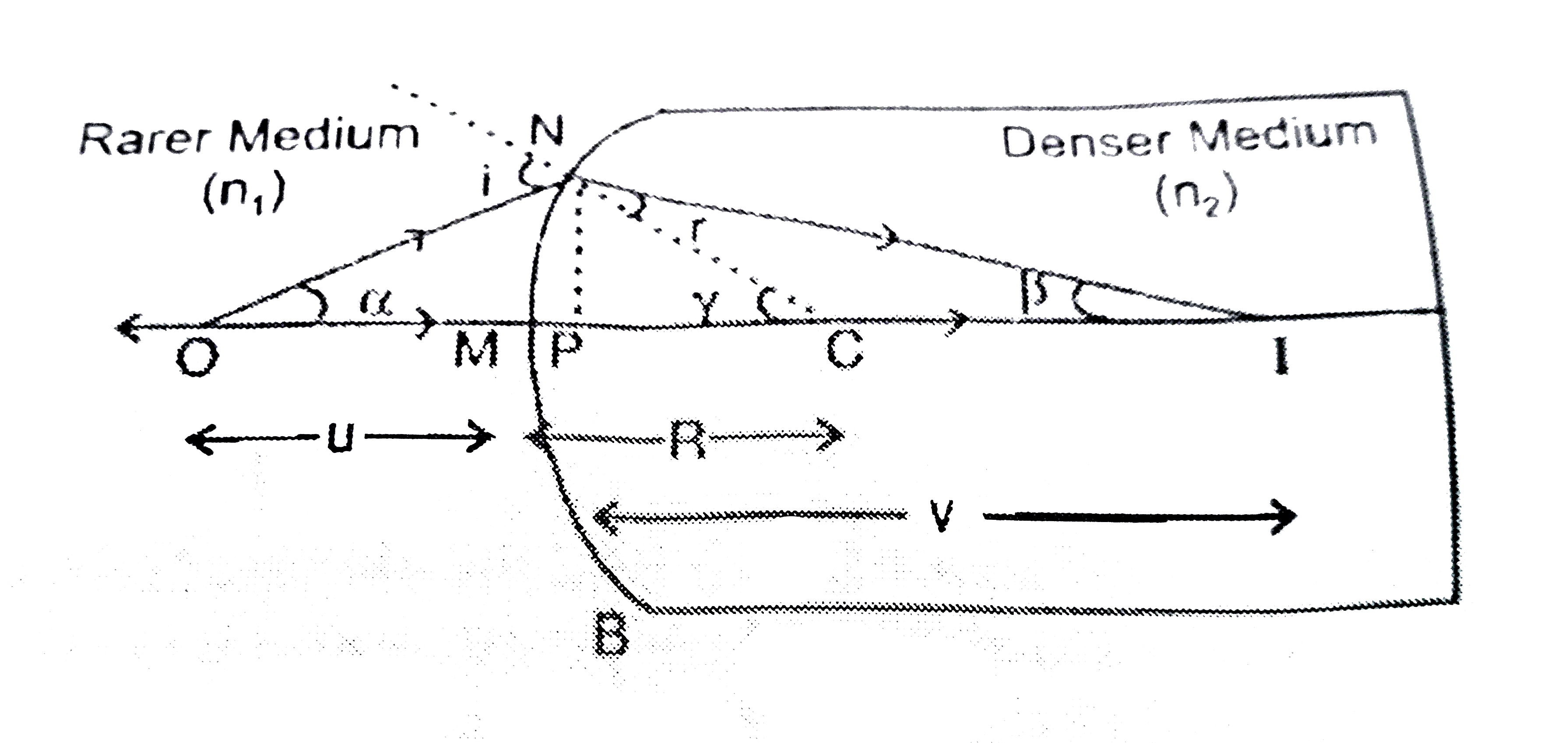

Let `i` be the angle of incidence of ray `OA` and `r` the anlge of refraction in the densor medium i.e, `/_OAN=i` and `/_CAI=r`. Let `/_AOP=a /_AIP=B` and `/_ACP=b` and `/_CP ACP=y`
In triangle `OAC` `i=y+a`
In triangle `AIC`, `y=b+t` or `r=y-B`
From Snell's law
If point `A` is very close to `P`, the angles `i,r,a,b` and `c` will be very small. Therefore
`sin i=i` and `sinr=r`
From equation,
`(i)/(r )=(n_(2))/(n_(1))`
Sunstituting values of `i` and `r` , we get
`(gamma+alpha)/(gamma-beta)=(n_(2))/(n_(1))` or `n_(1)(gamma+alpha)/(gamma-beta)=(n_(2))/(n_(1))` or `n_(1)=(gamma+alpha)=n_(2)(gamma-beta)`
Let `h` be the height of perpendicular drawn from `A` on principal axis i.e. `AM=h`. As `a,b` and `y` are very small angles.
`:. tanalpha=alpha`, `tanbeta=beta` and `tangamma=gamma`
Substituting these values,
`n_(1)(tangamma+tan alpha)=n_(2)(tangamma-tanbeta)`
As point A is very close to point `P`, Point `M` is coincident with `P`.
From figure `tan alpha=(AM)/(OM)=(h)/(OP)impliestanbeta=(AM)/(MI)=(h)/(PI)`
`tangamma=(AM)/(MC)=(h)/(PC)`
Substituting these values , we get
`n_(1)((h)/(PC)+(h)/(OP))=n_(2)((h)/(PC)+(h)/(PI))` or `n_(1)((1)/(PC)+(1)/(OP))=n_(2)((1)/(PC)+(1)/(PI))`
If the distances of object `O`, image `I`, centre of curvature `C` from the pole be `u,v` and `R` respectively, then by sign convention `PO` is negative while `PC` and `PI` are positive. Thus,
`u=-OP`, `v=+PI`, `R=+PC`
Substituting these values in `(vi)`, we get
`n_(1)((1)/(R)-(1)/(u))=n_(2)((1)/(R )+(1)/(v))` or `(n_(1))/(R )-(n_(1))/(R )-(n_(1))/(u)=(n_(2))/(R )-(n_(2))/(u)`
`(n_(2))/(v)-(n_(1))/(u)=(n_(2)-n_(1))/(R )`
Promotional Banner

Topper's Solved these Questions

  • XII BOARDS

    XII BOARDS PREVIOUS YEAR|Exercise SET-I (SECTION-A)|5 Videos
  • XII BOARDS

    XII BOARDS PREVIOUS YEAR|Exercise SET-I (SECTION-B)|5 Videos
  • XII BOARDS

    XII BOARDS PREVIOUS YEAR|Exercise Section-D|18 Videos
  • SAMPLE PAPER 2019

    XII BOARDS PREVIOUS YEAR|Exercise SECTION D|6 Videos

Similar Questions

Explore conceptually related problems

Monochromatic light of wavelength lambda_1 travelling in medium of refractive index n_1 enters a denser medium of refractive index n_2 . The wavelength in the second medium is

A small point object is placed at O at a distance of 0.60 metre in air from a convex spherical surface of refractive index 1.5 .If the radius of the curvature is 25cm then what is the position of the image on the principal axis.

If the wavelength of light in vacuum be lambda , the wavelength in a medium of refractive index n will be

When a lens of refractive index n_(1) , then the lens looks to be dissapeared only, if

A ray of light travels from a medium of refractive index n_(1) to a medium of refractive index n_(2) . If angle of incidence is i and angle of refraction is r, than (sin i)/(sin r) is equal to

XII BOARDS PREVIOUS YEAR-XII BOARDS-Section-E
  1. (i) Draw a labelled diagram of a step-down transformer. State the prin...

    Text Solution

    |

  2. (a) Explain the meaning of the term mutual inductance. Consider two co...

    Text Solution

    |

  3. (i) Device the mathematical n between refractive indices n(1) and n(2)...

    Text Solution

    |

  4. (a) Draw a labelled ray diagram to obtain the real image formed by an ...

    Text Solution

    |

  5. (i) Use Gauss's law to find the electric field due to a uniformly char...

    Text Solution

    |

  6. (i) If two similar large plates, each of area A having surface charge ...

    Text Solution

    |

  7. (a) State Gauss's law. Using this law, obtain the expression for the e...

    Text Solution

    |

  8. (a) Derive the expression for the electric potential at any point P, a...

    Text Solution

    |

  9. (a) Prove that an ideal capacitor in ac circuit does not dissipate pow...

    Text Solution

    |

  10. (a) A metallic rod of length l is moved perpendicular to its length wi...

    Text Solution

    |

  11. (a) Explain with reason, how the power of a diverging lens changes whe...

    Text Solution

    |

  12. (a) Deduce the expression, by drawing a suitable ray diagram, for the ...

    Text Solution

    |

  13. (a) Define electric flux. Is is the scalar or a vector quantity? A ...

    Text Solution

    |

  14. (a) Use Gauss's law to derive the expression for the electric filed ...

    Text Solution

    |

  15. (a) State the principle of an ac generator and explain its working ...

    Text Solution

    |

  16. A device X is connected across an ac source of voltage V = V(0) sin om...

    Text Solution

    |

  17. (a) Draw a ray diagram to show image fromation when the concave mirro...

    Text Solution

    |

  18. (a) Define a wavefront. Using Huygen's principle, verify the laws of...

    Text Solution

    |

