Home
Class 12
PHYSICS
(a) Show using a proper diagram how unp...

(a) Show using a proper diagram how unpolarised light can be linearly polarised by reflection from a transparent glass surface.
(b) The figure shows a ray of light falling normally on. the face AB of an equilateral glass prism having refractive index 3/2, placed A in water ofrefractive index 4/3. Will this ray suffer total internal reflection on striking the face AC? Justify your answer.

Text Solution

Verified by Experts
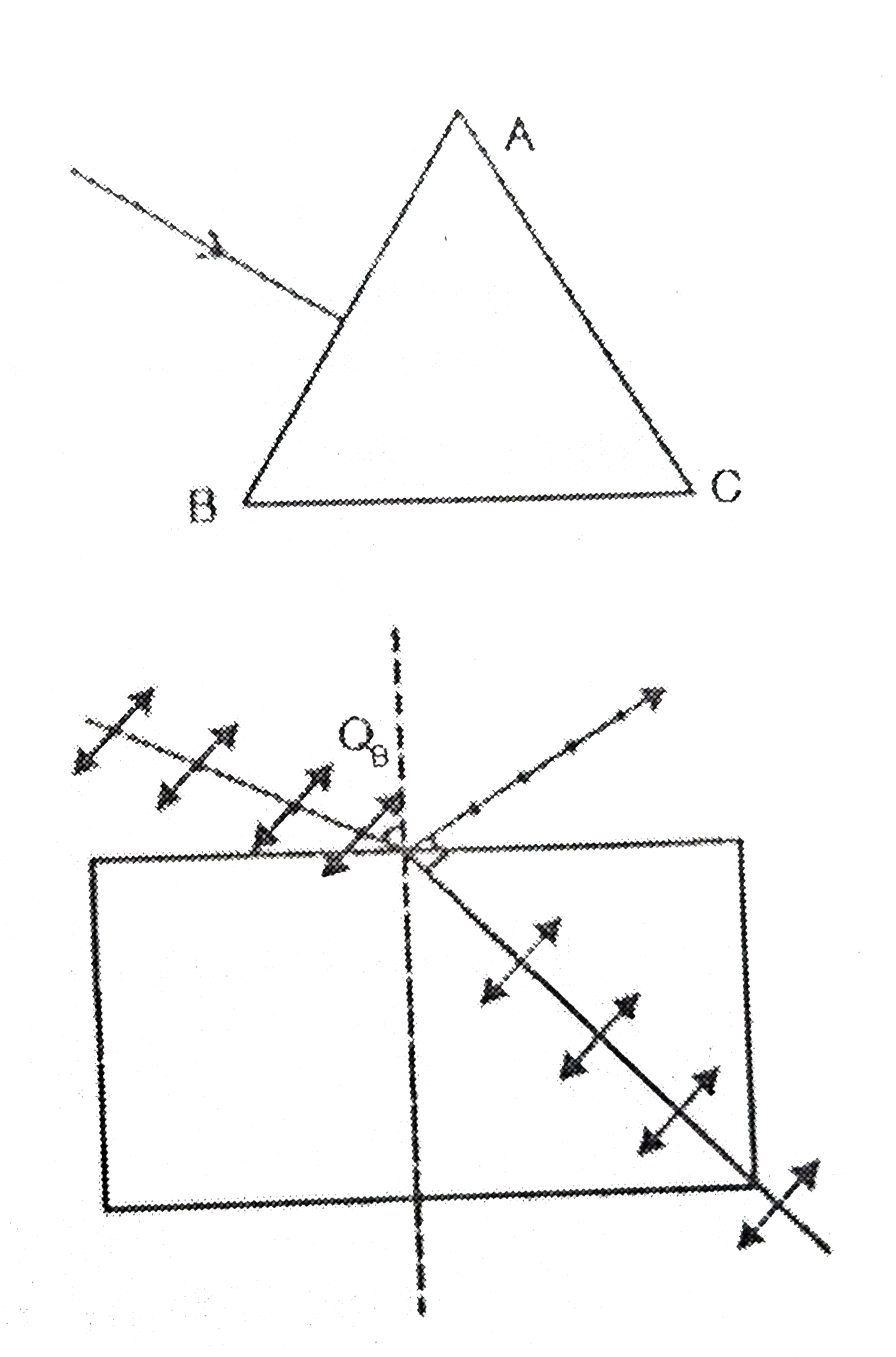
(a) It is possible to transform unpolarised light in the polarised light. Polarised light waves ore light waves in which the vibration occur in a single plane, the process of transforming unpolarised into polarised is know as polarisation .
Brester angle of incident at which light with a particular polarisation is perfectly transimitted throught a transperent dielectric is perfectly transmitted throught a transparent dielectric surface. With no relflection when unpolarised light is incident at this angle, the light thal is reflected from the surface is polarised.
(b) `U = 1//sin C" "[mu "is refraction index"]`
`U_(2)//U_(1)` and C is critical angle `3//2//4//3 = 1//sin C`
`9//8 = 1//sin C`
`sin C = 8//9`
C= approx `62.73^(@)` ray is perpendicular therefore, would not show any refraction or any reflection.
While incident ray reaches AC it would make a triangle with angle of prizm `60^(@)` and perpendicular Angle. Now angle of incident ray with ax is `180-60+90= 30^(@)`
Angle of incident `= 90-30 = 60^(@)`
Since, angle of incident is less than critical angle. Ray will not suffer TIR.
Promotional Banner

Topper's Solved these Questions

  • XII BOARDS

    XII BOARDS PREVIOUS YEAR|Exercise SECTION - A|7 Videos
  • XII BOARDS

    XII BOARDS PREVIOUS YEAR|Exercise SECTION - B|9 Videos
  • XII BOARDS

    XII BOARDS PREVIOUS YEAR|Exercise SECTION - E|6 Videos
  • SAMPLE PAPER 2019

    XII BOARDS PREVIOUS YEAR|Exercise SECTION D|6 Videos

Similar Questions

Explore conceptually related problems

A light ray falls perpendicular on one face of an equilateral prism having refractive index sqrt(2) .The angle of deviation is :

A glass prism of refractive index 1.5 is immersed in water (refractive index 4//3 ) . A light beam normally on the face AB is totally reflected to reach on the face BC if

A ray of light is incident normally on one face of 30^(@) - 60^(@) - 90^(@) prism of refractive index 5/3 immersed in water of refractive index 4/3 as shown in figure .

A ray of light is incident normally on one face of an equilateral prism of refractive index 1.5 . The angle of deviation is: (Given sin^-1.(2)/(3)=42^@ )

A glass prism of refractive index 1.5 is immersed in water (refractive index 4/3). A light beam incident normally on the face AB is totally reflected to reach on the face BC if.

A glass prism of refractive index 1.5 is immersed in water (refractive index 4/3). A light beam incident normally on the face AB is totally reflected to reach the face BC , Fig. if : .

