Home
Class 11
CHEMISTRY
Why does boron trifluoride behave as a L...

Why does boron trifluoride behave as a Lewis acid?

Text Solution

Verified by Experts
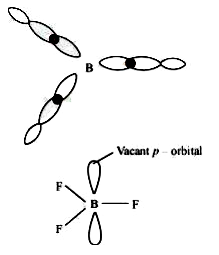
The electric configuration of boron is `ns^(2)" "np^(1)`. It has three electrons in its valence shell. Thus, it can form only three covalent bonds. This means that three are only six electrons around boron and its octet remains incomplete. When one atom of bronon combines with three fluorine atoms, its octet remains incomplete. Hence, boron trifluoride remains electron-deficient and acts as a Lewis acid.
Promotional Banner

Topper's Solved these Questions

  • THE P-BLOCK ELEMENTS

    NCERT ENGLISH|Exercise EXERCISE|38 Videos
  • STRUCTURE OF ATOM

    NCERT ENGLISH|Exercise EXERCISE|67 Videos
  • THE S-BLOCK ELEMENTS

    NCERT ENGLISH|Exercise EXERCISE|32 Videos

Similar Questions

Explore conceptually related problems

Carbon terachloride behaves as a Lewis acid .

PCl_5 behaves as a Lewis acid.

A non-metallic element of group 13, used in making bullet proof vests is extremely hard solid of black colour. It can exist in many allotropic forms and has unusually high melting point. Its trifluride acts as Lewis acid towards ammonia. The element exihibits maximum covalency of four. Identify the element and write the reaction of its trifluoride with ammonia Explain why does the trifluoride act as a Lewis acid ?

Explain, why is boron trifluoride a strong Lewis acid.

Why is boron trifluoride a weaker Lewis acid as compared to B Br_3 and BCl_3 ?

Boron behaves as :

The best Lewis acid is

Why do boron halides act as Lewis acids ?

Explain why the following compounds behave as Lewis acids ? (a) BCl_(3) (b) AlCl_(3)

Which of the following example behave as a lewis acid BF_3, SnCl_2, SnCl_4 :

NCERT ENGLISH-THE P-BLOCK ELEMENTS -EXERCISE
  1. Discuss the pattern of variation in the oxidation states of (a)B to TI...

    Text Solution

    |

  2. How can you explain higher stability of BCI(3) as compared to TICI(3)?

    Text Solution

    |

  3. Why does boron trifluoride behave as a Lewis acid?

    Text Solution

    |

  4. Consider the compounds, BCl(3) and C Cl(4).How will they behave with w...

    Text Solution

    |

  5. Is boric acid a protic acid? Explain.

    Text Solution

    |

  6. Explain what happens when boric acid is heated.

    Text Solution

    |

  7. Describe the shapes of BF(3) and BH(4)^(ө). Assign the hybridisation o...

    Text Solution

    |

  8. Write reaction of justify amphoteric nature of aluminium.

    Text Solution

    |

  9. What are electron-deficient compounds? Are BCl(3) and SiCl(4) electron...

    Text Solution

    |

  10. Write the resonance structure of CO(3)^(2-) and HCO(3)^(ө).

    Text Solution

    |

  11. What is the state of hybridisation of carbon in (a)CO(3)^(2-), (b) dia...

    Text Solution

    |

  12. Explain the difference in properties of diamond and graphite on the ba...

    Text Solution

    |

  13. Rationalise the given statements and give chemical reactions. a. Lea...

    Text Solution

    |

  14. Suggest reasons why the B–F bond lengths in BF(3) (130 pm) and BF(4 )^...

    Text Solution

    |

  15. If B-Cl bond has a dipole moment, explain why BCl(3) molecule has zero...

    Text Solution

    |

  16. AlF(3) is insoluble in anhydrous HF but dissolves on addition of NaF. ...

    Text Solution

    |

  17. Suggest a reason as to why CO is poisonous.

    Text Solution

    |

  18. How is excessive content of CO(2) responsible for global warming?

    Text Solution

    |

  19. Explain structures of diborane and boric acid.

    Text Solution

    |

  20. What happens when (a) Borax is heated strongly, (b) Boric acid is ...

    Text Solution

    |

