Home
Class 11
CHEMISTRY
Derive the structure of (i) 2-Chlorohexa...

Derive the structure of (i) 2-Chlorohexane, (ii) Pent-4-en-2-ol, (iii) 3- Nitrocyclohexene, (iv) Cyclohex-2-en-1-ol, (v) 6-Hydroxy- heptanal.

Text Solution

Verified by Experts
(i) ‘hexane’ indicates the presence of 6 carbon atoms in the chain. The functional group chloro is present at carbon 2. Hence, the structure of the compound is `CH_(3)CH_(2)CH_(2)CH_(2)CH(Cl)CH_(3).`
(ii) ‘pent’ indicates that parent hydrocarbon contains 5 carbon atoms in the chain. ‘en’ and ‘ol’ correspond to the functional groups C=C and -OH at carbon atoms 4 and 2 respectively. Thus, the structure is
`CH_(2)=CHCH_(2)CH(OH)CH_(3).`
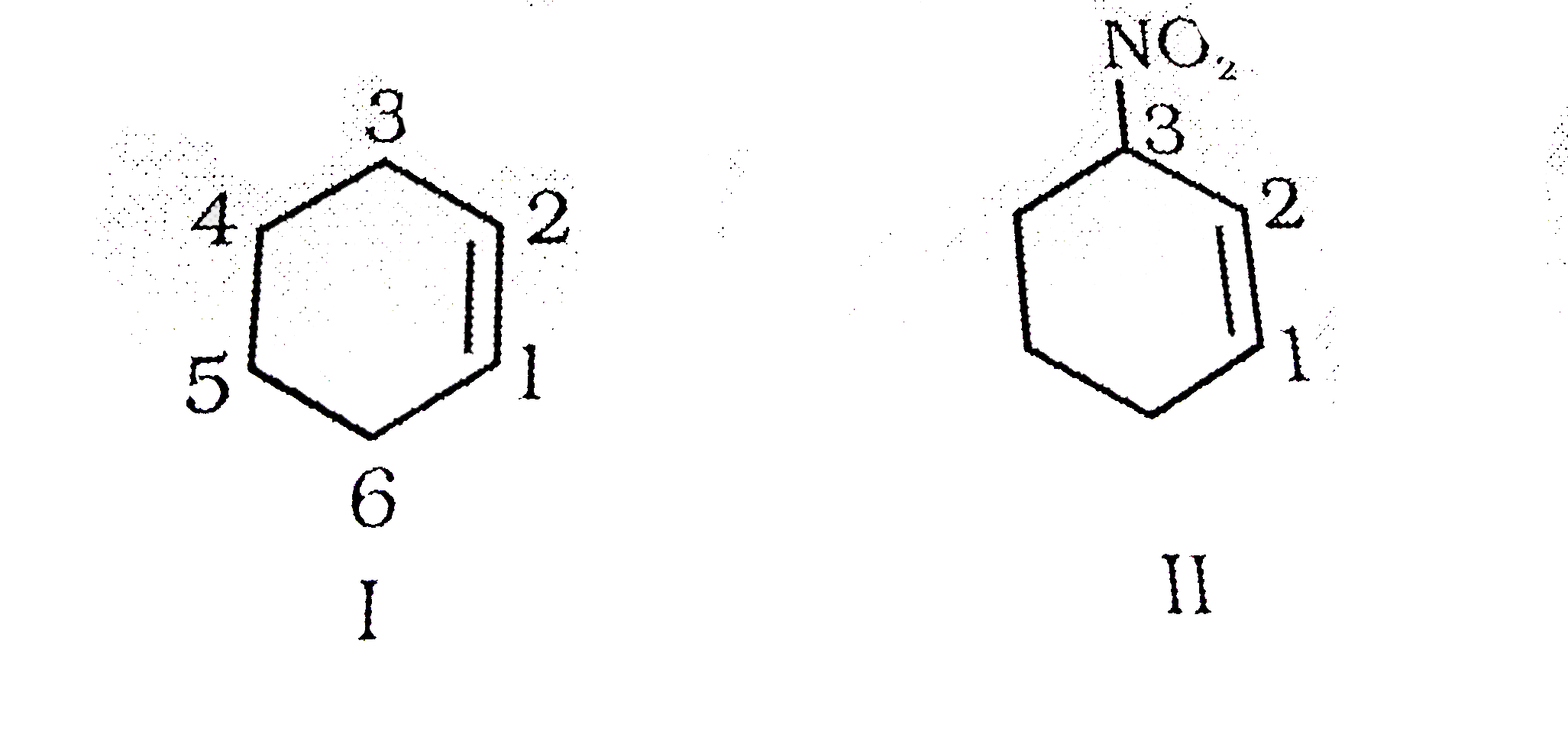
(iii) Six membered ring containing a carbon-carbon double bond is implied by cyclohexene, which is numbered as shown in (I). The prefix 3-nitro means that a nitro group is present on C-3. Thus, complete structural formula of the compound is (II). Double bond is suffixed functional group whereas `NO_(2)` is prefixed functional group therefore double bond gets preference over –`NO_(2)` group:

(iv) ‘1-ol’ means that a -OH group is present at C-1. OH is suffixed functional group and gets preference over C=C bond. Thus the structure is as shown in (II):

(v) ‘heptanal’ indicates the compound to be an aldehyde containing 7 carbon atoms in the parent chain. The ‘6-hydroxy’ indicates that -OH group is present at carbon 6. Thus, the structural formula of the compound is: `CH_(3)CH(OH)CH_(2)CH_(2)CH_(2)CH_(2)CHO.` Carbon atom of –CHO group is included while numbering the carbon chain. 12.5.4 Nomenclature of Substituted.
Promotional Banner

Topper's Solved these Questions

  • ORGANIC CHEMISTRY- SOME BASIC PRINCIPLES AND TECHNIQUES

    NCERT ENGLISH|Exercise EXERCISE|40 Videos
  • HYDROGEN

    NCERT ENGLISH|Exercise EXERCISE|36 Videos
  • REDOX REACTIONS

    NCERT ENGLISH|Exercise EXERCISE|30 Videos

Similar Questions

Explore conceptually related problems

Draw the structure of 2-methylprop-1-ene

Draw the structures of (i)2-Chlorohexane (ii) 3-Nitrocyclohexene (iii) 6-Hydroxyheptanal

Write the structure of prop-2-en-1-amine.

What is the structure of 4 -Methylhex- 5 -en- 3 -ol.

Write the structures of the following compounds (i) 4-chloropentn-2-one (ii) p-Nitropropiophenone (iii) 3-Methylbutanal (iv) 4-Methylpent-3-en-2--one (v) p-Methoxy benzaldehyde (vi) o,o'-Dichlorobenzophenone (vii) Penta-1,4-dien-3-one (viii) 2-Methyyl-4-oxohexanal (ix) Cyclohex-2-en-1-one ( x) Pentan-2,4-dione

Write the structure of 4, 4-dimethylpentan-2-ol.

Draw the structure of the compound named 4-methylpent-3-en-2-one

Draw the structure of 4-methylpent-3-en-2-one

NCERT ENGLISH-ORGANIC CHEMISTRY- SOME BASIC PRINCIPLES AND TECHNIQUES-EXERCISE
  1. Derive the structure of (i) 2-Chlorohexane, (ii) Pent-4-en-2-ol, (iii)...

    Text Solution

    |

  2. Given the hybridistaiton state of each carbon in the following compoun...

    Text Solution

    |

  3. Indicate the sigma- and pi - bonds in the following molecules: I. C(...

    Text Solution

    |

  4. Write the bond line formula for the following compounds: I. Isopropy...

    Text Solution

    |

  5. Give the IUPAC names of the following compounds :

    Text Solution

    |

  6. Which of the following represents the corrcet IUPAC name for the compo...

    Text Solution

    |

  7. Draw the formulae for the first five numbers of each homologous series...

    Text Solution

    |

  8. Give condensed and bond line structural formulas and identify the func...

    Text Solution

    |

  9. Identify the functional groups in the following compounds

    Text Solution

    |

  10. Which of the two: O(2)NCH(2)CH(2)O^(–) or CH(3)CH(2)O^(–) is expecte...

    Text Solution

    |

  11. Explain why alkyl groups act as electron donors when attacted to a pi-...

    Text Solution

    |

  12. Draw the resonance structures for the following compounds. Show the el...

    Text Solution

    |

  13. What are electrophiles and nucleophiles ? Explain with examples.

    Text Solution

    |

  14. Identify the reagents shown in bold in the following equations as nucl...

    Text Solution

    |

  15. Classify the following reactions in one of the reaction type studied i...

    Text Solution

    |

  16. What is the relationship between the members of the following pairs of...

    Text Solution

    |

  17. For the following bond cleavages, use curved-arrow to show the electro...

    Text Solution

    |

  18. Explain the terms Inductive and Electromeric effects. Which electron d...

    Text Solution

    |

  19. Give a brief description of the principles of the following techniques...

    Text Solution

    |

  20. Describe the method, which can be used to separate two compounds with ...

    Text Solution

    |

  21. What is the difference between distillation, distillation under reduce...

    Text Solution

    |