Home
Class 11
CHEMISTRY
For the following bond cleavages, use cu...

For the following bond cleavages, use curved-arrow to show the electron flow and classify each as homolysis or heterolysis. Identify intermediate products as free radical, carbocation, and carbanion.
(a) `CH_3O - OCH_3 rarr CH_3 dot O+ dot O CH_3`
.

Text Solution

Verified by Experts

(a) The bond cleavage using curved-arrows to show the electron flow of the given reaction can be represented as

It is an example of homolytic cleavage as one of the shared pair in a covalent bond goes with the bonded atom. The reaction intermediate formed is a free radical.
(b) The bond cleavage using curved-arrows to show the electron flow of the given reaction can be represented as
It is an example of heterolytic cleavage as the bond breaks in such a manner that the shared pair of electrons remains with the carbon of propanone. The reaction intermediate formed is carbanion.
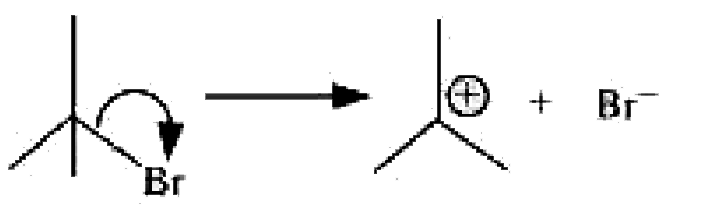
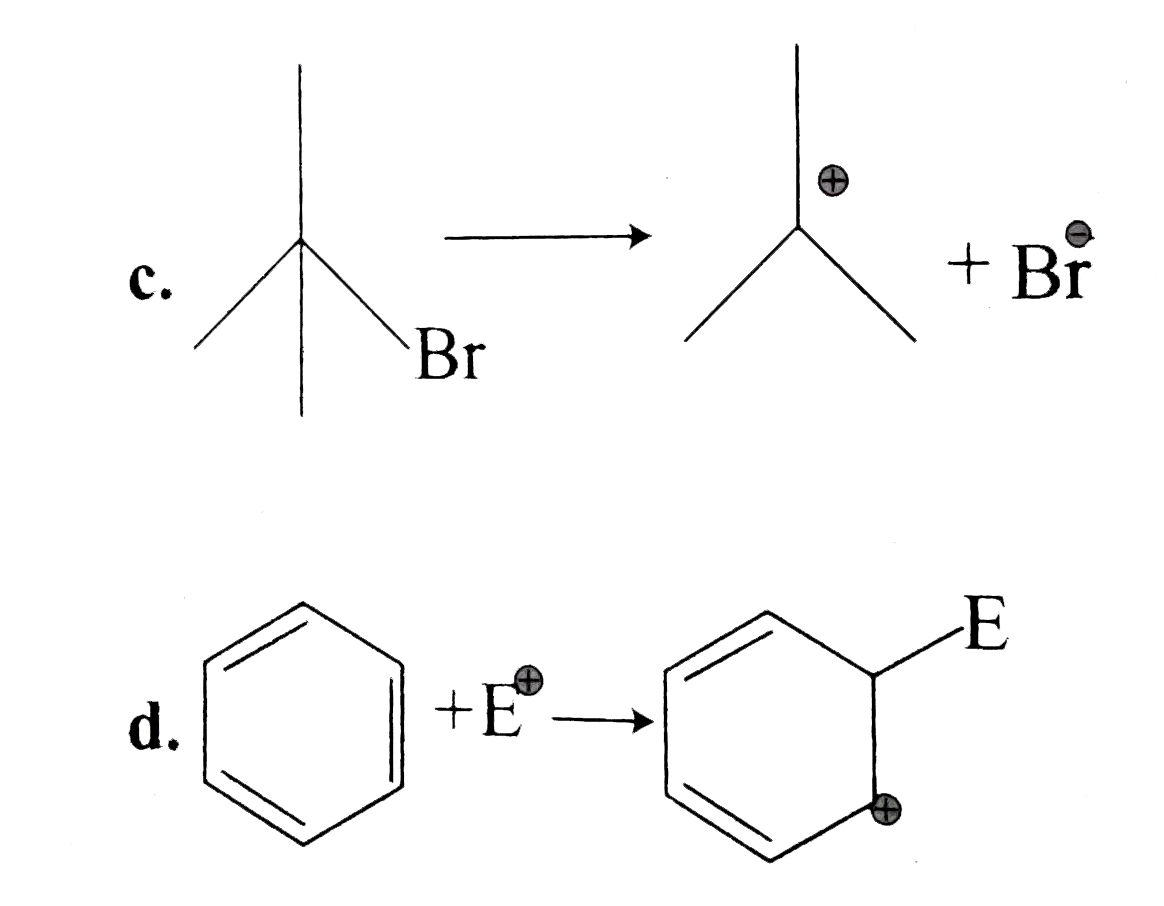
(c) The bond cleavage using curved-arrows to show the electron flow of the given reaction can be represented as

It is an example of heterolytic cleavage as the bond breaks in such a manner that the shared pair of electrons remains with the bromine ion. The reaction intermediate formed is a carbocation.
(d) The bond cleavage using curved-arrows to show the electron flow of the given reaction can be represented as

It is a heterolytic cleavage as the bond breaks in such a manner that the shared pair of electrons remains with one of the fragments. The intermediate formed is a carbocation.
Promotional Banner

Topper's Solved these Questions

  • ORGANIC CHEMISTRY- SOME BASIC PRINCIPLES AND TECHNIQUES

    NCERT ENGLISH|Exercise EXERCISE|40 Videos
  • HYDROGEN

    NCERT ENGLISH|Exercise EXERCISE|36 Videos
  • REDOX REACTIONS

    NCERT ENGLISH|Exercise EXERCISE|30 Videos

Similar Questions

Explore conceptually related problems

For the following bond cleavages, use curved-arrows to show the electron flow and classify each as homolysis or heterolysis. Identify reactive intermediate produced as free radical, carbocation and carbanion.

Classify each of the following as homolysis or heterolysis. Identify the reaction intermediates produced , as free radical, carbocation and carbanion.

Using the curved-arrow notation, show the formation of reactive intermediates when the following convalent bonds undergo heterolytic cleavage : (a) CH_3 - S - CH_3 (b) CH_3 - CN ( c) CH_3 - Cu .

The major organic product in the reaction CH_(3)-O-CH(CH_(3))_(2)+HIrarr product is

The major organic product in the reaction CH_(3)-O-CH(CH_(3))_(2)+HIrarr product is

The major organic product in the reaction CH_(3)-O-CH(CH_(3))_(2)+HIrarr product is

Identify electrophilic centre in the following : (1) CH_3CH=O (2) CH_3-CN (3) CH_3 I .

Write the products of following reactions (a) CH_(3)-C-=N overset(H_(3)O^(-))rarr (b) CH_(3)NC overset(H_(3)O^(+))rarr

Show the formation of H_(3)O ^(+) using the electron dot diagram.

NCERT ENGLISH-ORGANIC CHEMISTRY- SOME BASIC PRINCIPLES AND TECHNIQUES-EXERCISE
  1. Classify the following reactions in one of the reaction type studied i...

    Text Solution

    |

  2. What is the relationship between the members of the following pairs of...

    Text Solution

    |

  3. For the following bond cleavages, use curved-arrow to show the electro...

    Text Solution

    |

  4. Explain the terms Inductive and Electromeric effects. Which electron d...

    Text Solution

    |

  5. Give a brief description of the principles of the following techniques...

    Text Solution

    |

  6. Describe the method, which can be used to separate two compounds with ...

    Text Solution

    |

  7. What is the difference between distillation, distillation under reduce...

    Text Solution

    |

  8. Discuss the chemistry of Lassaigne’s test.

    Text Solution

    |

  9. Differentiate between the principle of estimation of nitrogen in an or...

    Text Solution

    |

  10. Discuss the principle of estimation of halogens, sulphur and phosphoru...

    Text Solution

    |

  11. Explain the principle of paper chromatography.

    Text Solution

    |

  12. Why is nitric acid added to sodium extract before adding silver nitrat...

    Text Solution

    |

  13. Explain the reason for the fusion of an organic compound with metallic...

    Text Solution

    |

  14. Name a suitable technique of the components from a mixture of calcium ...

    Text Solution

    |

  15. Explain why an organic liquid vaporises at a temperature below its boi...

    Text Solution

    |

  16. Will C Cl4 give white precipitate of AgCl on heating with nitrate? Giv...

    Text Solution

    |

  17. Why is solution of potassium hydroxide used to absorb carbon dioxide e...

    Text Solution

    |

  18. Why is it necessary to use acetic acid and not suplhuric acid for the ...

    Text Solution

    |

  19. An organic compound contains 69% carbon and 4.8% hydrogen, the remaind...

    Text Solution

    |

  20. 0.50 gm of an organic compound was treated according to Kjeldahl's meg...

    Text Solution

    |