Home
Class 11
PHYSICS
Given below are observations on molar sp...

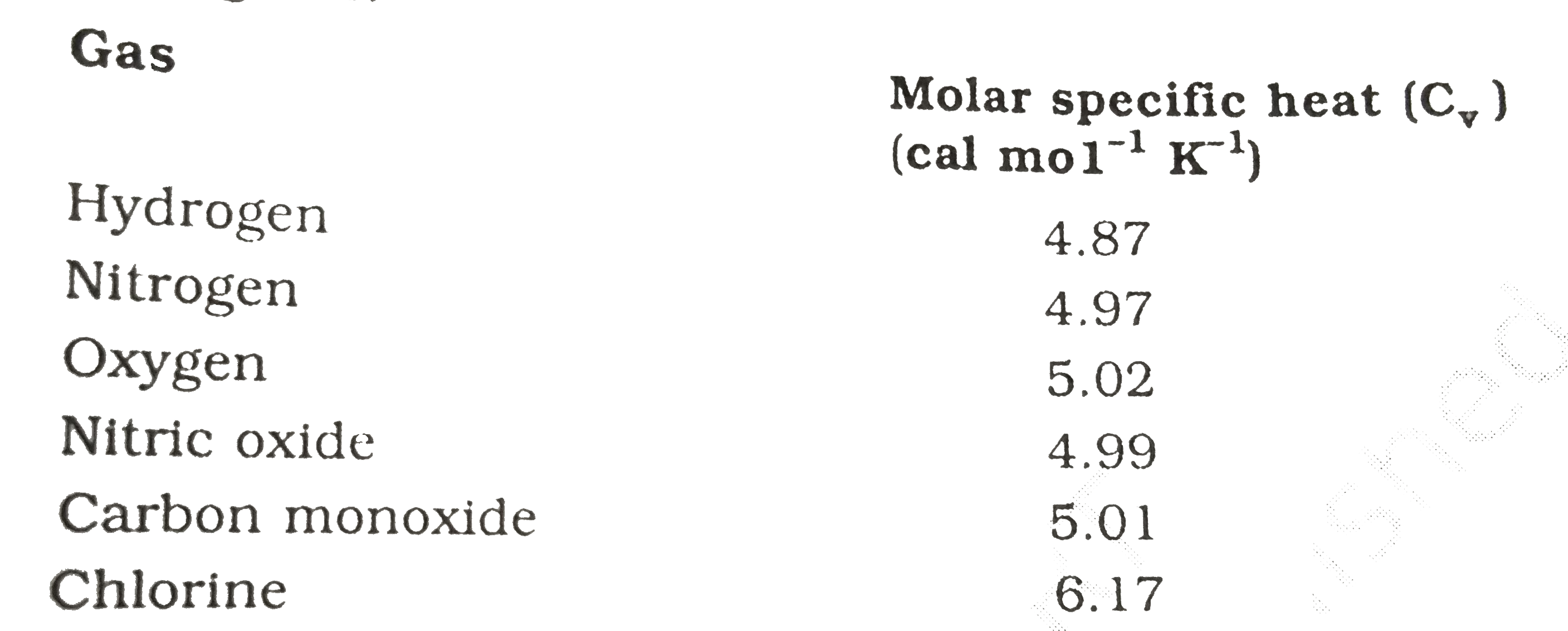
Given below are observations on molar specific heats at room temperature of some common gases

The measured molar specific heats of these gases are markedly different from those for monatomic gases. Typically, molar specific heat of a monatomic gas is 2.92 cal/mol K. Explain this difference. What can you infer from the somewhat larger (than the rest) value for chlorine ?

Text Solution

Verified by Experts

The gases listed in the given table are diatomic. Besides the translational degree of freedom, they have other degrees of freedom (modes of motion).
Heat must be supplied to increase the temperature of these gases. This increases the average energy of all the modes of motion. Hence, the molar specific heat of diatomic gases is more than that of monatomic gases.
If only rotational mode of motion is considered, then the molar specific
heat of a diatomic `gas=(5)/(2)R`
`=(5)/(2)xx1.98=4.95 "cal mol"^(1)K^(-1)`
With the exception of chlorine, all the observations in the given table
agree with`((5)/(2)R)`.This is because at room temperature, chlorine also has vibrational modes of motion besides rotational and translational modes of motion.
Promotional Banner

Topper's Solved these Questions

  • THERMAL PROPERTIES OF MATTER

    NCERT ENGLISH|Exercise EXERCISE|22 Videos
  • SYSTEMS OF PARTICLES AND ROTATIONAL MOTION

    NCERT ENGLISH|Exercise EXERCISE|33 Videos
  • THERMODYNAMICS

    NCERT ENGLISH|Exercise EXERCISE|10 Videos

Similar Questions

Explore conceptually related problems

The molar specific heat capacity of all monatomic gases is the same. Is this ture of false ? (Assumed ideal nature.)

What are the two specific heat capacities of a gas and why are they different? Find the difference between the two molar heat capacities in terms of the constant R.

A process in which work perfomed by an ideal gas is proportional to the corresponding increment of its internal energy is described as a polytropic process. If we represent work done by a ppolytropic process by W and increase in internal energy as Delta U then W prop Delta U or W=K_(1) DeltaU ...(i) For this process, it can be demonstrated that the relation between pressure and volume is given by the equation PV^( eta)= K_(2) (constant ) .....(ii) We know that a gas can have various values for molar specific heats. The molar specific heat 'C' for an ideal gas in polytropic process can be calculated with the help of first law of thermodynamics. In polytropic process process the variation of molar specific heat 'C' with eta for a monatomic gas is plotted as in the graph shown. For a monoatomic gas, the values of polytropic constant η for which value specific heat is negative.

A process in which work perfomed by an ideal gas is proportional to the corresponding increment of its internal energy is described as a polytropic process. If we represent work done by a ppolytropic process by W and increase in internal energy as Delta U then W prop Delta U or W=K_(1) DeltaU ...(i) For this process, it can be demonstrated that the relation between pressure and volume is given by the equation PV^( eta)= K_(2) (constant ) .....(ii) We know that a gas can have various values for molar specific heats. The molar specific heat 'C' for an ideal gas in polytropic process can be calculated with the help of first law of thermodynamics. In polytropic process process the variation of molar specific heat 'C' with eta for a monatomic gas is plotted as in the graph shown. In the graph shown, the y- coordinate of point A is ( for monatomic gas )

An ideal gas may expands from V_(0) to 2V_(0) according to following three processes. Molar specific heat for processes b will be

The molar specific heat of a gas as given from the kinetic theory is (5)/(2) R . If it is not specified whether it is C_(p) or C_(upsilon) one could conclude that the molecules of the gas

An ideal monatomic gas undergoes a process where its pressure is inversely proportional to its temperature. (a) Calculate the molar specific heat of the process. (b) Find the work done by two moles of gas if the temperature change from T_1 to T_2 .

Statement - 1 : An ideal gas has infinitely many molar specific heats. Statement- 2 : Specific heat is amount of heat needed to raise the temperature of 1 mole of gas by 1K .

The molar specific heats of an ideal gas at constant volume and constant pressure are respectively 4.98 and 6.96 cal mol^(-1) K^(-1) . If the molecular weight of the gas be 32, then calculate the root means square speed of the molecule of the gas at 120^@ C . (1 cal = 4.2 J)

One mole of a perfect gas expands adiabatically .As a result of this,its pressure ,temperature and volume changes from P1,T1,V1, to P2,T2,V2 respectively .If molar specific heat at volume is Cv then work done by the gas wil be ?

NCERT ENGLISH-THERMAL PROPERTIES OF MATTER-EXERCISE
  1. The electrical resistance in ohms of a certain thermometer varies with...

    Text Solution

    |

  2. Answer the following : (a) The triple-point of water is a standard...

    Text Solution

    |

  3. Two ideal gas thermometer A and B use oxygen and hydrogen respectively...

    Text Solution

    |

  4. A steel tape 1m long is correctly calibrated for a temperature of 27^(...

    Text Solution

    |

  5. a large steel wheel is to be fitted on to a shaft of the same material...

    Text Solution

    |

  6. A hole is drilled in a copper sheet. The diameter of the hole is 4.24 ...

    Text Solution

    |

  7. A brass wire 1.8 m long at 27^(@)C is held taut with little tension be...

    Text Solution

    |

  8. A brass rod of length 50 cm and diameter 3.0 cm is joined to a steel r...

    Text Solution

    |

  9. The coefficient of volume expansion of glycerine is 49 xx 10^(-5)//^(@...

    Text Solution

    |

  10. A 10 kW drilling machine is used to drill a bore in a small aluminium ...

    Text Solution

    |

  11. A copper block of mass 2.5 kg is heated in a furnace to a temperature ...

    Text Solution

    |

  12. In an experiment on the specific heat of a metal a 0.20 kg block of th...

    Text Solution

    |

  13. Given below are observations on molar specific heats at room temperatu...

    Text Solution

    |

  14. A child running a temperature of 101^F is given and antipyrin (i.e. a ...

    Text Solution

    |

  15. A thermocole cubical icebox of side 30 cm has a thickness of 5.0 cm if...

    Text Solution

    |

  16. A brass boiler has a base area of 0.15m^2 and thickness 1.0 cm it boil...

    Text Solution

    |

  17. Explain why : (a) A body with large reflectivity is a poor emitter. (...

    Text Solution

    |

  18. A body cools from 80^(@)C to 50^(@)C in 5 min-utes Calculate the time ...

    Text Solution

    |

  19. Answer the following questions based on the p-T phase diagram of carbo...

    Text Solution

    |

  20. Answer the following questions based on the P – T phase diagram of CO(...

    Text Solution

    |
