Home
Class 11
PHYSICS
Answer the following questions based on ...

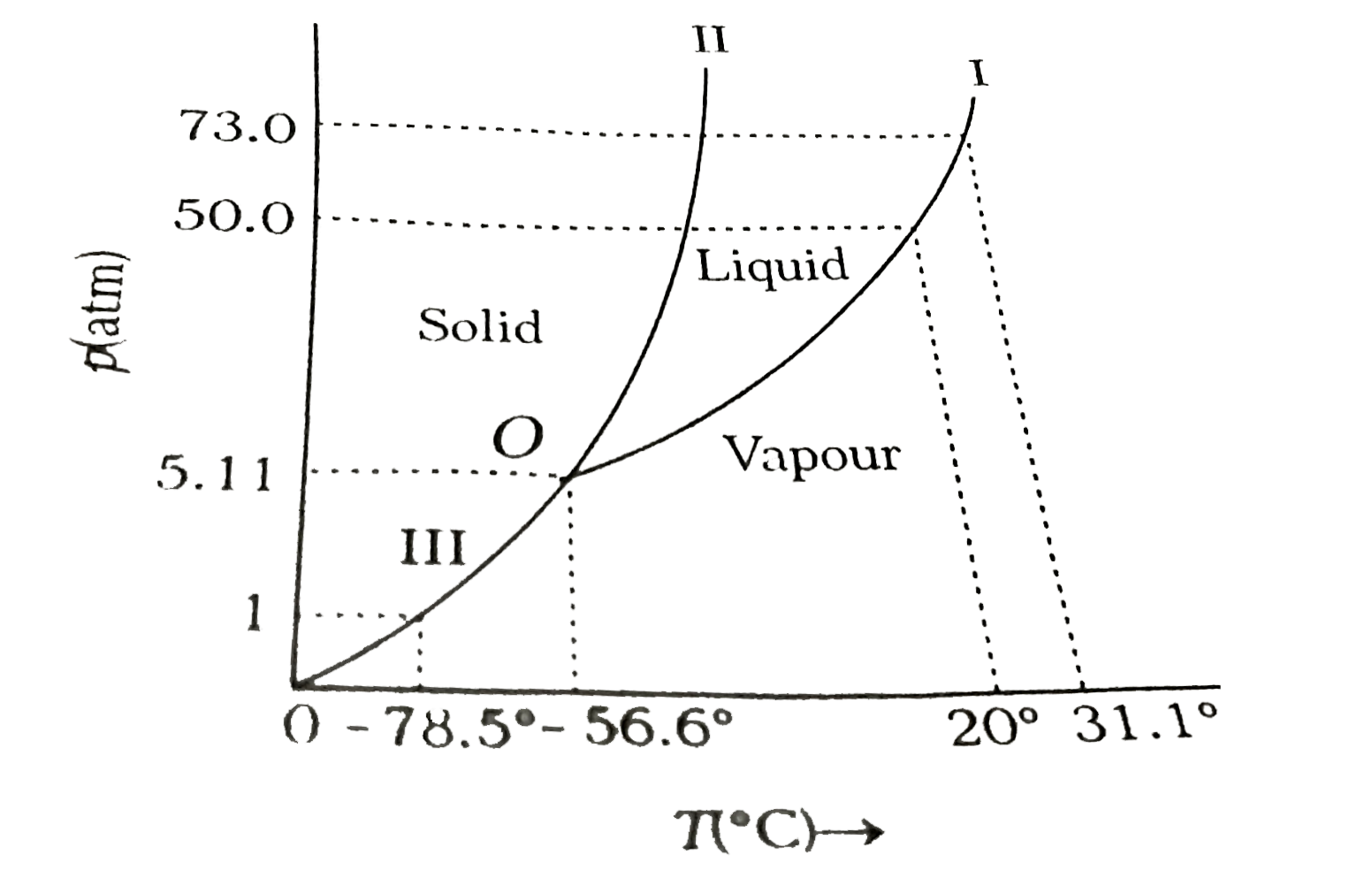
Answer the following questions based on the P – T phase diagram of `CO_(2)`:
(a) `CO_(2)` at 1 atm pressure and temperature` – 60^(@)C` is compressed isothermally. Does it go through a liquid phase ?
(b) What happens when `CO_(2)` at 4 atm pressure is cooled from room temperature at constant pressure ?
(c) Describe qualitatively the changes in a given mass of solid `CO_(2)` at 10 atm pressure and temperature `–65^(@)C` as it is heated up to room temperature at constant pressure.
(d) `CO_(2)` is heated to a temperature `70^(@)C` and compressed isothermally. What changes in its properties do you expect to observe ?

Text Solution

Verified by Experts
Answer:
(a) No
(b) It condenses to solid directly.
(c) The fusion and boiling points are given by the intersection point where this parallel line cuts the fusion and vaporisation curves.
(d) It departs from ideal gas behaviour as pressure increases.
Explanation:
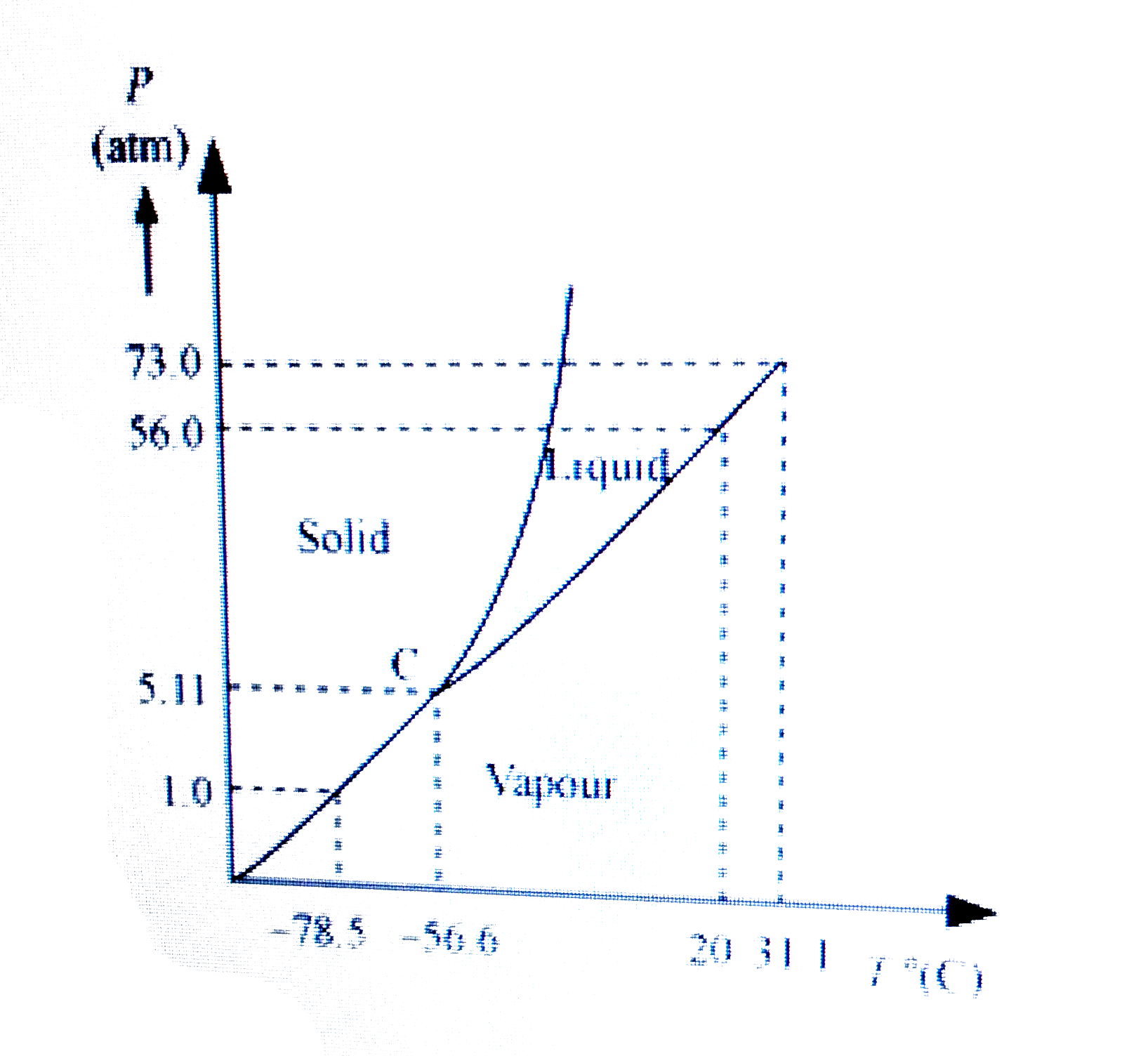
(a) The P–T phase diagram for `CO_(2)` is shown in the following figure.

At 1 atm pressure and at `–60^(@)C, CO_(2)` lies to the left of `–56.6^(@)C` (triple point C). Hence, it lies in the region of vaporous and solid phases.
Thus, CO2 condenses into the solid state directly, without going through the liquid state.
(b) At 4 atm pressure, `CO_(2)` lies below 5.11 atm (triple point C). Hence, it lies in the region of vaporous and solid phases. Thus, it condenses into the solid state directly, without passing through the liquid state.
(c) When the temperature of a mass of solid `CO_(2)` (at 10 atm pressure and at `–65^(@)C`) is increased, it changes to the liquid phase and then to the vaporous phase. It forms a line parallel to the temperature axis at 10 atm. The fusion and boiling points are given by the intersection point where this parallel line cuts the fusion and vaporisation curves.
(d) If `CO_(2)` is heated to `70^(@)C` and compressed isothermally, then it will not exhibit any transition to the liquid state. This is because `70^(@)C` is higher than the critical temperature of `CO_(2)`. It will remain in the vapour state, but will depart from its ideal behaviour as pressure increases.
Promotional Banner

Topper's Solved these Questions

  • THERMAL PROPERTIES OF MATTER

    NCERT ENGLISH|Exercise EXERCISE|22 Videos
  • SYSTEMS OF PARTICLES AND ROTATIONAL MOTION

    NCERT ENGLISH|Exercise EXERCISE|33 Videos
  • THERMODYNAMICS

    NCERT ENGLISH|Exercise EXERCISE|10 Videos

Similar Questions

Explore conceptually related problems

What is the density of CO_(2) at 27 .^(@)C and 2.5 atm pressure ?

One mole of SO_(2) at 298K and 1atm pressure is heated in a closed vessel so that its temperature is 475K and pressure is 4atm . It is then cooled so that temperature becomes 298K and pressure is 1atm . What is that change in the internal energy of the gas?

Sodium phenoxide reacts with CO_(2) at 400K and 4-7 atm pressure to give

An ideal gas at a pressure of 1 atm and temperature of 27^(@)C is compressed adiabatically until its pressure becomes 8 times the initial pressure , then final temperature is (gamma=(3)/(2))

The temperature and pressure of one mole of an ideal monoatomic gas changes from 25^(@) C and 1 atm pressure to 250^(@) C and 25 atm. Calculate the change in entropy for the process.

Name the major product formed when sodium phenoxide is heated with CO_(2) at 400 Kunder 4-7 atm. pressure. What is the name of the reaction?

The rms speed of helium gas at 27^(@)C and 1 atm pressure is 900 ms^(-1) . Then the rms speed of helium molecules at temperature 27^(@)C and 2 atm pressure is

The rms speed of helium gas at 27^(@)C and 1 atm pressure is 800 ms^(-1) . Then the rms speed of helium molecules at temperature 27^(@)C and 2 atm pressure is

One mole of an ideal gas (C_(v,m)=(5)/(2)R) at 300 K and 5 atm is expanded adiabatically to a final pressure of 2 atm against a constant pressure of 2 atm. Final temperature of the gas is :

A vessel is filled with an ideal gas at a pressure of 20 atm and is a temperature of 27^@ C One - half of the mass is removed from the vessel and the temperature of the remaining gas is increased to 87^@ C . At this temperature, Find the pressure of the gas.

NCERT ENGLISH-THERMAL PROPERTIES OF MATTER-EXERCISE
  1. The electrical resistance in ohms of a certain thermometer varies with...

    Text Solution

    |

  2. Answer the following : (a) The triple-point of water is a standard...

    Text Solution

    |

  3. Two ideal gas thermometer A and B use oxygen and hydrogen respectively...

    Text Solution

    |

  4. A steel tape 1m long is correctly calibrated for a temperature of 27^(...

    Text Solution

    |

  5. a large steel wheel is to be fitted on to a shaft of the same material...

    Text Solution

    |

  6. A hole is drilled in a copper sheet. The diameter of the hole is 4.24 ...

    Text Solution

    |

  7. A brass wire 1.8 m long at 27^(@)C is held taut with little tension be...

    Text Solution

    |

  8. A brass rod of length 50 cm and diameter 3.0 cm is joined to a steel r...

    Text Solution

    |

  9. The coefficient of volume expansion of glycerine is 49 xx 10^(-5)//^(@...

    Text Solution

    |

  10. A 10 kW drilling machine is used to drill a bore in a small aluminium ...

    Text Solution

    |

  11. A copper block of mass 2.5 kg is heated in a furnace to a temperature ...

    Text Solution

    |

  12. In an experiment on the specific heat of a metal a 0.20 kg block of th...

    Text Solution

    |

  13. Given below are observations on molar specific heats at room temperatu...

    Text Solution

    |

  14. A child running a temperature of 101^F is given and antipyrin (i.e. a ...

    Text Solution

    |

  15. A thermocole cubical icebox of side 30 cm has a thickness of 5.0 cm if...

    Text Solution

    |

  16. A brass boiler has a base area of 0.15m^2 and thickness 1.0 cm it boil...

    Text Solution

    |

  17. Explain why : (a) A body with large reflectivity is a poor emitter. (...

    Text Solution

    |

  18. A body cools from 80^(@)C to 50^(@)C in 5 min-utes Calculate the time ...

    Text Solution

    |

  19. Answer the following questions based on the p-T phase diagram of carbo...

    Text Solution

    |

  20. Answer the following questions based on the P – T phase diagram of CO(...

    Text Solution

    |

